CAS 91270-68-7
:6-Bromonaphthalin-1-ol
Beschreibung:
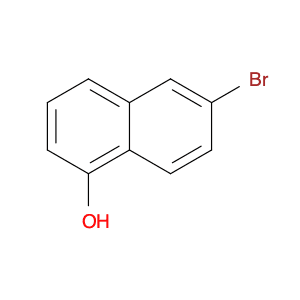
6-Bromonaphthalin-1-ol ist eine organische Verbindung, die durch das Vorhandensein eines Bromatoms und einer Hydroxylgruppe, die an ein Naphthalenring-System gebunden ist, gekennzeichnet ist. Diese Verbindung weist ein Naphthalen-Rückgrat auf, das aus zwei fusionierten Benzolringen besteht, wobei die Hydroxylgruppe (-OH) an der Position 1 und das Bromatom an der Position 6 lokalisiert ist. Sie erscheint typischerweise als Feststoff bei Raumtemperatur und ist in organischen Lösungsmitteln löslich, während sie aufgrund ihrer hydrophoben Naphthalenstruktur eine begrenzte Löslichkeit in Wasser aufweist. Das Vorhandensein des Bromatoms führt zu einer einzigartigen Reaktivität, die sie in verschiedenen chemischen Reaktionen nützlich macht, einschließlich nucleophiler Substitutionen und Kupplungsreaktionen. Darüber hinaus trägt die Hydroxylgruppe zu ihrem Potenzial als phenolische Verbindung bei, die an Wasserstoffbrückenbindungen teilnehmen und ihre physikalischen Eigenschaften beeinflussen kann. 6-Bromonaphthalin-1-ol könnte Anwendungen in der organischen Synthese, Materialwissenschaft und als Zwischenprodukt in der Herstellung von Arzneimitteln oder Agrochemikalien finden. Sicherheitsvorkehrungen sollten beim Umgang mit dieser Verbindung beachtet werden, da sie potenziell toxisch ist und Auswirkungen auf die Umwelt haben kann.
Formel:C10H7BrO
InChl:InChI=1/C10H7BrO/c11-8-4-5-9-7(6-8)2-1-3-10(9)12/h1-6,12H
SMILES:c1cc2cc(ccc2c(c1)O)Br
Synonyme:- 1-Naphthalenol, 6-Bromo-
- 6-Bromo-1-naphthol
- 6-broMonaphthalen-1-ol
- 6-BROMO-1-HYDROXYNAPHTHALENE, 6-Bromonaphthalen-1-ol
- 6-Bromo-1-hydroxyphthalene
- 6-Bromo-1-hydroxynaphthalene
Sortieren nach
Reinheit (%)
0
100
|
0
|
50
|
90
|
95
|
100
4 Produkte.
6-Bromo-1-hydroxynaphthalene
CAS:Formel:C10H7BrOReinheit:97%Farbe und Form:SolidMolekulargewicht:223.06606-Bromo-1-hydroxynaphthalene
CAS:Formel:C10H7BrOReinheit:97%Farbe und Form:SolidMolekulargewicht:223.0696-Bromonaphthalen-1-ol
CAS:6-Bromonaphthalen-1-ol is a compound that has shown antimicrobial and antifungal activity. It is the most potent of the naphthoxazines tested to date, with an MIC of 0.04 µg/ml against Escherichia coli. 6-Bromonaphthalen-1-ol was synthesized by reacting 1,2,4-trihydroxybenzene with bromine gas in the presence of mercuric chloride catalyst. The compound was hydrolyzed for elemental analysis and found to be C7H4BrO. Elemental analysis yielded a weight percentage of 71% carbon, 13% hydrogen, 3% bromine, and 12% oxygen. The x-ray diffraction pattern showed peaks at 2θ values of 22.3° (100), 26.5° (101), 33.7° (102), 40° (104), 44° (105) and 62°Formel:C10H7BrOReinheit:Min. 95%Molekulargewicht:223.07 g/mol