CAS 91575-26-7
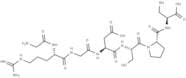
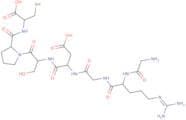
:L-Cystein, Glycyl-L-arginylglycyl-L-a-aspartyl-L-seryl-L-prolyl-
- H-Gly-Arg-Gly-Asp-Ser-Pro-Cys-OH
- L-Cysteine,N-[1-[N-[N-[N-(N2-glycyl-L-arginyl)glycyl]-L-a-aspartyl]-L-seryl]-L-prolyl]-
- 18:PN: KR20090132911 SEQID: 113 claimed protein
- 1: PN: WO2005054859 PAGE: 22claimed protein
- 74: PN: JP2007051127 SEQID: 70 unclaimed protein
- 83: PN: WO2008134544 SEQID:88 unclaimed protein
- 901: PN:US20090175821 SEQID: 1147 claimed protein
- 12: PN: WO0004941 PAGE: 31 claimed sequence
- 8: PN: US6376248 SEQID: 8 unclaimed sequence
- 462: PN: WO0069900 SEQID: 1147 unclaimed sequence
- 103: PN: WO2004039825PAGE: 164 unclaimed sequence
- 90: PN: WO2008113030 SEQID: 91unclaimed sequence
- 3: PN: US20080131425SEQID: 3 claimed sequence
- 28: PN: US6051429 SEQID: 8 unclaimed sequence
- Weitere Synonyme anzeigen
H-Gly-Arg-Gly-Asp-Ser-Pro-Cys-OH
CAS:The integrin-binding heptapeptide GRGDSPC can be easily linked to carriers or surfaces.Formel:C25H42N10O11SReinheit:>98%Farbe und Form:White PowderMolekulargewicht:690.74GRGDSPC
CAS:GRGDSPC: 7-AA thiolated peptide; non-viral gene vector; easy synthesis; high efficiency; low toxicity.Formel:C25H42N10O11SReinheit:98%Farbe und Form:SolidMolekulargewicht:690.73H-Gly-Arg-Gly-Asp-Ser-Pro-Cys-OH trifluoroacetate salt
CAS:H-Gly-Arg-Gly-Asp-Ser-Pro-Cys-OH trifluoroacetate salt is a peptide that has been shown to inhibit the growth of tumor cells. It has also been shown to have biological properties in a number of experimental models, including in vitro and in vivo studies. H-Gly-Arg-Gly-Asp-Ser-Pro-Cys-OH trifluoroacetate salt inhibits muscle cell proliferation by binding to the extracellular matrix protein collagen type I. This inhibition leads to reduced tissue formation and body growth. This peptide also inhibits the proliferation of cancer cells by blocking the production of growth factor beta 1 (GFβ1).
Formel:C25H42N10O11SReinheit:Min. 95%Molekulargewicht:690.73 g/molH-Gly-Arg-Gly-Asp-Ser-Pro-Cys-OH
CAS:H-Gly-Arg-Gly-Asp-Ser-Pro-Cys-OH is a monoclonal antibody (mAb) that binds to the cell surface receptor, TGFβRI. It has been shown to exhibit biological activities including inhibition of tumor growth and induction of apoptosis in cancer cells. This mAb can be used as a tumor treatment and can also inhibit the proliferation of cells in tissue culture. H-Gly-Arg-Gly-Asp-Ser-Pro-Cys has been shown to inhibit the production of collagen, which may be due to its ability to block integrin activation by binding to the cell surface receptor, αVβ3. HGRGSSPC has also been found to have antiangiogenic properties, which may be due to its ability to bind with high affinity and specificity to αVβ3 on endothelial cells.
Formel:C23H42N10O11SReinheit:Min. 95%Molekulargewicht:690.74 g/mol