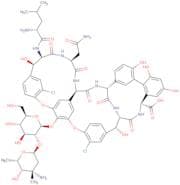
CAS 91700-98-0
:Norvancomycin
Beschreibung:
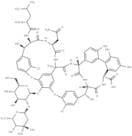
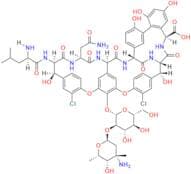
Norvancomycin ist ein glykopeptidisches Antibiotikum, das von Vancomycin abgeleitet ist und hauptsächlich zur Behandlung von Infektionen eingesetzt wird, die durch grampositive Bakterien verursacht werden, insbesondere solche, die gegen andere Antibiotika resistent sind. Es zeigt einen ähnlichen Wirkmechanismus wie Vancomycin, indem es die Synthese der bakteriellen Zellwand hemmt, indem es an das D-Alanin-D-Alanin-Terminus der Zellwandvorläufer bindet. Diese Wirkung stört die Integrität der bakteriellen Zellwand, was zu Zelllyse und Tod führt. Norvancomycin ist besonders wirksam gegen Stämme von Staphylococcus aureus, einschließlich methicillin-resistentem Staphylococcus aureus (MRSA). Die Verbindung zeichnet sich durch ihre komplexe Struktur aus, die mehrere aromatische Ringe und Zuckermoleküle umfasst, was zu ihrer Löslichkeit und Stabilität beiträgt. Ihre Pharmakokinetik, einschließlich Absorption, Verteilung, Metabolismus und Exkretion, ähnelt der von Vancomycin, obwohl spezifische Parameter variieren können. Norvancomycin wird typischerweise intravenös verabreicht, insbesondere bei schweren Infektionen, und seine Anwendung wird genau überwacht, um Toxizität und die Entwicklung von Resistenzen zu verhindern. Insgesamt stellt Norvancomycin eine wichtige therapeutische Option im Kampf gegen resistente bakterielle Infektionen dar.
Formel:C65H73Cl2N9O24
InChl:InChI=1/C65H73Cl2N9O24/c1-5-22(2)44(69)58(88)75-48-50(82)25-7-10-36(31(66)13-25)96-38-15-27-16-39(54(38)100-64-55(53(85)52(84)40(21-77)98-64)99-42-20-65(4,70)56(86)23(3)95-42)97-37-11-8-26(14-32(37)67)51(83)49-62(92)74-47(63(93)94)30-17-28(78)18-35(80)43(30)29-12-24(6-9-34(29)79)45(59(89)76-49)73-60(90)46(27)72-57(87)33(19-41(68)81)71-61(48)91/h6-18,22-23,33,40,42,44-53,55-56,64,77-80,82-86H,5,19-21,69-70H2,1-4H3,(H2,68,81)(H,71,91)(H,72,87)(H,73,90)(H,74,92)(H,75,88)(H,76,89)(H,93,94)/t22?,23-,33-,40+,42-,44+,45+,46+,47+,48+,49-,50+,51+,52+,53-,55+,56+,64-,65-/m0/s1
InChI Key:InChIKey=NUAQIRUAZSJTAI-YRPZDAAMSA-N
SMILES:O(C=1C2=CC3=CC1OC=4C(Cl)=CC(=CC4)[C@@H](O)[C@@H](NC([C@@H](CC(C)C)N)=O)C(=O)N[C@@H](CC(N)=O)C(=O)N[C@]3(C(=O)N[C@@]5(C=6C=C(C=7C([C@@H](C(O)=O)NC(=O)[C@]([C@H](O)C=8C=C(Cl)C(O2)=CC8)(NC5=O)[H])=CC(O)=CC7O)C(O)=CC6)[H])[H])[C@H]9[C@H](O[C@H]%10C[C@](C)(N)[C@H](O)[C@H](C)O%10)[C@@H](O)[C@H](O)[C@@H](CO)O9
Synonyme:- 56-Demethylvancomycin
- N-Demethylvancomycin
- Antibiotic A 51568A
- Vancomycin, 56-demethyl-
- 22H-8,11:18,21-Dietheno-23,36-(iminomethano)-13,16:31,35-dimetheno-1H,16H-[1,6,9]oxadiazacyclohexadecino[4,5-m][10,2,16]benzoxadiazacyclotetracosine, vancomycin deriv.
Sortieren nach
Reinheit (%)
0
100
|
0
|
50
|
90
|
95
|
100
5 Produkte.
N-Demethylvancomycin
CAS:N-Demethylvancomycin is a glycopeptide antibiotic that can be extracted from Nocardia orientalis and exhibits activity against various strains of Staphylococcus aureus and Staphylococcus epidermidis. It is utilized in research related to infections.Formel:C65H73Cl2N9O24Farbe und Form:SolidMolekulargewicht:1435.23Norvancomycin Trifluoroacetic Acid Salt >85%
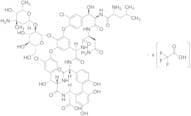
CAS:Kontrolliertes ProduktFormel:C65H73Cl2N9O24(freeamine)Reinheit:>85%Farbe und Form:NeatMolekulargewicht:1435.23Norvancomycin trifluoroacetate
CAS:Norvancomycin trifluoroacetate is an antibiotic compound, which is a glycopeptide derived from the bacterium Amycolatopsis orientalis. Its mode of action involves inhibiting bacterial cell wall synthesis. Specifically, Norvancomycin disrupts the cross-linking of peptidoglycan layers in the bacterial cell wall by binding to the D-alanyl-D-alanine terminus of cell wall precursors. This disruption weakens the bacterial cell wall, ultimately leading to cell lysis and death, thereby exerting a bactericidal effect.Formel:C65H73Cl2N9O24•(C2HF3O2)xReinheit:Min. 95%Norvancomycin
CAS:Norvancomycin is an antimicrobial agent that is used as a treatment for infectious diseases. It prevents bacterial growth by binding to the D-alanyl-D-alanine moiety of the peptidoglycan cell wall, which inhibits cell wall synthesis. Norvancomycin has been shown to be effective against Gram-positive bacteria such as Staphylococcus aureus and Enterococcus faecalis and Gram-negative bacteria such as Escherichia coli and Pseudomonas aeruginosa. Norvancomycin also has the ability to inhibit transcriptional regulation, leading to decreased production of proteins essential for bacterial growth. Norvancomycin has been shown to have a long half-life in humans, making it useful for pharmacokinetic studies in human serum.
Formel:C65H73Cl2N9O24Reinheit:Min. 95%Molekulargewicht:1,435.23 g/molRef: 3D-FN164675
Ausgelaufenes produkt