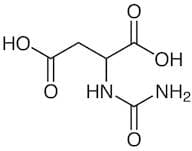
CAS 923-37-5
:Ureidosuccinsäure
Beschreibung:
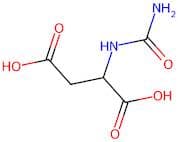
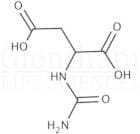
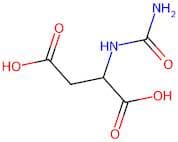
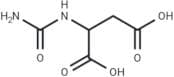
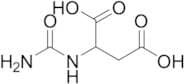
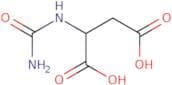
Ureidosuccinsäure, auch bekannt als 2-Ureido-1,2,3-Propantricarbonsäure, ist eine organische Verbindung, die durch ihre einzigartige Struktur gekennzeichnet ist, die sowohl ureido- als auch carboxylgruppen enthält. Es handelt sich um einen weißen kristallinen Feststoff, der in Wasser löslich ist, was seine polare Natur aufgrund der Anwesenheit mehrerer Carboxylgruppen widerspiegelt. Diese Verbindung wird häufig wegen ihrer potenziellen Anwendungen in der Biochemie und Pharmazie untersucht, insbesondere in Bezug auf ihre Rolle als metabolisches Zwischenprodukt. Ureidosuccinsäure kann an verschiedenen chemischen Reaktionen teilnehmen, einschließlich solcher, die die Bildung von Amiden und Carboxylat-Interaktionen betreffen. Seine molekulare Struktur ermöglicht es ihm, Wasserstoffbrückenbindungen einzugehen, was zu seiner Löslichkeit und Reaktivität beiträgt. Darüber hinaus kann es biologische Aktivität zeigen, was es von Interesse für die Forschung im Zusammenhang mit der Enzymhemmung oder als Baustein bei der Synthese komplexerer Moleküle macht. Insgesamt ist Ureidosuccinsäure eine vielseitige Verbindung mit erheblichen Implikationen in chemischen und biologischen Kontexten.
Formel:C5H8N2O5
InChl:InChI=1S/C5H8N2O5/c6-5(12)7-2(4(10)11)1-3(8)9/h2H,1H2,(H,8,9)(H,10,11)(H3,6,7,12)
InChI Key:InChIKey=HLKXYZVTANABHZ-UHFFFAOYSA-N
SMILES:C(CC(O)=O)(NC(N)=O)C(O)=O
Synonyme:- (2R)-2-(carbamoylamino)butanedioate
- (2S)-2-(carbamoylamino)butanedioate
- 2-(Carbamoylamino)butanedioic acid
- 2-Ureidosuccinic acid
- <span class="text-smallcaps">DL</span>-2-Ureidobutanedioic acid
- <span class="text-smallcaps">DL</span>-Aspartic acid, N-(aminocarbonyl)-
- Aspartic acid, N-(aminocarbonyl)-
- Aspartic acid, N-carbamoyl-
- Aspartic acid, N-carbamoyl-, <span class="text-smallcaps">DL</span>-
- Carbamyl-<span class="text-smallcaps">DL</span>-aspartic acid
- N-(Aminocarbonyl)aspartic acid
- N-Carbamoyl-<span class="text-smallcaps">DL</span>-aspartic acid
- N-Carbamyl-DL-aspartic acid Ureidosuccinic acid
- NSC 120033
- Ureidosuccinic acid
- DL-Aspartic acid, N-(aminocarbonyl)-
- Weitere Synonyme anzeigen
Sortieren nach
Reinheit (%)
0
100
|
0
|
50
|
90
|
95
|
100
11 Produkte gefunden.
N-Carbamoyl-DL-aspartic Acid
CAS:Formel:C5H8N2O5Reinheit:>98.0%(T)Farbe und Form:White to Almost white powder to crystalMolekulargewicht:176.13N-Carbamoyl-DL-aspartic acid, 98%
CAS:N-Carbamoyl-DL-aspartic acid, is a useful biochemical for proteomics research. It is also used as a carbamate derivative which serves as an intermediate in pyrimidine biosynthesis. This Thermo Scientific Chemicals brand product was originally part of the Alfa Aesar product portfolio. Some documentaFormel:C5H8N2O5Reinheit:98%Farbe und Form:White, PowderMolekulargewicht:176.13N-Carbamoyl-DL-aspartic acid, 10mM (in DMSO)
CAS:N-Carbamoyl-DL-aspartic acid, 10mM (in DMSO)Formel:C5H8N2O5Reinheit:≥95%Molekulargewicht:176.13N-Carbamoyl-DL-aspartic acid
CAS:N-Carbamoyl-DL-aspartic acid
Reinheit:≥98%Molekulargewicht:176.13g/molN-Carbamyl-DL-aspartic acid
CAS:N-Carbamyl-DL-aspartic acidFormel:C5H8N2O5Reinheit:>98.0%Farbe und Form:PowderMolekulargewicht:176.12742N-Carbamoyl-DL-aspartic acid
CAS:N-Carbamoyl-DL-aspartic acid (Ureidosuccinic acid) is an intermediary product in pyrimidine biosynthesis.Formel:C5H8N2O5Reinheit:99.95%Farbe und Form:SolidMolekulargewicht:176.13N-Carbamoyl-DL-aspartic Acid
CAS:Kontrolliertes ProduktApplications N-Carbamoyl-DL-aspartic Acid (cas# 923-37-5) is a useful research chemical.
Formel:C5H8N2O5Farbe und Form:NeatMolekulargewicht:176.13N-(Aminocarbonyl)aspartic acid
CAS:N-Aminocarbonyl-L-aspartic acid (NACD) is a molecule that is found in urine samples. It can be used as a biomarker to detect cancer, HIV infection, and many other diseases. The presence of NACD has been correlated with the development of acidosis, which is characterized by an increase in the pH of body fluids. The following are a few examples of how this product might be described on an eCommerce site: Rifapentine is an anti-tuberculosis drug that belongs to the class of rifamycins. It is the most active of the rifamycins for the treatment of tuberculosis. Rifapentine inhibits bacterial growth by binding to DNA-dependent RNA polymerase, thereby preventing transcription and replication. The high frequency of human activity has been shown using a patch-clamp technique on human erythrocytes. This active form is metabolized throughFormel:C5H8N2O5Reinheit:Min. 95%Farbe und Form:PowderMolekulargewicht:176.13 g/mol