CAS 925-58-6
:N-(2-aminoethyl)propanamid
Beschreibung:
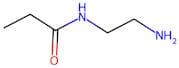
N-(2-aminoethyl)propanamid, auch bekannt als 3-(2-Aminoethyl)propanamid, ist eine organische Verbindung, die durch ihre Amidfunktionalität und eine Aminoethyl-Seitenkette gekennzeichnet ist. Sie weist ein Propanamid-Rückgrat auf, das zu ihrer polaren Natur beiträgt und sie in Wasser und anderen polaren Lösungsmitteln löslich macht. Die Anwesenheit sowohl einer Amin- als auch einer Amidgruppe ermöglicht potenzielle Wasserstoffbrückenbindungen, die ihre Reaktivität und Wechselwirkungen mit anderen Molekülen beeinflussen. Diese Verbindung ist typischerweise eine farblose bis hellgelbe Flüssigkeit oder ein Feststoff, abhängig von ihrer Reinheit und Temperatur. Sie hat Anwendungen in verschiedenen Bereichen, einschließlich Pharmazie und Biochemie, wo sie als Baustein für komplexere Moleküle oder als Reagenz in synthetischen Wegen dienen kann. Ihre molekulare Struktur deutet darauf hin, dass sie biologische Aktivität zeigen könnte, indem sie potenziell mit biologischen Systemen aufgrund der Anwesenheit der Aminogruppe interagiert. Sicherheitsdaten sollten für den Umgang und die Lagerung konsultiert werden, wie bei jeder chemischen Substanz, um sicherzustellen, dass die richtigen Vorsichtsmaßnahmen getroffen werden.
Formel:C5H12N2O
InChl:InChI=1/C5H12N2O/c1-2-5(8)7-4-3-6/h2-4,6H2,1H3,(H,7,8)
SMILES:CCC(=NCCN)O
Synonyme:- propanamide, N-(2-aminoethyl)-
Sortieren nach
Reinheit (%)
0
100
|
0
|
50
|
90
|
95
|
100
3 Produkte.
N-(2-Aminoethyl)propanamide
CAS:<p>N-(2-Aminoethyl)propanamide (NAPA) is a model compound for the investigation of the effect of laser ablation on the membrane properties and interactions with water. NAPA is a crosslinked, nanoparticle polymer with a large number of amide groups that are sensitive to laser irradiation. The 13C-NMR spectroscopy analysis showed that NAPA exhibits an osmotic response, which can be attributed to its high chloride content. Laser ablation has been shown to alter the environment within the cells and may affect their function by changing the permeability of membranes. The following are examples of product descriptions: 6-Fluoro-3-indoxyl-beta-D-galactopyranoside is an antituberculosis drug that belongs to the class of rifamycins. It is the most active of the rifamycins for the treatment of tuberculosis. Rifapentine inhibits</p>Formel:C5H12N2OReinheit:Min. 95%Molekulargewicht:116.16 g/mol