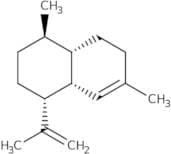
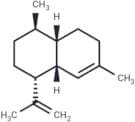
CAS 92692-39-2
:(-)-Amorpha-4,11-dien
Beschreibung:
(-)-Amorpha-4,11-dien ist ein natürlich vorkommendes Sesquiterpen, das hauptsächlich aus verschiedenen Pflanzenarten, insbesondere aus der Familie der Fabaceae, gewonnen wird. Es ist durch seine einzigartige bicyclische Struktur gekennzeichnet, die zu seinen besonderen chemischen Eigenschaften beiträgt. Diese Verbindung ist bekannt für ihre potenziellen biologischen Aktivitäten, einschließlich entzündungshemmender und antimikrobieller Wirkungen, was sie für die pharmakologische Forschung von Interesse macht. Die molekulare Formel von (-)-Amorpha-4,11-dien spiegelt seine Zusammensetzung aus Kohlenstoff- und Wasserstoffatomen wider, die typisch für Terpene ist. Seine Stereochemie ist signifikant, da die (-) Bezeichnung seine spezifische optische Aktivität anzeigt, die seine Wechselwirkung mit biologischen Systemen beeinflussen kann. Darüber hinaus wird diese Verbindung häufig hinsichtlich ihrer Rolle in der Biosynthese anderer natürlicher Produkte und ihrer potenziellen Anwendungen in der Kräutermedizin untersucht. Aufgrund seiner komplexen Struktur und biologischen Relevanz bleibt (-)-Amorpha-4,11-dien ein interessantes Thema sowohl in der organischen Chemie als auch in der Forschung zu Naturstoffen.
Formel:C15H24
InChl:InChI=1S/C15H24/c1-10(2)13-8-6-12(4)14-7-5-11(3)9-15(13)14/h9,12-15H,1,5-8H2,2-4H3/t12-,13+,14+,15-/m1/s1
InChI Key:InChIKey=HMTAHNDPLDKYJT-CBBWQLFWSA-N
SMILES:C(C)(=C)[C@H]1[C@@]2([C@]([C@H](C)CC1)(CCC(C)=C2)[H])[H]
Synonyme:- Amorpha-4,11-diene
- Naphthalene, 1,2,3,4,4a,5,6,8a-octahydro-4,7-dimethyl-1-(1-methylethenyl)-, (1R,4R,4aS,8aR)-
- (-)-Amorpha-4,11-diene
- (1R,4R,4aS,8aR)-1,2,3,4,4a,5,6,8a-Octahydro-4,7-dimethyl-1-(1-methylethenyl)naphthalene
- Naphthalene, 1,2,3,4,4a,5,6,8a-octahydro-4,7-dimethyl-1-(1-methylethenyl)-, [1R-(1α,4β,4aβ,8aβ)]-
Sortieren nach
Reinheit (%)
0
100
|
0
|
50
|
90
|
95
|
100
6 Produkte.
Amorphadiene
CAS:Kontrolliertes ProduktApplications Amorphadiene is a sesquiterpene synthesized via the cyclization of farnesyl pyrophosphate and a precursor in the biosynthesis of Artemisinin (A777500), which is an effective antimalarial agent used to treat malaria. Genetically modified Saccharomyces cerevisiae can be utilized as an alternative semisynthetic strategy to produce artemisinin from amorphadiene.
References Wallaart, T. E., et al.: Planta 212, 460 (2001); Westfall, P. J. et al.: Proc. Natl. Acad. Sci. USA 109, E111 (2012); Shiba, Y., et al.: Metab. Eng 9, 160 (2007).Formel:C15H24Farbe und Form:NeatMolekulargewicht:204.35Amorphadiene
CAS:Amorphadiene is a sesquiterpene hydrocarbon, which is a naturally occurring organic compound produced through the mevalonate pathway in plants, particularly in Artemisia annua. It is derived from the enzymatic cyclization of farnesyl diphosphate, mediated by amorphadiene synthase. This compound plays a pivotal role as a precursor molecule in the biosynthesis of artemisinin, an effective antimalarial agent.Formel:C15H24Reinheit:Min. 95 Area-%Farbe und Form:Colorless Clear LiquidMolekulargewicht:204.35 g/molAmorphadiene
CAS:Amorphadiene serves as a precursor to the antimalarial drug artemisinin, generated via the cyclization of farnesyl pyrophosphate (FPP) in yeast, catalyzed by amorphadiene synthase (ADS).Formel:C15H24Farbe und Form:SolidMolekulargewicht:204.35