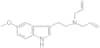
CAS 928822-98-4
:5-MeO-DALT
Beschreibung:
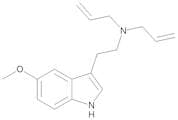
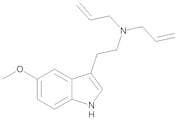
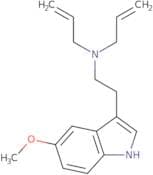
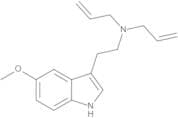
5-MeO-DALT, oder 5-Methoxy-N,N-dialyltryptamin, ist eine synthetische Verbindung, die zur Klasse der Tryptamine gehört und für ihre psychoaktiven Eigenschaften bekannt ist. Sie ist strukturell mit anderen Tryptaminen verwandt und zeichnet sich durch das Vorhandensein einer Methoxygruppe und zweier Allylgruppen aus, die am Stickstoffatom angebracht sind. Diese Verbindung wird oft auf ihre potenziellen Auswirkungen auf Serotoninrezeptoren, insbesondere den 5-HT2A-Rezeptor, der an der Regulierung der Stimmung und der Wahrnehmung beteiligt ist, untersucht. Benutzer haben eine Reihe subjektiver Effekte berichtet, darunter veränderte sensorische Wahrnehmung, verstärkte emotionale Erfahrungen und introspektive Einsichten. Das pharmakologische Profil von 5-MeO-DALT ist jedoch nicht umfassend untersucht, und seine Sicherheit, Wirksamkeit und langfristigen Auswirkungen bleiben weitgehend unbekannt. Wie bei vielen neuartigen psychoaktiven Substanzen gibt es Bedenken hinsichtlich der Reinheit, Dosierung und des Potenzials für unerwünschte Reaktionen. Aufgrund seines rechtlichen Status, der je nach Gerichtsbarkeit variiert, wird Vorsicht für diejenigen empfohlen, die eine Verwendung in Betracht ziehen.
Formel:C17H22N2O
InChl:InChI=1S/C17H22N2O/c1-4-9-19(10-5-2)11-8-14-13-18-17-7-6-15(20-3)12-16(14)17/h4-7,12-13,18H,1-2,8-11H2,3H3
InChI Key:InChIKey=HGRHWEAUHXYNNP-UHFFFAOYSA-N
SMILES:C(CN(CC=C)CC=C)C=1C=2C(NC1)=CC=C(OC)C2
Synonyme:- 1H-Indole-3-ethanamine, 5-methoxy-N,N-di-2-propen-1-yl-
- 5-Meo-dalt
- 5-Methoxy-N,N-di-2-propen-1-yl-1H-indole-3-ethanamine
- 5-Methoxy-N,N-diallyl-1H-indole-3-ethanamine
- 5-Methoxy-N,N-diallyltryptamine
- N-allyl-N-[2-(5-methoxy-1H-indol-3-yl)ethyl]prop-2-en-1-amine
Sortieren nach
Reinheit (%)
0
100
|
0
|
50
|
90
|
95
|
100
5 Produkte.
5-MeO-DALT (5-Methoxy-N,N-diallyltryptamine) 1.0 mg/ml in Acetonitrile
CAS:Kontrolliertes ProduktFarbe und Form:Single SolutionN,N-Diallyl-5-methoxytryptamine
CAS:Kontrolliertes ProduktN,N-Diallyl-5-methoxytryptamine (DMAT) is a synthetic cannabinoid that has been shown to produce effects similar to those of tetrahydrocannabinol. It has been used in clinical studies to study the effects of cannabinoids on the central nervous system. DMAT binds with high affinity to 5-HT2A receptors and low affinity to histamine H1 receptors. DMAT also binds moderately with 5-HT1A receptors, which are serotonin receptors found in the cerebral cortex and hippocampus regions of the brain. DMAT is a potent monoamine neurotransmitter reuptake inhibitor, which means it prevents the reuptake of monoamines such as dopamine, norepinephrine, and serotonin by blocking their transporters. This results in an increase in extracellular concentrations of these monoamines. DMAT is structurally similar to other drugs that have been shown to cause seizures, such as meprobamate, benzodiazepines,Formel:C17H22N2OReinheit:Min. 95%Molekulargewicht:270.37 g/molN,N-Diallyl-5-methoxytryptamine
CAS:Kontrolliertes ProduktApplications It is a tryptamine derivative recently used as a component in ‘bath salts’ that act directly on monoamine receptors (similar to MDMA) to produce its psychoactive effects. This compound is a standard for the forensic analysis of samples that may contain this compound.
References Kuipers, W., et al.: J. Med. Chem., 38, 1942 (1995), Green, A., et al.: Pharmacol. Rev., 55, 463 (2003), Nagai, F., et al.: Eur. J. Pharmacol., 559, 132 (2007),Formel:C17H22N2OFarbe und Form:NeatMolekulargewicht:270.369