CAS 930-29-0
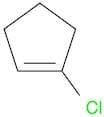
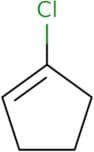
:1-chlor-1-cyclopenten
Beschreibung:
1-chlor-1-cyclopenten ist eine organische Verbindung, die durch einen Cyclopentenenring mit einem Chlor-Substituenten an der ersten Kohlenstoffposition gekennzeichnet ist. Es ist bei Raumtemperatur eine farblose bis blassgelbe Flüssigkeit und besitzt einen charakteristischen Geruch. Die Verbindung wird als halogeniertes Alken klassifiziert, was zu ihrer Reaktivität beiträgt, insbesondere bei nucleophilen Substitutions- und Additionsreaktionen. Ihre molekulare Struktur umfasst eine Doppelbindung, die Ungesättigtheit verleiht und ihr chemisches Verhalten beeinflusst. 1-chlor-1-cyclopenten ist in organischen Lösungsmitteln löslich, hat jedoch eine begrenzte Löslichkeit in Wasser aufgrund ihrer hydrophoben Natur. Die Anwesenheit des Chloratoms erhöht ihre Polarität im Vergleich zu nicht-halogenierten Alkenen, was ihre Wechselwirkungen mit anderen Substanzen beeinflusst. Diese Verbindung wird in der organischen Synthese verwendet und kann als Zwischenprodukt bei der Herstellung verschiedener chemischer Produkte dienen. Wie bei vielen chlorierten Verbindungen ist es wichtig, 1-chlor-1-cyclopenten mit Vorsicht zu behandeln, da potenzielle Gesundheits- und Umweltgefahren im Zusammenhang mit chlorierten Kohlenwasserstoffen bestehen.
Formel:C5H7Cl
InChl:InChI=1/C5H7Cl/c6-5-3-1-2-4-5/h3H,1-2,4H2
SMILES:C1CCC(=C1)Cl
Synonyme:- Cyclopentene, 1-chloro-
- 1-Chlorocyclopentene
Sortieren nach
Reinheit (%)
0
100
|
0
|
50
|
90
|
95
|
100
2 Produkte.
1-Chloro-1-cyclopentene
CAS:<p>1-Chloro-1-cyclopentene is a chlorine atom that belongs to the group of halides. It can be prepared by reacting 1,1-dichloroethane with n-butyl lithium and potassium t-butoxide in amide solvent at low temperature. The reaction product of 1-chloro-1-cyclopentene is a nucleophilic reagent for the formation of esters or amides. Chlorine atoms are also used as catalysts for many reactions involving organic compounds. They are able to react with electron rich molecules such as alkenes, alkynes, and even aromatic rings. This reaction proceeds via addition of the chlorine atom to one of the bonds on the molecule, followed by nucleophilic attack on the other bond. The chlorination process is reversible, which makes it possible to use the same molecule for both steps in an overall chemical process.</p>Formel:C5H7ClReinheit:Min. 95%Farbe und Form:Clear LiquidMolekulargewicht:102.56 g/mol