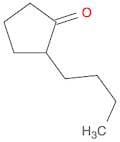
CAS 934-42-9
:2-Butylcyclopentanon
Beschreibung:
2-Butylcyclopentanon ist eine zyklische Keton, die durch einen Cyclopentanring mit einer Butylgruppe, die an einem der Kohlenstoffatome befestigt ist, gekennzeichnet ist. Seine chemische Formel ist C10H18O, was die Anwesenheit von zehn Kohlenstoffatomen, achtzehn Wasserstoffatomen und einem Sauerstoffatom anzeigt. Diese Verbindung erscheint typischerweise als farblose bis blassgelbe Flüssigkeit mit einem charakteristischen Geruch. Sie hat einen moderaten Siedepunkt und ist in organischen Lösungsmitteln löslich, aber ihre Löslichkeit in Wasser ist aufgrund ihrer hydrophoben Natur begrenzt. 2-Butylcyclopentanon wird in verschiedenen Anwendungen verwendet, einschließlich als Zwischenprodukt in der organischen Synthese und in der Herstellung von Duftstoffen und Aromastoffen. Ihre Reaktivität wird durch die ketonische funktionelle Gruppe beeinflusst, die an nucleophilen Additionsreaktionen teilnehmen kann. Sicherheitsdaten zeigen, dass sie, wie viele organische Lösungsmittel, mit Vorsicht behandelt werden sollte, da sie bei Kontakt mit Haut oder Augen Reizungen verursachen kann und in gut belüfteten Bereichen verwendet werden sollte, um das Einatmen von Dämpfen zu vermeiden.
Formel:C9H16O
InChl:InChI=1S/C9H16O/c1-2-3-5-8-6-4-7-9(8)10/h8H,2-7H2,1H3
InChI Key:InChIKey=ZAQYRXDJFINJJE-UHFFFAOYSA-N
SMILES:C(CCC)C1C(=O)CCC1
Synonyme:- 2-Butyl-1-cyclopentanone
- 2-n-Butylcyclopentanone
- Ai3-36552
- Cyclopentanone, 2-butyl-
- 2-Butylcyclopentanone
- 2-Butylcyclopentanone
Sortieren nach
Reinheit (%)
0
100
|
0
|
50
|
90
|
95
|
100
2 Produkte.
2-Butylcyclopentanone
CAS:2-Butylcyclopentanone is a protonated molecule that can be used in the kinetic protonation of alkyl halides. It has been shown to catalyze the formation of chiral carbanions from enolates and to form stereoisomers by kinetic asymmetric addition. The homologous series of 2-butylcyclopentanones has been studied extensively, as these molecules have been shown to have a wide range of uses, including as catalysts and reagents in organic synthesis. The mechanistic studies on this molecule have revealed that it is an electrophilic alkylation agent that reacts with nucleophiles at the protonated carbon atom. The selectivity of this reaction depends on the reactivity of the nucleophile, with more reactive nucleophiles leading to higher levels of selectivity. Protonation and alkylation are reversible processes and equilibrium constants for these reactions can be determined experimentally by measuring rates for both forward andFormel:C9H16OReinheit:Min. 95%Molekulargewicht:140.22 g/mol