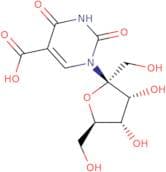
CAS 934743-11-0
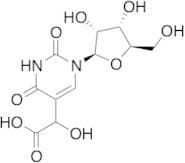
:1,2,3,4-Tetrahydro-α-hydroxy-2,4-dioxo-1-β-D-ribofuranosyl-5-pyrimidinacetat
Beschreibung:
1,2,3,4-Tetrahydro-α-hydroxy-2,4-dioxo-1-β-D-ribofuranosyl-5-pyrimidinacetat, mit der CAS-Nummer 934743-11-0, ist eine chemische Verbindung, die eine komplexe Struktur aufweist, die sowohl eine Ribofuranosyl-Gruppe als auch einen Pyrimidinacetic-Säure-Komponenten enthält. Diese Verbindung ist durch ihre Tetrahydro-Struktur gekennzeichnet, die auf das Vorhandensein eines gesättigten zyklischen Systems hinweist, sowie durch das Vorhandensein von Hydroxyl- und Dicarbonyl-Funktionalgruppen, die zu ihrer Reaktivität und potenziellen biologischen Aktivität beitragen. Der Ribofuranosyl-Teil deutet darauf hin, dass sie nucleosidähnliche Eigenschaften haben könnte, die in biochemischen Kontexten, insbesondere im Zusammenhang mit dem Nukleinsäurestoffwechsel oder als potenzielles Therapeutikum, relevant sein könnten. Die spezifische Stereochemie der Verbindung und die funktionellen Gruppen können ihre Löslichkeit, Stabilität und Wechselwirkungen mit biologischen Zielen beeinflussen. Insgesamt stellt diese Verbindung eine einzigartige Mischung von Merkmalen dar, die in der medizinischen Chemie und biochemischen Forschung von Interesse sein könnten.
Formel:C11H14N2O9
InChl:InChI=1S/C11H14N2O9/c14-2-4-6(16)7(17)9(22-4)13-1-3(5(15)10(19)20)8(18)12-11(13)21/h1,4-7,9,14-17H,2H2,(H,19,20)(H,12,18,21)/t4-,5?,6-,7-,9-/m1/s1
InChI Key:InChIKey=UVGCZRPOXXYZKH-QADQDURISA-N
SMILES:O=C1N(C=C(C(C(O)=O)O)C(=O)N1)[C@@H]2O[C@H](CO)[C@@H](O)[C@H]2O
Synonyme:- 5-Carboxyhydroxymethyl-uridine
- 1,2,3,4-Tetrahydro-α-hydroxy-2,4-dioxo-1-β-D-ribofuranosyl-5-pyrimidineacetic acid
- 5-Pyrimidineacetic acid, 1,2,3,4-tetrahydro-α-hydroxy-2,4-dioxo-1-β-D-ribofuranosyl-
- 5-(2-HO-carboxymethyl) uridine
Sortieren nach
Reinheit (%)
0
100
|
0
|
50
|
90
|
95
|
100
2 Produkte.
5-Carboxyhydroxymethyluridine
CAS:5-Carboxyhydroxymethyluridine is a hydroxylated nucleoside that is used to study DNA repair. It is a nucleotide analogue that has been modified at the hydroxyl group by methylation. 5-Carboxyhydroxymethyluridine can be converted back to uridine by escherichia coli hydroxylases, but this conversion does not occur in vivo. 5-Carboxyhydroxymethyluridine can be used as a substrate for methyltransferase enzymes, which are involved in DNA repair. The enzyme 5'-methylthioadenosine phosphorylase converts 5-carboxyhydroxymethyluridine into S-adenosylhomocysteine and adenine. This conversion can be reversed by the enzyme methionine synthase. Some homologues of 5-carboxyhydroxymethyluridine have been found in nature and other modifications have been made on theFormel:C11H14N2O9Reinheit:Min. 95%Farbe und Form:PowderMolekulargewicht:318.24 g/mol5-Carboxyhydroxymethyluridine
CAS:Kontrolliertes ProduktApplications 5-Carboxyhydroxymethyluridine is a naturally occuring modified nucleoside in RNA that assists in RNA stability, folding and other functions.
References Aduri, R., et al.: J. Chem. Theory Comput., 3, 1464 (2007); Xu, Y., et al.: J. Comput. Chem., 37, 896 (2016)Formel:C11H14N2O9Farbe und Form:NeatMolekulargewicht:318.237