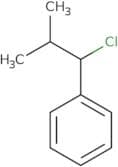
CAS 936-26-5
:(1-chlor-2-methylpropyl)benzol
Beschreibung:
(1-chlor-2-methylpropyl)benzol, auch bekannt als Benzyl-1-chloro-2-methylpropyl, ist eine organische Verbindung, die durch einen Benzolring gekennzeichnet ist, der mit einer 1-chloro-2-methylpropyl-Gruppe substituiert ist. Diese Verbindung ist typischerweise eine farblose bis blassgelbe Flüssigkeit mit einem charakteristischen aromatischen Geruch. Sie wird als Alkylhalogenid klassifiziert, da das Chloratom zu ihrer Reaktivität beiträgt. Die Verbindung ist mäßig in organischen Lösungsmitteln löslich, hat jedoch eine begrenzte Löslichkeit in Wasser, was ihre hydrophobe Natur widerspiegelt. Ihre chemische Struktur ermöglicht verschiedene Reaktionen, einschließlich nucleophiler Substitution und Eliminierungsreaktionen, was sie in der organischen Synthese nützlich macht. Darüber hinaus kann (1-chlor-2-methylpropyl)benzol Eigenschaften wie Flüchtigkeit und Entflammbarkeit aufweisen, was eine sorgfältige Handhabung und Lagerung erfordert. Sicherheitsdatenblätter sollten konsultiert werden, um spezifische Gefahren und Handhabungsvorkehrungen zu erfahren. Insgesamt dient diese Verbindung als wichtiges Zwischenprodukt in der Synthese komplexerer organischer Moleküle im Bereich der Chemie.
Formel:C10H13Cl
InChl:InChI=1/C10H13Cl/c1-8(2)10(11)9-6-4-3-5-7-9/h3-8,10H,1-2H3
SMILES:CC(C)C(c1ccccc1)Cl
Synonyme:- Benzene, (1-Chloro-2-Methylpropyl)-
Sortieren nach
Reinheit (%)
0
100
|
0
|
50
|
90
|
95
|
100
1 Produkte.
(1-Chloro-2-methylpropyl)benzene
CAS:1-Chloro-2-methylpropylbenzene is a medicine that has been used in the treatment of cancer. It is an alkylating agent and a chloride channel blocker. It interferes with the production of proteins by disrupting DNA and RNA synthesis, leading to cancer cell death. The reaction time for 1-chloro-2-methylpropylbenzene is constant at pH 7.4 and 37°C, due to its high reactivity. This alkylating agent also inhibits the activity of hydroxylase enzymes in fungi and nitroreductase enzymes in bacteria, which are responsible for the synthesis of nitric oxide (NO).Formel:C10H13ClReinheit:Min. 95%Molekulargewicht:168.66 g/mol