CAS 939-57-1
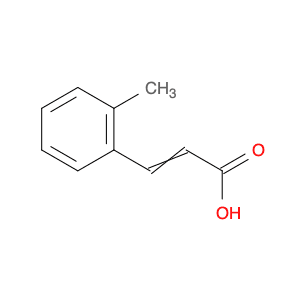
:(2E)-3-(2-Methylphenyl)-2-propensäure
Beschreibung:
(2E)-3-(2-Methylphenyl)-2-propensäure, allgemein bekannt als 2-Methylcinnaminsäure, ist eine organische Verbindung, die durch ihre Struktur gekennzeichnet ist, die eine propenoische Säureeinheit mit einer 2-Methylphenylgruppe aufweist. Diese Verbindung ist typischerweise ein weißes bis blassgelbes kristallines Feststoff mit einem charakteristischen aromatischen Geruch. Sie ist in organischen Lösungsmitteln wie Ethanol und Ether löslich, hat jedoch eine begrenzte Löslichkeit in Wasser aufgrund ihres hydrophoben aromatischen Rings. Die Verbindung weist sowohl saure als auch aromatische Eigenschaften auf, was sie zu einem vielseitigen Baustein in der organischen Synthese macht. Sie kann an verschiedenen chemischen Reaktionen teilnehmen, einschließlich Esterifizierung und Michael-Zusatz, und wird häufig in der Synthese von Duftstoffen, Arzneimitteln und anderen feinen Chemikalien verwendet. Darüber hinaus kann sie biologische Aktivität zeigen, was in der medizinischen Chemie von Interesse sein kann. Sicherheitsdaten zeigen, dass sie, wie viele organische Säuren, mit Vorsicht behandelt werden sollte, um Haut- und Augenreizungen zu vermeiden.
Formel:C10H10O2
InChl:InChI=1S/C10H10O2/c1-8-4-2-3-5-9(8)6-7-10(11)12/h2-7H,1H3,(H,11,12)/b7-6+
InChI Key:InChIKey=RSWBWHPZXKLUEX-VOTSOKGWSA-N
SMILES:C(=C/C(O)=O)\C1=C(C)C=CC=C1
Synonyme:- (2E)-3-(2-Methylphenyl)-2-propenoic acid
- 2-Methyl-trans-cinnamic acid
- 2-Propenoic acid, 3-(2-methylphenyl)-, (E)-
- 2-Propenoic acid, 3-(2-methylphenyl)-, (2E)-
- Cinnamic acid, o-methyl-, (E)-
Sortieren nach
Reinheit (%)
0
100
|
0
|
50
|
90
|
95
|
100
4 Produkte.
3-(2-methylphenyl)prop-2-enoic acid
CAS:Formel:C10H10O2Reinheit:98%Farbe und Form:SolidMolekulargewicht:162.1852(E)-3-(o-Tolyl)acrylic Acid
CAS:Formel:C10H10O2Reinheit:>98.0%(GC)(T)Farbe und Form:White to Almost white powder to crystalMolekulargewicht:162.19(E)-3-(o-Tolyl)acrylic acid
CAS:(E)-3-(o-Tolyl)acrylic acid is a boronic acid with the chemical structure of an ester. Boronic acids are electron-deficient, which makes them good ligands for metal ions such as ruthenium. In this case, the boronic acid is used to form a ruthenium complex. The compound can be used in a Suzuki coupling reaction to form C–H bonds. It also has acidic properties and hydrogenations that make it useful for synthetic purposes. (E)-3-(o-Tolyl)acrylic acid is able to bind to prostanoid receptors, which are a type of ligand in the body that interacts with prostanoids (hormones). This makes it useful as a synthetic ligand for radioligands or radioactive isotopes.
Formel:C10H10O2Reinheit:Min. 95%Molekulargewicht:162.18 g/mol