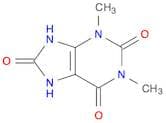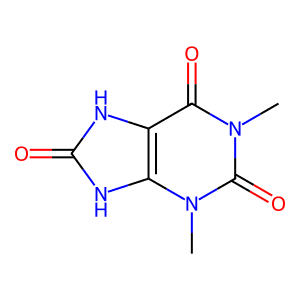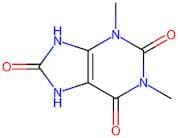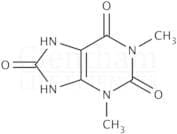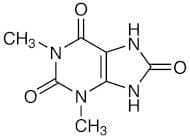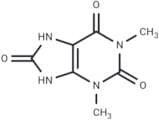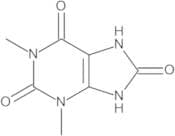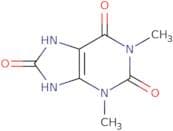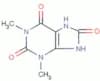
CAS 944-73-0
:1,3-Dimethylharnsäure
- 1,3-Dimethyl-2,6,8-Trioxopurine
- 1,3-Dimethyl-7,9-dihydro-3H-purine-2,6,8-trione
- 1,3-Dimethyl-7,9-dihydropurine-2,6,8-trione
- 1,3-Dimethyluric acid
- 1,3-dimethyl-7,9-dihydro-1H-purine-2,6,8(3H)-trione
- 1H-Purine-2,6,8(3H)-trione, 7,9-dihydro-1,3-dimethyl-
- Ba 2751
- Brn 0193698
- Nsc 95854
- Oxytheophylline
- Uric acid, 1,3-dimethyl-
- Uric acid, 1,3-dimethyl- (VAN)
- 7,9-Dihydro-1,3-dimethyl-1H-purine-2,6,8(3H)-trione
- 7,9-Dihydro-1,3-dimethyl-1H-purine-2,6,8(3H)-trione
- Weitere Synonyme anzeigen
1,3-Dimethyl-1H-Purine-2,6,8(3H,7H,9H)-Trione
CAS:1,3-Dimethyl-1H-Purine-2,6,8(3H,7H,9H)-TrioneReinheit:98%Molekulargewicht:196.16g/mol1,3-Dimethyluric acid
CAS:Formel:C7H8N4O3Reinheit:≥ 98%Farbe und Form:White, off-white or light-yellow powderMolekulargewicht:196.16Theophylline EP Impurity E
CAS:Formel:C7H8N4O3Farbe und Form:White To Off-White SolidMolekulargewicht:196.171,3-Dimethyluric Acid
CAS:Formel:C7H8N4O3Reinheit:>98.0%(T)(HPLC)Farbe und Form:White to Light yellow powder to crystalMolekulargewicht:196.171,3-Dimethyluric acid
CAS:1,3-Dimethyluric acid is a product of theophylline metabolism in man. It is one of the purine components in urinary calculi.Formel:C7H8N4O3Reinheit:99.84% - 99.94%Farbe und Form:SolidMolekulargewicht:196.161,3-Dimethyluric Acid
CAS:Kontrolliertes ProduktApplications 1,3-Dimethyluric Acid, is a metabolite of Caffeine (C080100), that is shown to have some of Its similar effects.
References Kalow, W., et al.: Clin. Pharmacol. Ther., 53, 503 (1993), Sharma, S., et al.: Cancer Res., 54, 5848 (1994), Sugawara, M., et al.: J. Biol. Chem., 275, 16473 (2000), Takeda, M., et al.: J. Pharmacol. Exp. Ther., 302, 666 (2002),Formel:C7H8N4O3Farbe und Form:NeatMolekulargewicht:196.161,3-Dimethyl-1H-purine-2,6,8(3H,7H,9H)-trione
CAS:Formel:C7H8N4O3Reinheit:97%Molekulargewicht:196.1661,3-Dimethyluric acid
CAS:Kontrolliertes Produkt1,3-Dimethyluric acid is a metabolite of caffeine. It is formed by the oxidative deamination of 1,3-dimethylxanthine in the liver. The concentrations of 1,3-dimethyluric acid are elevated in patients with chronic renal failure and those who are taking theophylline. The concentration–time curve for 1,3-dimethyluric acid was found to be linear and predictable after intravenous administration of caffeine at a dose of 10 mg/kg body weight in rats. This suggests that it is possible to estimate the rate of elimination from plasma after intravenous dosing with caffeine based on measurements of plasma concentrations and time. The metabolism of caffeine involves two pathways: oxidative deamination (1,3-dimethyluric acid) and demethylation (paraxanthine). It has been shown that the metabolites 1,3-dimethyluric acid and paraxanthine are formed by different metabolic pathways. The
Formel:C7H8N4O3Reinheit:Min. 98 Area-%Farbe und Form:White PowderMolekulargewicht:196.16 g/mol