CAS 94805-82-0
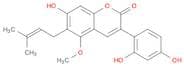
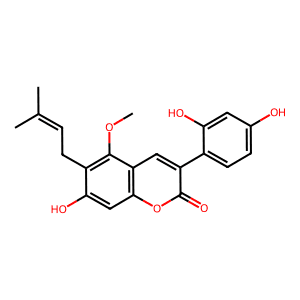
:Glycycoumarin
Beschreibung:
Glycycoumarin ist eine natürlich vorkommende Verbindung, die aus der Süßholzpflanze, insbesondere aus Glycyrrhiza glabra, gewonnen wird. Es wird als Cumarin-Derivat klassifiziert, das durch seine aromatische Struktur mit einem Benzopyron-Kern gekennzeichnet ist. Glycycoumarin zeigt eine Reihe biologischer Aktivitäten, einschließlich entzündungshemmender, antioxidativer und potenzieller krebsbekämpfender Eigenschaften, was es für die pharmakologische Forschung von Interesse macht. Die Verbindung liegt typischerweise in Form eines weißen bis blassgelben kristallinen Feststoffs vor und ist in organischen Lösungsmitteln löslich, jedoch weniger in Wasser. Ihre molekulare Struktur ermöglicht Wechselwirkungen mit verschiedenen biologischen Zielen, was zu ihrem therapeutischen Potenzial beiträgt. Darüber hinaus wurde Glycycoumarin für seine Rolle in der traditionellen Medizin und seine potenziellen Anwendungen in der Lebensmittel- und Kosmetikindustrie aufgrund seiner geschmackgebenden und konservierenden Eigenschaften untersucht. Wie bei vielen natürlichen Verbindungen sind weitere Forschungen erforderlich, um ihre Wirkmechanismen und potenziellen gesundheitlichen Vorteile vollständig zu ermitteln.
Formel:C21H20O6
InChl:InChI=1/C21H20O6/c1-11(2)4-6-14-18(24)10-19-16(20(14)26-3)9-15(21(25)27-19)13-7-5-12(22)8-17(13)23/h4-5,7-10,22-24H,6H2,1-3H3
InChI Key:InChIKey=NZYSZZDSYIBYLC-UHFFFAOYSA-N
SMILES:O(C)C1=C2C(OC(=O)C(=C2)C3=C(O)C=C(O)C=C3)=CC(O)=C1CC=C(C)C
Synonyme:- 2H-1-Benzopyran-2-one, 3-(2,4-dihydroxyphenyl)-7-hydroxy-5-methoxy-6-(3-methyl-2-buten-1-yl)-
- 2H-1-Benzopyran-2-one, 3-(2,4-dihydroxyphenyl)-7-hydroxy-5-methoxy-6-(3-methyl-2-butenyl)-
- 3-(2,4-Dihydroxy-phenyl)-7-hydroxy-5-methoxy-6-(3-methyl-but-2-enyl)-1-benzopyran-2-one
- 3-(2,4-Dihydroxyphenyl)-7-hydroxy-5-methoxy-6-(3-methyl-2-buten-1-yl)-2H-1-benzopyran-2-one
- Glycycoumarin
- Glycocoumarin -
- 3-(2,4-Dihydroxyphenyl)-7-hydroxy-5-methoxy-6-(3-methyl-2-butenyl)-2H-1-benzopyran-2-one
- 3-(2,4-Dihydroxyphenyl)-6-(3-methyl-2-butenyl)-5-methoxy-7-hydroxy-2H-1-benzopyran-2-one
- Glycocoumarin - Glycyrrhiza uralensis (liquorice)
- 3-(2,4-Dihydroxyphenyl)-5-methoxy-6-(3-methyl-2-butenyl)-7-hydroxy-2H-1-benzopyran-2-one
Sortieren nach
Reinheit (%)
0
100
|
0
|
50
|
90
|
95
|
100
7 Produkte.
2H-1-Benzopyran-2-one,3-(2,4-dihydroxyphenyl)-7-hydroxy-5-methoxy-6-(3-methyl-2-butenyl)-
CAS:Formel:C21H20O6Reinheit:95%Farbe und Form:SolidMolekulargewicht:368.3799Glycycoumarin
CAS:Glycycoumarin is an estrogen agonist, it shows moderate inhibitory effects against CYP1A2 and CYP2B6.Formel:C21H20O6Reinheit:97.64% - 99.78%Farbe und Form:SolidMolekulargewicht:368.38Ref: TM-TN1702
1mg39,00€5mg77,00€1mL*10mM (DMSO)85,00€10mg115,00€25mg222,00€50mg329,00€100mg489,00€200mg705,00€Glycocoumarin - Glycyrrhiza uralensis (liquorice) - Bio-X ™
CAS:This product is part of our Bio-X ™ Range. These products are aimed at life science researchers who need high quality ready-to-use products for assay development, screening or other R&D work. With a solubility datasheet and convenient vials, all of our Bio-X ™ products are in stock across our global warehouses for rapid delivery and ease of use.Formel:C21H20O6Reinheit:Min. 95%Farbe und Form:PowderMolekulargewicht:368.38 g/molGlycocoumarin - Glycyrrhiza uralensis (liquorice)
CAS:Glycocoumarin is a phytochemical compound that is primarily categorized as a bioactive flavonoid. It is derived from Glycyrrhiza uralensis, commonly known as liquorice, a plant renowned for its diverse pharmacological properties. The mode of action of glycocoumarin involves the modulation of various biological pathways, including its potential to influence inflammatory responses and antioxidant activity. This compound is known to interact with cellular signaling mechanisms, which could mediate its effects on immune modulation and cellular protection.Formel:C21H20O6Reinheit:Min. 98 Area-%Farbe und Form:PowderMolekulargewicht:368.38 g/mol