CAS 94928-86-6
:Tris(2-phenylpyridin)iridium
Beschreibung:
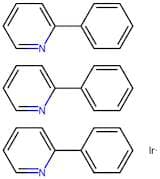
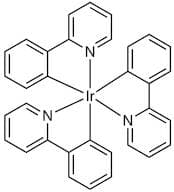
Tris(2-phenylpyridin)iridium, allgemein bekannt als Ir(ppy)3, ist ein Koordinationskomplex von Iridium mit bemerkenswerten photophysikalischen Eigenschaften, was ihn in den Bereichen der organischen Elektronik und Photonik bedeutend macht. Diese Verbindung weist drei 2-Phenylpyridin-Liganden auf, die an ein zentrales Iridium-Atom koordiniert sind, was zu einer stabilen oktaedrischen Geometrie führt. Sie zeigt eine starke Lumineszenz, insbesondere im blau-grünen Bereich des Spektrums, aufgrund ihrer Triplet-Metall-Ligand-Ladungsübertragungsübergänge (MLCT). Die Verbindung wird häufig als phosphoreszierender Emitter in organischen Leuchtdioden (OLEDs) und in verschiedenen photochemischen Anwendungen verwendet. Ihre Löslichkeit in organischen Lösungsmitteln erhöht ihre Anwendbarkeit in lösungsbasierten Prozessen. Darüber hinaus ist Tris(2-phenylpyridin)iridium durch seine relativ hohe thermische Stabilität und Widerstandsfähigkeit gegen Photodegradation gekennzeichnet, was ihn für langfristige Anwendungen in optoelektronischen Geräten geeignet macht. Sicherheitsüberlegungen sollten berücksichtigt werden, da Iridiumverbindungen toxisch sein können, was eine ordnungsgemäße Handhabung und Entsorgungsprotokolle in Laborumgebungen erfordert.
Formel:C33H24IrN3
InChl:InChI=1/3C11H8N.Ir/c3*1-2-6-10(7-3-1)11-8-4-5-9-12-11;/h3*1-6,8-9H;/rC33H24IrN3/c1-4-16-28(25(13-1)31-19-7-10-22-35-31)34(29-17-5-2-14-26(29)32-20-8-11-23-36-32)30-18-6-3-15-27(30)33-21-9-12-24-37-33/h1-24H
SMILES:c1ccc(c(c1)c1ccccn1)[Ir](c1ccccc1c1ccccn1)c1ccccc1c1ccccn1
Synonyme:- Iridium, Tris[2-(2-Pyridinyl)Phenyl]-
- Tris(2-phenylpyridine)iridium(III)
- Tris[2-(pyridin-2-yl)phenyl]iridium
- Ir(ppy)3
- Tris(2-phenylpyridinato)iridium(III)
- Lt-E504
- Tris(2-phenylpyridinato)iridium(III)(purifiedbysublimation)
Sortieren nach
Reinheit (%)
0
100
|
0
|
50
|
90
|
95
|
100
7 Produkte.
Tris(2-phenylpyridinato)iridium(III)
CAS:Formel:C33H24IrN3Reinheit:>98.0%(HPLC)Farbe und Form:Light yellow to Brown powder to crystalineMolekulargewicht:654.79Tris(2-phenylpyridinato-C2,N)iridium(III), 95%
CAS:Tris(2-phenylpyridinato-C2,N)iridium(III), 95%
Formel:C33H24IrN3Reinheit:95%Farbe und Form:yellow pwdr.Molekulargewicht:654.78Iridium, tris[2-(2-pyridinyl-kN)phenyl-kC]-, (OC-6-22)-
CAS:Formel:C33H24IrN3Reinheit:99%Farbe und Form:SolidMolekulargewicht:654.7808Tris(2-phenylpyridine)iridium
CAS:Tris(2-phenylpyridine)iridiumFormel:Ir·3C11H9NReinheit:95%Farbe und Form: yellow powderMolekulargewicht:657.80g/molTris(2-phenylpyridinato)iridium(III) (purified by sublimation)
CAS:Formel:C33H24IrN3Reinheit:>99.0%(HPLC)Farbe und Form:Light yellow to Brown powder to crystalMolekulargewicht:654.79Tris(2-phenylpyridine)iridium
CAS:Tris(2-phenylpyridine)iridium (IrCl) is a coordination compound that is used as a catalyst to initiate cationic polymerization of biphenyl. It is also used as an analytical reagent for determining the content of fatty acids in oils and fats. The steric interactions between the phenyl groups and the electron-rich iridium atoms lead to a high degree of conversion of ethylene oxide to ethylene glycol, which can be observed by UV absorption. The synthesis of IrCl occurs in two steps: first, the reaction of chloroacetone with phenylmagnesium bromide followed by addition of hydrated iridium chloride. The product crystallizes in red needles, which are analyzed using x-ray crystal structures. Analysis using nmr spectroscopy reveals that IrCl contains four nitrogen atoms and three oxygen atoms. Its redox potentials are -0.9 volts for oxidation and +1.3 volts for reduction, makingFormel:C33H24IrN3Reinheit:Min. 98 Area-%Farbe und Form:PowderMolekulargewicht:654.78 g/mol



![Iridium, tris[2-(2-pyridinyl-kN)phenyl-kC]-, (OC-6-22)-](/_next/image/?url=https%3A%2Fstatic.cymitquimica.com%2Fproducts%2FIN%2Fthumb%2FDA00IINQ.jpg&w=3840&q=75)