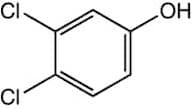
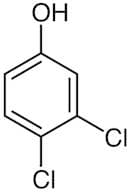
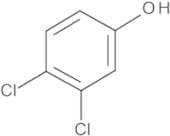
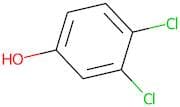
CAS 95-77-2
:3,4-Dichlorphenol
Beschreibung:
3,4-Dichlorphenol ist eine organische Verbindung, die durch das Vorhandensein von zwei Chloratomen und einer Hydroxylgruppe (-OH), die an einen phenolischen Ring gebunden ist, gekennzeichnet ist. Ihre chemische Formel lautet C6H4Cl2O, und sie wird als chloriertes Phenol klassifiziert. Diese Verbindung erscheint typischerweise als farbloser bis blassgelber Feststoff mit einem charakteristischen Geruch. Sie ist in organischen Lösungsmitteln löslich und hat eine begrenzte Löslichkeit in Wasser. 3,4-Dichlorphenol ist bekannt für seine antimikrobiellen Eigenschaften und wird in verschiedenen Anwendungen eingesetzt, einschließlich als Desinfektionsmittel und in der Synthese anderer chemischer Verbindungen. Es wird jedoch auch für seine potenzielle Toxizität und Umweltbelastung anerkannt, da es schädlich für aquatische Lebewesen sein kann und Gesundheitsrisiken bei Exposition darstellen kann. Eine ordnungsgemäße Handhabung und Entsorgung sind entscheidend, um seine Auswirkungen zu mindern. In Bezug auf die chemische Reaktivität kann es aufgrund der Anwesenheit der Hydroxylgruppe typischen elektrophilen Substitutionsreaktionen unterliegen, was es zu einem vielseitigen Zwischenprodukt in der organischen Synthese macht.
Formel:C6H4Cl2O
InChl:InChI=1S/C6H4Cl2O/c7-5-2-1-4(9)3-6(5)8/h1-3,9H
InChI Key:InChIKey=WDNBURPWRNALGP-UHFFFAOYSA-N
SMILES:ClC1=C(Cl)C=CC(O)=C1
Synonyme:- 3,4-Dichlorphenol
- 3,4-Diclorofenol
- 4,5-Dichlorophenol
- Brn 1907693
- Ccris 5904
- Hsdb 4247
- Nsc 60648
- Phenol, 3,4-dichloro-
- 3,4-Dichlorophenol
Sortieren nach
Reinheit (%)
0
100
|
0
|
50
|
90
|
95
|
100
16 Produkte.
3,4-Dichlorophenol, 97%
CAS:It is also a photo-degradation product of the common antibacterial and antifungal agent triclosan along with the dioxin 2,8-dichlorodibenzo-p-dioxin. This Thermo Scientific Chemicals brand product was originally part of the Alfa Aesar product portfolio. Some documentation and label information may rFormel:C6H4Cl2OReinheit:97%Farbe und Form:White to cream to brown, Crystals or powder or crystalline powder or flakes or needles or fibresMolekulargewicht:163.003,4-Dichlorophenol 10 µg/mL in Methanol
CAS:Kontrolliertes ProduktFormel:C6H4Cl2OFarbe und Form:Single SolutionMolekulargewicht:163.003,4-Dichlorophenol
CAS:Formel:C6H4Cl2OReinheit:>98.0%(GC)Farbe und Form:White to Almost white powder to crystalMolekulargewicht:163.003,4-Dichlorophenol
CAS:Kontrolliertes ProduktFormel:C6H4Cl2OFarbe und Form:NeatMolekulargewicht:163.003,4-Dichlorophenol 100 µg/mL in Methanol
CAS:Kontrolliertes ProduktFormel:C6H4Cl2OFarbe und Form:Single SolutionMolekulargewicht:163.00SVOC Mixture 231 100 µg/mL in Methanol
CAS:Kontrolliertes Produkt- 105-67-9
- 106-44-5
- 106-48-9
- 108-39-4
- 108-43-0
- 108-68-9
- 108-95-2
- 120-83-2
- 123-07-9
- 1570-64-5
- 15950-66-0
- 2416-94-6
- 4901-51-3
- 496-78-6
- 526-75-0
- 527-54-8
- 527-60-6
- 576-24-9
- 576-26-1
- 58-90-2
- 583-78-8
- 59-50-7
- 591-35-5
- 609-19-8
- 620-17-7
- 697-82-5
- 87-65-0
- 87-86-5
- 88-06-2
- 90-00-6
- 933-75-5
- 933-78-8
- 935-95-5
- 95-48-7
- 95-57-8
- 95-65-8
- 95-77-2
- 95-87-4
- 95-95-4
Farbe und Form:MixtureSVOC Mixture 231 100 µg/mL in Methanol
CAS:Kontrolliertes Produkt- 105-67-9
- 106-44-5
- 106-48-9
- 108-39-4
- 108-43-0
- 108-68-9
- 108-95-2
- 120-83-2
- 123-07-9
- 1570-64-5
- 15950-66-0
- 2416-94-6
- 4901-51-3
- 496-78-6
- 526-75-0
- 527-54-8
- 527-60-6
- 576-24-9
- 576-26-1
- 58-90-2
- 583-78-8
- 59-50-7
- 591-35-5
- 609-19-8
- 620-17-7
- 697-82-5
- 87-65-0
- 87-86-5
- 88-06-2
- 90-00-6
- 933-75-5
- 933-78-8
- 935-95-5
- 95-48-7
- 95-57-8
- 95-65-8
- 95-77-2
- 95-87-4
- 95-95-4
Farbe und Form:Mixture3,4-Dichlorophenol
CAS:3,4-DichlorophenolFormel:C6H4Cl2OReinheit:98%Farbe und Form: grey low melting solidMolekulargewicht:163.00g/mol3,4-Dichlorophenol
CAS:3,4-Dichlorophenol is a chemical compound that is produced by the chlorination of phenols. It is used as an industrial solvent, in the production of plastics and pesticides, and for wastewater treatment. 3,4-Dichlorophenol can also be found in some household cleaners and detergents. The matrix effect has been shown to influence the measurement of 3,4-dichlorophenol in urine samples by reducing the concentration of this chemical by approximately one order of magnitude. Chemical ionization has been shown to be useful for analyzing 3,4-dichlorophenol in urine samples. This method involves a chemical reaction with chlorine atoms at high temperatures to produce hydrogen chloride gas and other products. Hydrogen bond has been shown to have an effect on the kinetics of 3,4-dichlorophenol oxidation catalysts. The kinetic study showed that there are two distinct rates for this reaction: one fast rate with hydrogen bonding and one slowFormel:C6H4Cl2OReinheit:Min. 95%Farbe und Form:PowderMolekulargewicht:163 g/mol