CAS 956-75-2
:P-Nitrophenylcaproat
Beschreibung:
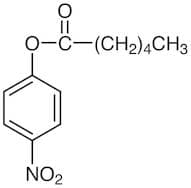
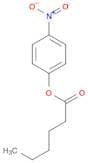
P-Nitrophenylcaproat, mit der CAS-Nummer 956-75-2, ist eine organische Verbindung, die zur Klasse der Ester gehört. Sie wird aus Capronsäure und p-Nitrophenol abgeleitet und weist eine p-Nitrophenylgruppe auf, die an die Caproat-Gruppe gebunden ist. Diese Verbindung erscheint typischerweise als gelbliches Feststoff oder Flüssigkeit, abhängig von ihrer Reinheit und Temperatur. P-Nitrophenylcaproat ist bekannt für seine Verwendung als Substrat in biochemischen Tests, insbesondere in Studien, die Esterasen und Lipasen betreffen, aufgrund seiner Fähigkeit, p-Nitrophenol bei der Hydrolyse freizusetzen. Die Anwesenheit der Nitrogruppe erhöht ihre Reaktivität und Löslichkeit in organischen Lösungsmitteln. Darüber hinaus zeigt sie eine moderate Stabilität unter Standardlaborbedingungen, kann jedoch empfindlich gegenüber Feuchtigkeit und Licht sein. Sicherheitsvorkehrungen sollten beim Umgang mit dieser Verbindung getroffen werden, da sie Gesundheitsrisiken darstellen kann, wenn sie eingeatmet oder verschluckt wird, und geeignete persönliche Schutzausrüstung verwendet werden sollte. Insgesamt dient P-Nitrophenylcaproat als wertvolles Werkzeug in der organischen Synthese und enzymatischen Studien.
Formel:C12H15NO4
InChl:InChI=1/C12H15NO4/c1-2-3-4-5-12(14)17-11-8-6-10(7-9-11)13(15)16/h6-9H,2-5H2,1H3
SMILES:CCCCCC(=O)Oc1ccc(cc1)N(=O)=O
Synonyme:- n-Caproic acid 4-nitrophenyl ester
- 4-Nitrophenyl Hexanoate
Sortieren nach
Reinheit (%)
0
100
|
0
|
50
|
90
|
95
|
100
5 Produkte.
4-Nitrophenyl Hexanoate
CAS:Formel:C12H15NO4Reinheit:>98.0%(GC)Farbe und Form:Light yellow to Brown clear liquidMolekulargewicht:237.26Hexanoic acid, 4-nitrophenyl ester
CAS:Formel:C12H15NO4Reinheit:96%Farbe und Form:LiquidMolekulargewicht:237.25184-Nitrophenyl hexanoate
CAS:Formel:C12H15NO4Reinheit:95%Farbe und Form:Liquid, No data available.Molekulargewicht:237.2554-Nitrophenyl hexanoate
CAS:4-Nitrophenyl hexanoate is an acyl phosphate monoclonal antibody (aMAb) that binds to the enzyme hydroxylase, which converts 4-nitrophenol to p-nitrophenol. This aMAb has been shown to inhibit the activity of this enzyme and its conversion of 4-nitrophenol to p-nitrophenol, leading to its use in biochemical studies as a model for monooxygenase enzymes. The reaction mechanism for this aMAb is believed to be that it reacts with the acyl chain of hydroxylase and hinders the active site from binding 4-nitrophenol. 4-Nitrophenyl hexanoate also has a cationic surfactant that can bind or react with proteins or nucleic acids by electrostatic interactions or hydrogen bonding. It is also able to form polymers with other monoclonal antibodies and has been used in protein purification processesFormel:C12H15NO4Reinheit:Min. 98 Area-%Farbe und Form:Colorless Clear LiquidMolekulargewicht:237.25 g/mol