CAS 96-07-1
:2-(1-Methylethyl)cyclohexanol
Beschreibung:
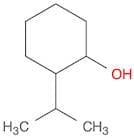
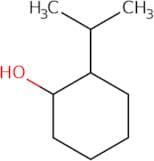
2-(1-Methylethyl)cyclohexanol, auch bekannt als Isopropylcyclohexanol, ist eine organische Verbindung, die durch ihren Cyclohexanring gekennzeichnet ist, der mit einer Hydroxylgruppe und einer Isopropylgruppe substituiert ist. Es handelt sich um eine farblose bis blassgelbe Flüssigkeit mit einem charakteristischen Geruch. Das Vorhandensein der Hydroxylgruppe (-OH) klassifiziert es als Alkohol, was zu seiner Löslichkeit in polaren Lösungsmitteln und seiner Fähigkeit beiträgt, Wasserstoffbrückenbindungen einzugehen. Diese Verbindung hat einen relativ niedrigen Siedepunkt und eine moderate Flüchtigkeit, was sie in verschiedenen Anwendungen nützlich macht, einschließlich als Lösungsmittel und in der Synthese anderer organischer Verbindungen. Ihre chemische Struktur ermöglicht eine potenzielle Reaktivität in organischen Reaktionen, wie Dehydratisierung und Oxidation. Darüber hinaus ist 2-(1-Methylethyl)cyclohexanol von Interesse in der Untersuchung der Chemie von Düften und Aromen aufgrund seines angenehmen Duftprofils. Sicherheitsdaten zeigen, dass es, wie viele organische Lösungsmittel, mit Vorsicht behandelt werden sollte, um Inhalation oder Hautkontakt zu vermeiden.
Formel:C9H18O
InChl:InChI=1S/C9H18O/c1-7(2)8-5-3-4-6-9(8)10/h7-10H,3-6H2,1-2H3
InChI Key:InChIKey=IXVGVVQGNQZQGD-UHFFFAOYSA-N
SMILES:C(C)(C)C1C(O)CCCC1
Synonyme:- (1S,2R)-2-isopropylcyclohexanol
- 2-(1-Methylethyl)cyclohexanol
- 2-(Propan-2-Yl)Cyclohexanol
- 2-(Propan-2-yl)cyclohexan-1-ol
- 2-Propan-2-ylcyclohexan-1-ol
- Cyclohexanol, 2-(1-methylethyl)-
- Cyclohexanol, 2-isopropyl-
- NSC 2330
- 2-Isopropylcyclohexanol
Sortieren nach
Reinheit (%)
0
100
|
0
|
50
|
90
|
95
|
100
3 Produkte.
2-(Propan-2-yl)cyclohexan-1-ol
CAS:Formel:C9H18OReinheit:98%Farbe und Form:SolidMolekulargewicht:142.23862-Isopropylcyclohexan-1-ol
CAS:2-Isopropylcyclohexan-1-ol is a nonpolar organic compound with a high boiling point. It is used in the industrial production of β-lactam antibiotics, such as cephalosporins and carbapenems. The synthesis of 2-isopropylcyclohexanol involves an asymmetric process that produces two enantiomers. One enantiomer can be converted to an α-hydroxy acid (2-isopropylmalic acid) and the other to a β hydroxy acid (2-isobutyric acid). 2-Isopropylcyclohexan-1-ol is also used in chromatographic science as a solute for column chromatography. It has been shown that magnesium sulfate can be used to increase the separation efficiency of 2-isopropylcyclohexanol, which may be because it increases the adsorption of this solute on silicaFormel:C9H18OReinheit:Min. 95%Molekulargewicht:142.24 g/mol