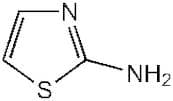
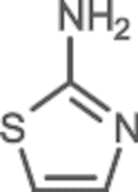
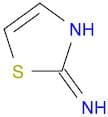
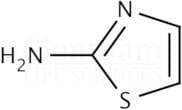
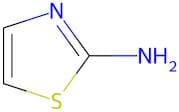
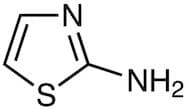
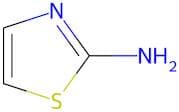
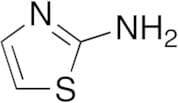
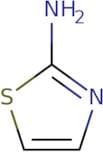
CAS 96-50-4
:2-Aminothiazol
- 1,3-Thiazol-2-amine
- 2-Amino-1,3-thiazole
- 2-Thiazolamine
- 2-Thiazolylamine
- 2-Thiazylamine
- 4-Thiazoline, 2-imino-
- Abadol
- Abadole
- Aminothiazol
- Aminothiazole
- Aminothiozole-2
- Aminotiazol
- Basedol
- Nsc 1900
- Weitere Synonyme anzeigen
2-Aminothiazole, 97%
CAS:2-Aminothiazole is used in the synthesis of 2-aminothiazole-modified silica gel and also used in Ulmann coupling with 2-chlorobenzoic acids mediated by ultrasonic irradiation. It acts as a component of disperse dye, thyroid inhibitor in the treatment of hyperthyroidism, as the acid tartrate and as aFormel:C3H4N2SReinheit:97%Farbe und Form:Cream to dark brown to brown, Crystals or powder or crystalline powderMolekulargewicht:100.14Aminothiazole
CAS:Aminothiazole (2-Aminothiazole), a thyroid inhibitor, displays antibacterial activity.Formel:C3H4N2SReinheit:98.87%Farbe und Form:Physical Description Light Brown Crystals Or Brown Granular Solid (Ntp 1992)Molekulargewicht:100.142-Aminothiazole
CAS:Formel:C3H4N2SReinheit:>98.0%(T)Farbe und Form:White to Yellow to Orange powder to crystalMolekulargewicht:100.142-Amino-1,3-thiazole
CAS:2-Amino-1,3-thiazoleFormel:C3H4N2SReinheit:98%Farbe und Form: light tan powderMolekulargewicht:100.14g/mol2-Aminothiazole
CAS:Kontrolliertes ProduktApplications 2-Aminothiazole is a heterocyclic amine and is the beginning reagent for the synthesis of many pharmaceutical and agricultural related compounds.
References Gallardo-Godoy, A., et al.: J. Med. Chem., 54, 1010 (2011); Lai, H., et al.: Antiviral. Res., 97, 74 (2013); Yamamoto, K.N., et al.: Environ. Molec. Mutagen., 52, 547 (2011);Formel:C3H4N2SFarbe und Form:NeatMolekulargewicht:100.142-Aminothiazole
CAS:2-Aminothiazole is a nonsteroidal anti-inflammatory drug (NSAID) that inhibits the enzyme cyclooxygenase and prevents the formation of prostaglandins. It has been shown to be effective in the treatment of autoimmune diseases, HIV infection, and infectious diseases. 2-Aminothiazole has significant cytotoxicity against cancer cells and has been used for surface methodology experiments. This drug also exhibits antimicrobial activity against bacteria, but does not have any effect on fungi or viruses. 2-Aminothiazole has chemical stability in air, water and acid medium, but it is unstable in alkaline medium. It also reacts with copper chloride to form copper aminothiazoles. 2-Aminothiazole is an antagonist of nitric oxide synthase, which contributes to its biological properties as an anti-inflammatory agent.
Formel:C3H4N2SReinheit:Min. 95%Farbe und Form:PowderMolekulargewicht:100.14 g/mol