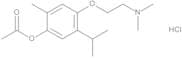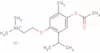
CAS 964-52-3
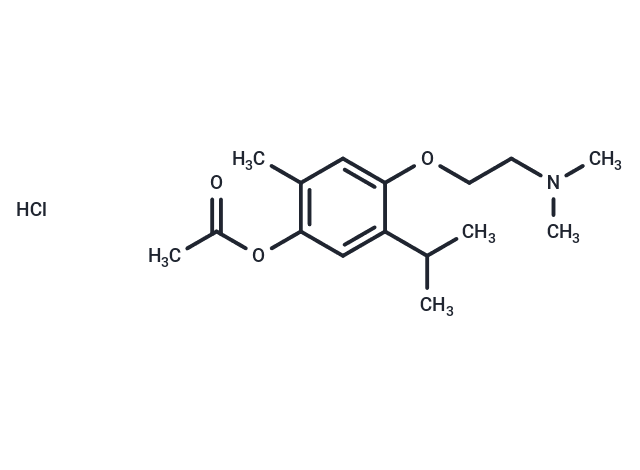
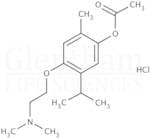
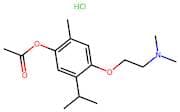
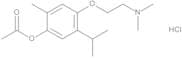
:Moxisylythydrochlorid
Beschreibung:
Moxisylythydrochlorid ist eine pharmazeutische Verbindung, die hauptsächlich als Vasodilatator verwendet wird, was bedeutet, dass sie hilft, die Blutgefäße zu erweitern und den Blutfluss zu verbessern. Sie wird als Alpha-Adrenozeptor-Antagonist klassifiziert, der speziell auf Alpha-1-Adrenozeptoren abzielt. Diese Wirkung kann zu einem Rückgang des Blutdrucks führen und wird häufig zur Behandlung von Erkrankungen wie Bluthochdruck eingesetzt. Die Substanz erscheint als weißes bis off-white kristallines Pulver und ist in Wasser löslich, was die Verabreichung in verschiedenen Formulierungen erleichtert. Moxisylythydrochlorid wird typischerweise oral oder intravenös verabreicht, abhängig vom klinischen Szenario. Ihre pharmakologischen Effekte sind durch einen relativ schnellen Wirkungseintritt gekennzeichnet, was sie in akuten Situationen wirksam macht. Wie bei vielen Medikamenten können potenzielle Nebenwirkungen Schwindel, Kopfschmerzen oder gastrointestinale Störungen umfassen. Es ist wichtig, dass Gesundheitsdienstleister die Patienten auf unerwünschte Reaktionen überwachen und die Dosierungen entsprechend anpassen. Insgesamt spielt Moxisylythydrochlorid eine bedeutende Rolle bei der Behandlung von Herz-Kreislauf-Erkrankungen durch seine vasodilatatorischen Eigenschaften.
Formel:C16H26ClNO3
InChl:InChI=1/C16H25NO3.ClH/c1-11(2)14-10-15(20-13(4)18)12(3)9-16(14)19-8-7-17(5)6;/h9-11H,7-8H2,1-6H3;1H
InChI Key:InChIKey=IPWGSXZCDPTDEH-UHFFFAOYSA-N
SMILES:C(C)(C)C1=C(OCCN(C)C)C=C(C)C(OC(C)=O)=C1.Cl
Synonyme:- (2-(4-Acetoxy-2-isopropyl-5-methylphenoxy)ethyl)dimethylamine hydrochloride
- 2-[4-(acetyloxy)-5-methyl-2-(propan-2-yl)phenoxy]-N,N-dimethylethanaminium chloride
- 4-(2-Dimethylaminoethoxy)-5-isopropyl-2-methylphenyl acetate hydrochloride
- 5-(2-(N,N-Dimethylamino)ethoxy)carvacrol acetate hydrochloride
- Arlitene
- Arlitine
- Carlytene
- Carvacrol, 5-(2-(N,N-dimethylamino)ethoxy)-, acetate, hydrochloride
- Carvacrol, 5-(2-(dimethylamino)ethoxy)-, acetate (ester), hydrochloride (8CI)
- Carvacrol, 5-[2-(dimethylamino)ethoxy]-, acetate (ester), hydrochloride
- Carvacrol, 5-[2-(dimethylamino)ethoxy]-, acetate, hydrochloride
- Chlorhydrate de acetoxy-thymoxy-ethyl-dimethylamine
- Chlorhydrate de acetoxy-thymoxy-ethyl-dimethylamine [French]
- Enfrental
- Limatene
- M 101 (vasodilator)
- M-101
- Moxilite
- Moxisylyte HCl
- Moxyl
- Nsc 170448
- Opilon
- Opilon hydrochloride
- Phenol, 4-(2-(dimethylamino)ethoxy)-2-methyl-5-(1-methylethyl)-, acetate (ester), hydrochloride (9CI)
- Phenol, 4-[2-(dimethylamino)ethoxy]-2-methyl-5-(1-methylethyl)-, 1-acetate, hydrochloride (1:1)
- Phenol, 4-[2-(dimethylamino)ethoxy]-2-methyl-5-(1-methylethyl)-, acetate (ester), hydrochloride
- Thymoxamine hydrochloride
- Unii-Wk2Kzm9V6X
- Uroalpha
- Vasoklin
- Wv 365
- Moxisylyte hydrochloride
- Antibiotic SQ-26970
- thymoxaminehydrochloride
- SQ-26970
- chlorhydratedeacetoxy-thymoxy-ethyl-dimethylamine
- 3-[[2-Acetylamino-3-hydroxy-1-oxo-3-[4-(sulfooxy)phenyl]propyl]amino]-3-methoxy-2-oxo-1-azetidinesulfonic acid
- 5-(2-(n,n-dimethylamino)ethoxy)carvacrolacetatehydrochloride
- Nsc170448
- SALOR-INT L255386-1EA
- (2-(4-acetoxy-2-isopropyl-5-methylphenoxy)ethyl)dimethylaminehydrochloride
- opilonhydrochloride
- 4-DIMETHYLAMINOETHOXY-5-ISOPROPYL-2-METHYLPHENYL ACETATE HYDROCHLORIDE
- Weitere Synonyme anzeigen
Sortieren nach
Reinheit (%)
0
100
|
0
|
50
|
90
|
95
|
100
7 Produkte.
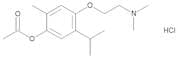
Phenol, 4-[2-(dimethylamino)ethoxy]-2-methyl-5-(1-methylethyl)-,acetate (ester), hydrochloride
CAS:Formel:C16H26ClNO3Reinheit:95%Farbe und Form:SolidMolekulargewicht:315.8355Moxisylyte hydrochloride
CAS:Moxisylyte hydrochloride (Thymoxamine hydrochloride) is an alpha-adrenergic blocking agent that is used in Raynaud's disease.Formel:C16H26ClNO3Reinheit:99.94% - ≥95%Farbe und Form:SolidMolekulargewicht:315.84Moxisylyte Hydrochloride
CAS:Kontrolliertes ProduktFormel:C16H25NO3·ClHFarbe und Form:NeatMolekulargewicht:315.84Moxisylyte Hydrochloride
CAS:Applications Moxisylyte Hydrochloride is α1-adrenoceptor antagonists.
References Goto, W., et al.: Brain Res., 1003, 130-137 (2004);Formel:C16H25NO3·ClHFarbe und Form:NeatMolekulargewicht:315.84

![Phenol, 4-[2-(dimethylamino)ethoxy]-2-methyl-5-(1-methylethyl)-,acetate (ester), hydrochloride](/_next/image/?url=https%3A%2Fstatic.cymitquimica.com%2Fproducts%2FIN%2Fthumb%2FDA00IJT1.jpg&w=3840&q=75)