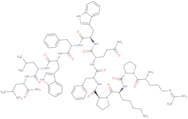
CAS 96736-12-8
:L-Leucinamid, D-arginyl-L-prolyl-L-lysinyl-L-prolyl-D-phenylalanyl-L-glutaminyl-D-tryptophanyl-L-phenylalanyl-D-tryptophanyl-L-leucyl-
Beschreibung:
L-Leucinamid, D-Arginyl-L-Prolyl-L-Lysyl-L-Prolyl-D-Phenylalanin-L-Glutamin-D-Tryptophan-L-Phenylalanin-D-Tryptophan-L-Leucin ist ein komplexes Peptid, das aus verschiedenen Aminosäuren besteht, einschließlich sowohl L- als auch D-Enantiomeren. Diese Struktur deutet darauf hin, dass es einzigartige biologische Eigenschaften aufweisen könnte, die auf die Anwesenheit beider Formen von Aminosäuren zurückzuführen sind, die seine Wechselwirkungen mit biologischen Systemen beeinflussen können. Die Anwesenheit mehrerer Prolinreste kann zu seiner strukturellen Stabilität und dem Potenzial zur Bildung spezifischer Konformationen beitragen. Die Sequenz des Peptids weist auf eine potenzielle Rolle in biologischen Prozessen hin, möglicherweise im Zusammenhang mit Signal- oder Strukturfunktionen in Proteinen. Seine CAS-Nummer, 96736-12-8, ermöglicht eine präzise Identifizierung in chemischen Datenbanken. Detaillierte Informationen über seine Löslichkeit, Stabilität und spezifischen biologischen Aktivitäten würden jedoch empirische Studien erfordern, da diese Eigenschaften je nach Konformation und Umgebung des Peptids erheblich variieren können. Insgesamt stellt diese Verbindung ein faszinierendes Forschungsgebiet in der Peptidchemie und Biochemie dar.
Formel:C79H109N19O12
Synonyme:- SubstanceP,1-D-arginine-5-D-phenylalanine-7-D-tryptophan-9-D-tryptophan-11-L-leucinamide-
- L 756867
- [D-Arg1,D-Phe5,D-Trp7,9,Leu11]substance P
- D-Arg-Pro-Lys-Pro-D-Phe-Gln-D-Trp-Phe-D-Trp-Leu-Leu-Nh2
Sortieren nach
Reinheit (%)
0
100
|
0
|
50
|
90
|
95
|
100
5 Produkte.
(D-Arg¹,D-Phe⁵,D-Trp⁷·⁹,Leu¹¹)-Substance P
CAS:(D-Arg¹,D-Phe⁵,D-Trp⁷·⁹,Leu¹¹)-Substance P initially described as a low potency ghrelin receptor antagonist has surprisingly been found to be a full inverse agonist (EC₅₀ = 5.2 nM). In COS-7 cells transiently transfected with the ghrelin receptor the substance P analog rPKPfQwFwLL decreased the constitutive signaling down to levels observed in untransfected cells. Assuming that constitutive signaling of the ghrelin receptor is of physiological relevance in the regulation of appetite control, inverse agonists of the ghrelin receptor could be interesting for the treatment of obesity. So, Asakawa et al. found that peripherally administered H-6395 decreased food intake in lean mice, in mice with diet induced obesity, and in ob/ob obese mice.Formel:C79H109N19O12Reinheit:98.2%Farbe und Form:White LyophilisateMolekulargewicht:1516.86[D-Arg1,D-Phe5,D-Trp7,9,Leu11]-Substance P
CAS:Broad-spectrum inverse agonist; potent at ghrelin receptor (EC50=5.2 nM); blocks other neuropeptide receptors; induces apoptosis; inhibits tumor growth.Formel:C79H109N19O12Reinheit:98%Farbe und Form:SolidMolekulargewicht:1516.85[D-Arg1, D-Phe5, D-Trp7,9, Leu11]-Substance P
CAS:Formel:C79H109N19O12Reinheit:≥ 95.0%Farbe und Form:White powderMolekulargewicht:1516.83[D-Arg1,D-Phe5,D-Trp7,9,Leu11]-Substance P
CAS:Substance P is a neuropeptide that belongs to the Feeding Regulatory Peptides family. It is synthesized in the hypothalamus and secreted by neurons in the spinal cord, brainstem, and gut. Substance P has been shown to regulate feeding behavior through its interaction with opioid receptors and the release of other neurotransmitters. The synthetic form of this peptide has been shown to reduce body fat in animal models and increased sensitivity to insulin in diabetic patients. This peptide also reduces camp levels in rats, which may be due to its ability to stimulate secretion of camp from pancreatic cells.Formel:C79H109N19O12Reinheit:Min. 95%Molekulargewicht:1,516.87 g/mol(D-Arg1,D-Phe5,D-Trp7·9,Leu11)-Substance P
CAS:Substance P is a neuropeptide that binds to the tachykinin receptor NK1. It has potent anti-inflammatory and mitogenic activities, which are mediated through its binding to the NK1 receptor. Substance P can stimulate lung cancer cells to proliferate and inhibit their apoptosis, which may be due to an autocrine mechanism. In addition, it has been shown that substance P can potentiate the growth of some cancers such as colon cancer in vitro and in vivo by increasing DNA synthesis and cell proliferation. This peptide also has a dose-dependent effect on cell growth, with high doses inhibiting cell proliferation at higher levels than low doses.Formel:C79H109N19O12Reinheit:Min. 95%Molekulargewicht:1,516.83 g/mol
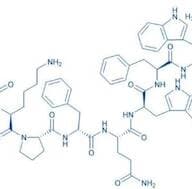

![[D-Arg1,D-Phe5,D-Trp7,9,Leu11]-Substance P](/_next/image/?url=https%3A%2Fstatic.cymitquimica.com%2Fproducts%2FTM%2Fthumb%2FTP1931.jpg&w=3840&q=75)

![[D-Arg1, D-Phe5, D-Trp7,9, Leu11]-Substance P](/_next/image/?url=https%3A%2Fstatic.cymitquimica.com%2Fproducts%2F7W%2Fthumb%2FGL9471.jpg&w=3840&q=75)

![[D-Arg1,D-Phe5,D-Trp7,9,Leu11]-Substance P](/_next/image/?url=https%3A%2Fstatic.cymitquimica.com%2Fproducts%2F3D%2Fthumb%2FPGH-3652-PI.jpg&w=3840&q=75)