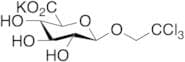
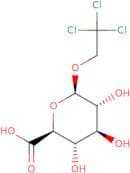
CAS 97-25-6
:Urochloralsäure
Beschreibung:
Urochloralsäure, mit der CAS-Nummer 97-25-6, ist eine organische Verbindung, die zur Klasse der chlorierten aromatischen Säuren gehört. Sie zeichnet sich durch ihre Struktur aus, die eine chlorierte phenolische Gruppe und eine carboxylische funktionelle Gruppe umfasst. Diese Verbindung kommt typischerweise in kristalliner Form vor und ist bekannt für ihre potenziellen Anwendungen in verschiedenen Bereichen, einschließlich Biochemie und Pharmazie. Urochloralsäure zeigt eine moderate Löslichkeit in Wasser und ist in organischen Lösungsmitteln besser löslich, was für viele aromatische Verbindungen typisch ist. Ihre chemischen Eigenschaften ermöglichen es ihr, an verschiedenen Reaktionen teilzunehmen, was sie zu einem nützlichen Zwischenprodukt in der organischen Synthese macht. Darüber hinaus kann sie biologische Aktivität zeigen, obwohl spezifische biologische Effekte je nach Konzentration und Umweltbedingungen variieren können. Sicherheitsdaten zeigen, dass sie, wie viele chlorierte Verbindungen, mit Vorsicht behandelt werden sollte, da sie potenziell toxisch ist und Auswirkungen auf die Umwelt haben kann. Insgesamt ist Urochloralsäure eine bemerkenswerte Verbindung im Studium der organischen Chemie und ihrer Anwendungen.
Formel:C8H11Cl3O7
InChl:InChI=1S/C8H11Cl3O7/c9-8(10,11)1-17-7-4(14)2(12)3(13)5(18-7)6(15)16/h2-5,7,12-14H,1H2,(H,15,16)/t2-,3-,4+,5-,7+/m0/s1
InChI Key:InChIKey=IQOASJJGUQMXDW-GHQVIJFQSA-N
SMILES:O(CC(Cl)(Cl)Cl)[C@@H]1O[C@H](C(O)=O)[C@@H](O)[C@H](O)[C@H]1O
Synonyme:- 2,2,2-Trichloroethanol glucuronide
- 2,2,2-Trichloroethyl b-D-Glucopyranosiduronic Acid
- 2,2,2-Trichloroethyl b-D-Glucosiduronic Acid
- 2,2,2-Trichloroethyl β-<span class="text-smallcaps">D</span>-glucopyranosiduronic acid
- 97-25-6
- Glucopyranosiduronic acid, 2,2,2-trichloroethyl, β-<span class="text-smallcaps">D</span>-
- Urochloralic acid
- beta-D-glucopyranosiduronic acid, 2,2,2-trichloroethyl
- β,β,β-Trichloroethyl-β-<span class="text-smallcaps">D</span>-glucuronic acid
- β,β,β-Trichloroethyl-β-<span class="text-smallcaps">D</span>-glucuronide
- β-<span class="text-smallcaps">D</span>-Glucopyranosiduronic acid, 2,2,2-trichloroethyl
- 2,2,2-Trichloroethyl beta-D-glucopyranosiduronic acid
- β,β,β-Trichloroethyl-β-D-glucuronide
- Glucopyranosiduronic acid, 2,2,2-trichloroethyl, β-D-
- β,β,β-Trichloroethyl-β-D-glucuronic acid
- Weitere Synonyme anzeigen
Sortieren nach
Reinheit (%)
0
100
|
0
|
50
|
90
|
95
|
100
4 Produkte.
Trichloroethyl Beta-D-Glucuronide Potassium Salt
CAS:Kontrolliertes ProduktFormel:C8H10Cl3KO7Farbe und Form:NeatMolekulargewicht:363.62Trichloroethyl b-D-glucuronide potassium salt
CAS:Trichloroethyl b-D-glucuronide potassium salt (TCEBG) is a chloral compound that is metabolized to trichloroacetic acid. It has been shown to be carcinogenic in rats, but not in mice. Trichloroethyl b-D-glucuronide potassium salt has been used as an experimental agent for the synthesis of monoclonal antibodies. TCEBG binds to rat liver microsomes and CD1 mouse liver microsomes, which may be due to its high lipophilicity. TCEBG also disrupts cell membranes and induces cell death by inhibiting protein synthesis at the ribosome level.Formel:C8H10Cl3KO7Reinheit:Min. 98 Area-%Farbe und Form:PowderMolekulargewicht:363.62 g/molTrichloroethyl-13C2,d2 β-D-Glucuronide Potassium Salt
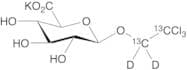
CAS:Kontrolliertes ProduktApplications A labelled metabolite of chloral hydrate (CH) and trichloroethylene (TRI).
References Salmon, A., et al.: Clin. Toxicol., 33, 115 (1995), Xu, G., et al.: Drug Metab. Dispos., 23, 1412 (1995), Bull, R., et al.: Toxicol. Appl. Pharmacol., 182, 55 (2002),Formel:C2C6D2H8Cl3KO7Farbe und Form:NeatMolekulargewicht:367.616