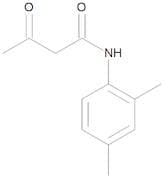
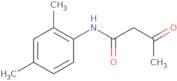
CAS 97-36-9
:aamx
Beschreibung:
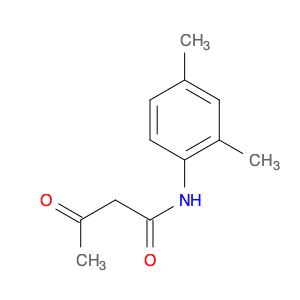
Die chemische Substanz mit dem Namen "aamx" und der CAS-Nummer 97-36-9 ist bekannt als 2-Amino-4-methylphenol. Es handelt sich um eine organische Verbindung, die durch das Vorhandensein einer Aminogruppe (-NH2) und einer Methylgruppe (-CH3), die an einen phenolischen Ring gebunden sind, gekennzeichnet ist. Diese Verbindung erscheint typischerweise als Feststoff und ist in Wasser und organischen Lösungsmitteln löslich. Sie wird hauptsächlich in der Synthese von Farbstoffen, Pigmenten und als Zwischenprodukt in verschiedenen chemischen Reaktionen verwendet. 2-Amino-4-methylphenol zeigt Eigenschaften wie eine schwache Base aufgrund der Aminogruppe und kann an elektrophilen aromatischen Substitutionsreaktionen teilnehmen. Sicherheitsüberlegungen umfassen den vorsichtigen Umgang, da sie Gesundheitsrisiken bei Exposition darstellen kann, einschließlich Haut- und Atemwegsreizungen. Es sollten geeignete Sicherheitsprotokolle befolgt werden, wenn mit dieser Substanz in einem Labor oder industriellen Umfeld gearbeitet wird.
Formel:C12H15NO2
InChl:InChI=1/C12H15NO2/c1-8-4-5-11(9(2)6-8)13-12(15)7-10(3)14/h4-6H,7H2,1-3H3,(H,13,15)
InChI Key:InChIKey=HGVIAKXYAZRSEG-UHFFFAOYSA-N
SMILES:N(C(CC(C)=O)=O)C1=C(C)C=C(C)C=C1
Synonyme:- 1-Acetoacetylamino-2,4-dimethylbenzene
- 2',4'-Acetoacetoxylidide
- 2',4'-Dimethylacetoacetanilide
- 2,4-Acetoacetoxylidide
- 2′,4′-Dimethylacetoacetanilide
- Acetoacet-M-Xylidide
- Acetoacetic acid m-xylidide
- Acetoaceto-m-xylidide
- Acetoacetyl-m-xylidide
- Butanamide, N-(2,4-dimethylphenyl)-3-oxo-
- N-(2,4-Dimethylphenyl)-3-Oxobutyramide
- N-(2,4-Dimethylphenyl)acetoacetamide
- N-(2,4-dimethylphenyl)-2-oxobutanamide
- N-(2,4-dimethylphenyl)-3-oxobutanamide
- N-Acetoacetyl-2,4-xylidine
- NSC 8398
- o,p-Dimethylacetoacetanilide
- AAMX
- N-2,4-Dimethyl-acetoacetylanilide
- N-2,4-XYLYLACETOACETAMIDE
- acetoacet-2,4-dimethylphenyl
- ACETO ACET M-XYLIDINE
- M-ACETOACETO-XYLIDIDE
- n-(2,4-dimethylphenyl)-3-oxo-butanamid
- LABOTEST-BB LT01274614
- 3-oxo-n-(2,4-methylphenyl)butanamide
- ACETOACET-2,4-XYLIDIDE
- 2’,4’-dimethyl-acetoacetanilid
- ACETOACETIC ACID-M-XYLIDID-2,4
- Acetoacet-M-xylidine
- Weitere Synonyme anzeigen
Sortieren nach
Reinheit (%)
0
100
|
0
|
50
|
90
|
95
|
100
7 Produkte.
N-(2,4-Dimethylphenyl)-3-oxobutyramide
CAS:Formel:C12H15NO2Reinheit:%Farbe und Form:SolidMolekulargewicht:205.2530N-(2,4-Dimethylphenyl)-3-oxobutanamide
CAS:N-(2,4-Dimethylphenyl)-3-oxobutanamideReinheit:98%Molekulargewicht:205.25g/molN-Acetoacetyl-2,4-xylidine 100 µg/mL in Acetonitrile
CAS:Formel:C12H15NO2Farbe und Form:Single SolutionMolekulargewicht:205.25N-(2,4-Dimethylphenyl)-3-oxobutanamide
CAS:Applications N-(2,4-Dimethylphenyl)-3-oxobutanamide (cas# 97-36-9) is a useful research chemical.
Formel:C12H15NO2Farbe und Form:NeatMolekulargewicht:205.25Acetoacetate-m-xylidide
CAS:Acetoacetate-m-xylidide (AAX) is a compound that is used as a reagent to detect protein adducts. It reacts with the amino groups of proteins to form an acetoacetate derivative, which can be detected by mass spectrometry or other analytical methods. The lability of AAX and its reactivity with oxygen make it a poor choice for use in the presence of air. The optimal pH for AAX is acidic, so it must be dissolved in water before use. AAX is used to detect proteins that have been modified by exposure to acid or alkaline environments. This chemical has also been shown to react with haemoglobin and s. aureus, but not p. aeruginosa or E. coli, due to their different structure of the protein cysteine residues. The maximum activation of AAX occurs at pH 4-7, and it becomes fully active at pH 3-4; this chemical does notFormel:C12H15NO2Reinheit:Min. 95 Area-%Farbe und Form:PowderMolekulargewicht:205.25 g/molN-(2,4-Dimethylphenyl)-3-oxobutanamide
CAS:Formel:C12H15NO2Reinheit:98%Farbe und Form:No data available.Molekulargewicht:205.257