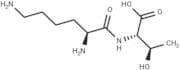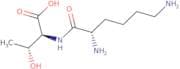
CAS 97791-84-9
:L-Threonin, L-lysinyl-
Beschreibung:
L-Threonin, L-lysinyl- ist ein Dipeptid, das aus den Aminosäuren L-Threonin und L-Lysin besteht. Es ist durch seine Struktur gekennzeichnet, die die Aminogruppe, die Carboxylgruppe und die Seitenketten beider Bestandteile umfasst. Diese Verbindung ist typischerweise in Wasser löslich, da sie polare funktionelle Gruppen enthält, die Wasserstoffbrückenbindungen erleichtern. L-Threonin ist eine essentielle Aminosäure, was bedeutet, dass sie über die Nahrung aufgenommen werden muss, während L-Lysin ebenfalls essentiell ist und eine entscheidende Rolle bei der Proteinsynthese, der Hormonproduktion und der Calciumaufnahme spielt. Die Dipeptidform kann einzigartige biologische Aktivitäten aufweisen, einschließlich potenzieller Rollen im Stoffwechsel und in zellulären Funktionen. Darüber hinaus kann sie an verschiedenen biochemischen Wegen beteiligt sein, die zur Synthese von Proteinen und anderen Biomolekülen beitragen. Die CAS-Nummer 97791-84-9 identifiziert diese Verbindung eindeutig in chemischen Datenbanken und unterstützt deren Studium und Anwendung in Bereichen wie Biochemie, Ernährung und Pharmazie.
Formel:C10H21N3O4
Sortieren nach
Reinheit (%)
0
100
|
0
|
50
|
90
|
95
|
100
3 Produkte.
Lysyl threonine
CAS:Lysyl threonine is a dipeptide composed of lysine and threonine. It is an incomplete breakdown product of protein digestion or protein catabolism.Formel:C10H21N3O4Farbe und Form:SolidMolekulargewicht:247.29H-Lys-Thr-OH trifluroacetate
CAS:Please enquire for more information about H-Lys-Thr-OH trifluroacetate including the price, delivery time and more detailed product information at the technical inquiry form on this pageFormel:C10H21N3O4•(C2HF3O2)xReinheit:Min. 95%H-Lys-Thr-OH hydrochloride salt
CAS:H-Lys-Thr-OH hydrochloride salt is a synthetic amino acid that has been used in the synthesis of a cyclic peptide. The synthesis was achieved by metathesis reactions, which involved the reaction of an acid chloride with a chiral amine to form an ester. H-Lys-Thr-OH hydrochloride salt has been shown to have high binding constants to its targets and can be used as a selective reagent for the synthesis of virus proteins. It is also able to bind to carboxylate groups, which are common in wild type viruses and gene products. This reagent also has cleavage products, which can be used for efficient method for synthesizing cyclic peptides.
Formel:C10H21N3O4Reinheit:Min. 95%Molekulargewicht:247.29 g/mol