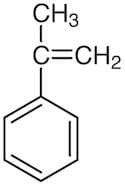
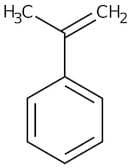
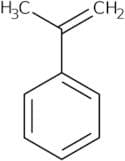
CAS 98-83-9
:α-Methylstyrol
- (1-Methylethenyl)benzene
- 1-Methyl-1-phenylethene
- 1-Methyl-1-phenylethylene
- 1-Methylvinyl benzene
- 1-Phenyl-1-methylethylene
- 1-Propene, 2-phenyl-
- 2-Fenilpropeno
- 2-Phenyl Propene
- 2-Phenyl-1-Propene
- 2-Phenyl-1-propylene
- 2-Phenyl-2-propene
- 2-Phenyl-propylene
- 2-Phenylpropen
- 2-Phenylpropene
- 2-Phenylpropylene
- Benzene, (1-methylethenyl)-
- Benzene, isopropenyl-
- Dow Corning 56
- Isopropenyl Benzene
- Isopropenylbenzene
- K 150 (styrene)
- Methylstyrene
- Nsc 9400
- Prop-1-en-2-ylbenzene
- Styrene, α-methyl-
- alpha-Methylstyrene monomer
- α-METHYL STYRENE
- α-Methylstyrene
- α-Methylstyrol
- α-Methylvinylbenzene
- Weitere Synonyme anzeigen
α-Methylstyrene (stabilized with TBC)
CAS:Formel:C9H10Reinheit:>99.0%(GC)Farbe und Form:Colorless to Almost colorless clear liquidMolekulargewicht:118.18α-Methylstyrene, 99%, stab. with 10-20 ppm 4-tert-butylcatechol
CAS:-Methylstyrene (AMS) is used in the synthesis of (acrylonitrile-styrene-acrylic copolymer)/(-methylstyrene-acrylonitrile copolymer). It is used in the manufacture of plasticizers, resins and polymers. This Thermo Scientific Chemicals brand product was originally part of the Alfa Aesar product portfoFormel:C9H10Reinheit:99%Farbe und Form:Clear colorless to pale yellow, LiquidMolekulargewicht:118.18α-Methylstyrene
CAS:α-MethylstyreneFormel:C9H10Reinheit:≥95%Farbe und Form: clear. almost colourless liquidMolekulargewicht:118.178g/molASTM Method D7845 Check Standard 0.01-0.05 Wt% in Toluene
CAS:Kontrolliertes Produkt- 100-42-5
- 100-80-1
- 105-67-9
- 108-93-0
- 108-95-2
- 1195-32-0
- 122-99-6
- 123-07-9
- 141-32-2
- 142-96-1
- 19902-08-0
- 2039-89-6
- 2234-20-0
- 25837-05-2
- 4169-04-4
- 5989-27-5
- 60-12-8
- 611-15-4
- 620-17-7
- 622-97-9
- 71-36-3
- 77-73-6
- 770-35-4
- 80-56-8
- 873-66-5
- 90-00-6
- 90-12-0
- 91-20-3
- 91-57-6
- 93-56-1
- 95-13-6
- 98-83-9
- 98-85-1
- 99-89-8
Farbe und Form:Mixtureα-Methylstyrene
CAS:Applications α-methylstyrene (AMS) is a useful intermediate. It can be used in the manufacture of plasticizers, resins and polymerization production processes. It is a co-product formed in a variation of the cumene process. The homopolymer obtained from this monomer, poly(α-methylstyrene), is unstable, being characterized by a low ceiling temperature.
Not a dangerous good if item is equal to or less than 1g/ml and there is less than 100g/ml in the package
References Lund, A., et al.: Spectrochim. Acta A, 98, 367 (2012); Natl. Toxicol. Program tech. report series, (543), 1-210 (2007); Chen, L., et al: Drug Metab. Dispos., 39, 498 (2011)Formel:C9H10Farbe und Form:NeatMolekulargewicht:118.18(1-Methylethenyl)-benzene contains 15 ppm p-tert-butylcatechol as inhibitor
CAS:Formel:C9H10Reinheit:95.0%Farbe und Form:LiquidMolekulargewicht:118.1792-Phenyl-1-propene - stabilized with TBC
CAS:2-Phenyl-1-propene stabilized with TBC is a monomer that is used in the production of cationic polymers. This polymer undergoes a free radical polymerization process, which requires a catalyst to initiate the reaction. The most commonly used catalyst for this process is an organometallic compound, such as titanium tetrachloride (TTC) or zirconium tetrachloride (ZTC). The kinetic data of this reaction show that the monomer reacts with two equivalents of TTC or ZTC. The reaction mechanism involves an initial addition reaction between TTC/ZTC and the hydroxyl group on 2-phenyl-1-propene, followed by a subsequent insertion reaction between the methyl ethyl group on 2-phenyl-1-propene and the nitrogen atom on TTC/ZTC. This process produces a stable cationic polymer that can be used in clinical pathology and carcinogenesis studies.
Formel:C9H10Reinheit:Min. 95%Molekulargewicht:118.18 g/mol