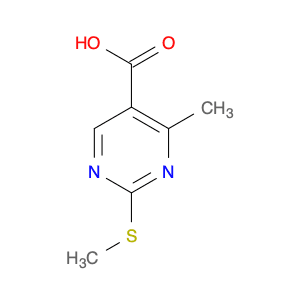
CAS 98276-75-6
:4-Methyl-2-(methylsulfanyl)pyrimidin-5-carbonsäure
Beschreibung:
4-Methyl-2-(methylsulfanyl)pyrimidin-5-carbonsäure ist eine organische Verbindung, die durch ihre Pyrimidinringstruktur gekennzeichnet ist, die einen sechsgliedrigen heterozyklischen aromatischen Ring enthält, der zwei Stickstoffatome an den Positionen 1 und 3 enthält. Diese Verbindung weist eine Carbonsäurefunktion an der Position 5 auf, die zu ihrer Säure und potenziellen Reaktivität beiträgt. Die Anwesenheit einer Methylsulfanylgruppe an der Position 2 führt ein Schwefelatom ein, das die chemischen Eigenschaften der Verbindung, wie Löslichkeit und Reaktivität, beeinflussen kann. Die Methylgruppe an der Position 4 trägt zum allgemeinen hydrophoben Charakter des Moleküls bei. Diese Verbindung kann biologische Aktivität zeigen, was sie für die pharmazeutische Forschung von Interesse macht. Ihre einzigartige Struktur ermöglicht verschiedene Wechselwirkungen in biologischen Systemen, was potenziell zu Anwendungen in der medizinischen Chemie führen kann. Wie viele Pyrimidinderivate kann sie an Wasserstoffbrückenbindungen und anderen intermolekularen Wechselwirkungen teilnehmen, die ihr Verhalten in verschiedenen Umgebungen beeinflussen. Insgesamt ist 4-Methyl-2-(methylsulfanyl)pyrimidin-5-carbonsäure eine vielseitige Verbindung mit potenziellen Anwendungen in verschiedenen Bereichen der Chemie und Biologie.
Formel:C7H8N2O2S
InChl:InChI=1/C7H8N2O2S/c1-4-5(6(10)11)3-8-7(9-4)12-2/h3H,1-2H3,(H,10,11)
SMILES:Cc1c(cnc(n1)SC)C(=O)O
Synonyme:- 4-methyl-2-(methylthio)pyrimidine-5-carboxylic acid
- 4-methyl-2-methylsulfanylpyrimidine-5-carboxylic acid
- 4-Methyl-2-(methylthio)-5-pyrimidinecarboxylic Acid
- 5-Pyrimidinecarboxylicacid, 4-methyl-2-(methylthio)-
- 4-Methyl-2-(methylsulphanyl)pyrimidine-5-carboxylic acid, 5-Carboxy-4-methyl-2-(methylthio)pyrimidine, 5-Carboxy-4-methyl-2-(methylsulphanyl)pyrimidine
- 4-Methyl-2-(methylthio)pyrimidine-5-carboxylic acid ,97%
- 4-Methyl-2-(methylsulphanyl)pyrimidine-5-carboxylic acid
- 4-METHYL-2-(METHYLTHIO)PYRIMIDINE-5-CARBOXYLIC ACID ISO 9001:2015 REACH
- 4-methyl-2-methylsulfanylpyrimidine-5-carboxylicaci
- 4-Methyl-2-(methylsulfanyl)-5-pyrimidinecarboxylic acid≥ 98.5% (HPLC)
- Weitere Synonyme anzeigen
Sortieren nach
Reinheit (%)
0
100
|
0
|
50
|
90
|
95
|
100
4 Produkte.
5-Pyrimidinecarboxylicacid, 4-methyl-2-(methylthio)-
CAS:Formel:C7H8N2O2SReinheit:95%Farbe und Form:SolidMolekulargewicht:184.21564-Methyl-2-(methylthio)pyrimidine-5-carboxylic acid
CAS:4-Methyl-2-(methylthio)pyrimidine-5-carboxylic acidFormel:C7H8N2O2SReinheit:95%Farbe und Form:PowderMolekulargewicht:184.22g/mol4-Methyl-2-(methylsulfanyl)-5-pyrimidinecarboxylic acid
CAS:Formel:C7H8N2O2SReinheit:95%Molekulargewicht:184.214-Methyl-2-(methylsulfanyl)-5-pyrimidinecarboxylic acid
CAS:Ribonucleosides, deoxyribonucleosides, and their activated forms (e.g., 4-methyl-2-(methylsulfanyl)-5-pyrimidinecarboxylic acid) are all important intermediates for the synthesis of DNA and RNA. Ribonucleosides are the key building blocks for the synthesis of DNA. They can be converted to nucleosides by removal of the ribose moiety. Deoxyribonucleosides are synthesized from ribonucleosides by removal of the hydroxyl group from carbon 2' position of ribose. The activated forms (e.g., 4-methyl-2-(methylsulfanyl)-5-pyrimidinecarboxylic acid) are useful in phosphoramidite chemistry as they have a free amine group on one side and a free sulfonyl group on the other side that can be used to react with a growing oligo or polyphosph
Formel:C7H8N2O2SReinheit:Min. 95%Molekulargewicht:184.22 g/mol