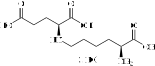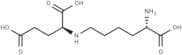
CAS 997-68-2
:Saccharopin
- <span class="text-smallcaps">L</span>-Glutamic acid, N-(5-amino-5-carboxypentyl)-, (S)-
- <span class="text-smallcaps">L</span>-Glutamic acid, N-[(5S)-5-amino-5-carboxypentyl]-
- <span class="text-smallcaps">L</span>-Saccharopine
- Glutamic acid, N-(5-amino-5-carboxypentyl)-, <span class="text-smallcaps">L</span>-
- L-Glutamic acid, N-(5-amino-5-carboxypentyl)-, (S)-
- N-(5-amino-5-carboxypentyl)glutamic acid
- N-[(5S)-5-Amino-5-carboxypentyl]-<span class="text-smallcaps">L</span>-glutamic acid
- N-[(5S)-5-amino-5-carboxypentyl]-L-glutamic acid
- Saccharopin
- Saccharopine
- epsilon-N-(L-Glutar-2-yl)-L-lysine
- L-Saccharopine
- L-Glutamic acid, N-[(5S)-5-amino-5-carboxypentyl]-
- Weitere Synonyme anzeigen
Saccharopine
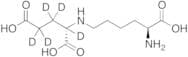
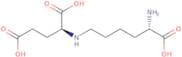
CAS:L-Saccharopine is a product of the breakdown of essential amino acid Lysine.Formel:C11H20N2O6Farbe und Form:SolidMolekulargewicht:276.29L-Saccharopine
CAS:Stability Hygroscopic
Applications L-Saccharopine is a product of breakdown of essential amino acid Lysine (L468895). Saccharopine is also part of the α-aminoadipate pathway of fungal lysine biosynthesis.
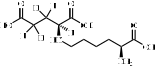
References Higashino, K., et al.: Biochem. Biophys. Res. Commun., 20, 285 (1965); Johansson, E., et al.: Structure, 8, 1037 (2000)Formel:C11H20N2O6Farbe und Form:NeatMolekulargewicht:276.29L-Saccharopine-d5
CAS:Kontrolliertes ProduktFormel:C11H15D5N2O6Farbe und Form:NeatMolekulargewicht:281.32L-Saccharopine
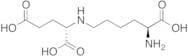
CAS:L-Saccharopine is an intermediate in the biosynthesis of lysine. It has been shown to have a role in brain function and is a potential biomarker for infectious diseases. L-Saccharopine can be found in plants, fungi, and bacteria. This enzyme is produced by dehydrogenase form saccharopine. The activity of this enzyme is measured by measuring the amount of NADH oxidized per minute at 30°C. L-Saccharopine has been shown to have a low toxicity and does not cause any side effects when administered to rats orally or intravenously at doses up to 2 g/kg body weight. L-Saccharopine has also been shown to inhibit the growth of certain types of bacteria, such as E. coli, through its inhibition of protein synthesis (in vitro).
Formel:C11H20N2O6Reinheit:Min. 95%Molekulargewicht:276.29 g/mol