Chromogene Substrate
Chromogene Substrate sind Verbindungen, die eine sichtbare Farbänderung erzeugen, wenn sie von spezifischen Enzymen umgesetzt werden. Diese Substrate werden häufig in diagnostischen Tests, biochemischen Forschungen und Enzymimmunoassays (ELISA) verwendet, um die Enzymaktivität zu erkennen und zu quantifizieren. Die Farbänderung ermöglicht eine einfache und schnelle visuelle Identifizierung von Enzymreaktionen, wodurch chromogene Substrate zu unverzichtbaren Werkzeugen in der Laboranalyse werden. Bei CymitQuimica bieten wir eine vielfältige Auswahl an hochwertigen chromogenen Substraten zur Unterstützung Ihrer Forschungs- und Diagnostikanwendungen.
712 Produkte aus dem Bereich "Chromogene Substrate" gefunden
Sortieren nach
Reinheit (%)
0
100
|
0
|
50
|
90
|
95
|
100
Chromogenix S-2222
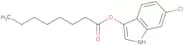
CAS:Formel:C32H43N9O9·HClC33H45N9O9·HClMolekulargewicht:697.75 36.46; 711.78 36.466-Chloro-1H-indol-3-yl octanoate
CAS:<p>6-Chloro-1H-indol-3-yl octanoate is a fluorogenic substrate that can be used to detect enzymes such as phosphatases, lipases, esterases, and proteases. 6-Chloro-1H-indol-3-yl octanoate is a ligand for metal ions such as Cu(II), Ni(II) and Zn(II). This product has high purity and quality. It is an enzyme substrate for many enzymes such as phosphatases, lipases, esterases, and proteases. This product can be used in diagnostics of various substances including food testing, environmental testing and staining. 6CIO is a chromogenic substrate that can be used to detect bioluminescence reactions.<br>6CIO is CAS No. 159954-35-5.</p>Reinheit:Min. 95%Molekulargewicht:293.79 g/mol5-Bromo-4-chloro-3-indolyl-D-thymidine-3'-phosphate cyclohexylammonium salt
CAS:<p>5-Bromo-4-chloro-3-indolyl-D-thymidine-3'-phosphate cyclohexylammonium salt is a chromogenic substrate used to detect the specific enzymatic activity of alkaline phosphatase. After cleavage, 5-bromo-4-chloro-indoxyl is released, resulting in a blue to blue-green color change in bacterial colonies or media. 5-Bromo-4-chloro-3-indolyl-D-thymidine-3'-phosphate cyclohexylammonium salt is used in immunohistochemistry (IHC) and Western blot detection, immunoassays used to detect proteins.</p>Formel:C18H17BrClN3O8P·C6H14NReinheit:Min. 95%Farbe und Form:White PowderMolekulargewicht:649.86 g/mol5-Bromo-4-chloro-3-indolyl a-D-mannopyranoside
CAS:<p>5-Bromo-4-chloro-3-indolyl a-D-mannopyranoside is a chromogenic substrate used to detect the specific enzymatic activity of alpha-mannosidase. After cleavage, 5-bromo-4-chloro-indoxyl is released, resulting in a blue to blue-green color change in bacterial colonies or media. 5-Bromo-4-chloro-3-indolyl a-D-mannopyranoside is used in alpha-mannosidosis diagnosis and other lysosomal storage disorder.</p>Formel:C14H15BrClNO6Reinheit:Min. 95 Area-%Farbe und Form:PowderMolekulargewicht:408.63 g/mol2-Naphthyl-β-D-Glucuronide Sodium Salt
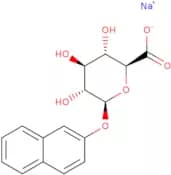
CAS:2-Naphthyl-beta-D-glucuronide sodium salt is an enzyme substrate to detect beta-glucuronidase. The enzyme cleaves the glycosidic bond in 2-naphthyl-beta-D-glucuronide to release 2-naphtol and glucuronic acid. Beta-glucuronidase activity assays are important in many fields such as cancer research, as the enzyme is expressed in some tumors and its activity can be targeted for cancer therapy. The enzyme has also an important role in drug metabolism as it recognizes and binds to drug glucuronide conjugate (as 2-naphthyl-beta-D-glucuronide) facilitating its hydrolysis to release the active part. 2-Naphthyl-beta-D-glucuronide sodium salt has a higher solubility as it is in its salt form.Formel:C16H15NaO7Reinheit:Min. 95%Farbe und Form:PowderMolekulargewicht:342.28 g/mol4-Nitrophenyl α-L-fucopyranoside
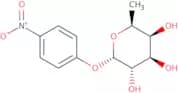
CAS:<p>Chromogenic substrate for alpha-L-fucosidase</p>Formel:C12H15NO7Reinheit:(%) Min. 98.0%Farbe und Form:PowderMolekulargewicht:285.25 g/mol5-Bromo-4-chloro-3-indolyl b-D-galactofuranoside
<p>5-Bromo-4-chloro-3-indolyl b-D-galactofuranoside is a chromogenic substrate used to detect the specific enzymatic activity of beta-D-galactofuranosidase. After cleavage, 5-bromo-4-chloro-indoxyl is released, resulting in a blue to blue-green color change in bacterial colonies or media. 5-Bromo-4-chloro-3-indolyl b-D-galactofuranoside is used in assays for detecting bacterial pathogens (e.g., Mycobacterium tuberculosis).</p>Formel:C14H15BrClNO6Reinheit:Min. 95%Farbe und Form:PowderMolekulargewicht:408.63 g/mol2-Nitrophenyl b-D-fucopyranoside
CAS:<p>2-Nitrophenyl b-D-fucopyranoside is a chromogenic substrate used in various enzymatic assays to detect the presence of fucosidase enzymes. It consists of a nitrophenyl group attached to a fucose sugar molecule. When acted upon by enzymes such as fucosidases, it releases the colored nitrophenyl group, which can be detected using spectrophotometry.</p>Formel:C12H15NO7Reinheit:Min. 95%Farbe und Form:White Off-White PowderMolekulargewicht:285.25 g/molNaphthol AS-D
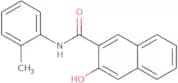
CAS:<p>Naphthol AS-D is a diagnostic chemical for phosphatase enzymes and is used to stain cells, tissues, and body fluids for diagnosis. The chemical reacts with the amino groups of proteins in cells and produces a brown color. Naphthol AS-D is not toxic to living cells in concentrations below 5%. It stains basophilic leukemia cells as well as brain cells. This chemical can be used to diagnose cutaneous lesions, such as psoriasis or melanoma, which are difficult to diagnose by standard methods. present in these lesions and produce a brown color.</p>Formel:C18H15NO2Reinheit:Min. 95%Farbe und Form:PowderMolekulargewicht:277.32 g/molAldol® 484 beta-D-glucopyranoside, Biosynth Patent: EP 2427431 and US 8940909
CAS:<p>Aldol® 484 beta-D-glucopyranoside is a chromogenic and fluorogenic enzyme substrate used for detection of beta-glucosidase activity. The colorless enzyme substrate is cleaved by bacteria producing beta-glucosidase in liquid or solid media, yielding intense red color and green fluorescent signal. Aldol® 484 beta-D-glucopyranoside can be used under aerobic and anaerobic conditions.</p>Formel:C26H24ClFN2O7Reinheit:Min. 95%Farbe und Form:PowderMolekulargewicht:530.93 g/molAldol® 518 myo-inositol-1-phosphate - Biosynth Patent: EP 2427431 and US 8940909
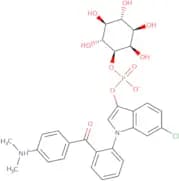
CAS:<p>Aldol® 518 myo-inositol-1-phosphate is a chromogenic and fluorogenic enzyme substrate used for detection of phosphatidyl-inositol specific phospholipase C activity (PI-PLC, EC 4.6.1.13). The colorless enzyme substrate is cleaved by PI-PLC or PI-PLC-positive microorganisms grown in liquid or solid media, yielding an intense red coloration. In combination with Aldol® 355 fluorescence enhancer, red fluorescence can also obtained. Aldol® 518 myo-inositol-1-phosphate is suitable for use in liquid and solid media, under aerobic as well as anaerobic conditions.</p>Formel:C29H33ClN3O10PReinheit:Min. 95 Area-%Farbe und Form:PowderMolekulargewicht:650.02 g/mol5-Bromo-4-chloro-3-indoxyl oleate
CAS:<p>5-Bromo-4-chloro-3-indoxyl oleate is a chromogenic substrate used to detect the specific enzymatic activity of lipase. After cleavage, 5-bromo-4-chloro-indoxyl is released, resulting in a blue to blue-green color change in bacterial colonies or media. 5-Bromo-4-chloro-3-indoxyl oleate is used in lipid metabolism disorder screening.</p>Formel:C26H37BrClNO2Reinheit:Min. 95%Farbe und Form:PowderMolekulargewicht:510.93 g/mol2-Nitrophenyl 2-acetamido-2-deoxy-a-D-glucopyranoside
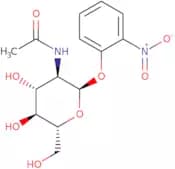
CAS:<p>2-Nitrophenyl 2-acetamido-2-deoxy-alpha-D-glucopyranoside is a chromogenic substrate used to assay the activity of enzymes that cleave N-acetyl-alpha-D-glucosaminide, such as chitinases and lysozymes. Upon cleavage by the enzyme of interest, the substrate releases a yellow-colored 2-nitrophenol that can be measured spectrophotometrically. This substrate is widely used in the food industry to monitor the activity of lysozyme in cheese, as well as in biomedical research for studying cellular and molecular mechanisms involved in conditions such as inflammation and cancer.</p>Reinheit:Min. 95%Farbe und Form:PowderMolekulargewicht:342.3 g/mol4-Nitrophenyl 2-acetamido-6-O-(2-acetamido-2-deoxy-b-D-glucopyranosyl)-3-O-(b-D-galactopyranosyl)-2-deoxy-a-D-galactopyranoside
CAS:<p>4-Nitrophenyl 2-acetamido-6-O-(2-acetamido-2-deoxy-b-D-glucopyranosyl)-3-O-(b-D-galactopyranosyl)-2-deoxy-a-D-galactopyranoside is a specific chromogenic substrate designed for the highly sensitive and accurate detection of glycosidase enzyme activity. Glycosidases are responsible for the cleavage of glycosidic bonds between saccharide units in various carbohydrates. The hydrolysis of this substrate by glycosidase enzymes produces 4-nitrophenol, a yellow-colored compound that can be easily monitored through spectrophotometric measurements due to its strong absorbance at 405 nm. This chromogenic substrate is widely used in the analysis of glycosidase activity in various biological samples, including bacterial, fungal, and plant tissues, as well as in environmental samples and biotechnological applications.</p>Formel:C28H41N3O18Reinheit:Min. 95 Area-%Farbe und Form:White PowderMolekulargewicht:707.63 g/mol2-Nitrophenyl a-D-galactopyranoside
CAS:<p>2-Nitrophenyl alpha-D-galactopyranoside is a chromogenic substrate used to detect the enzymatic activity of alpha-galactosidase. After cleavage, the nitrophenyl moiety is released exhibiting a light yellowish color. 2-Nitrophenyl alpha-D-galactopyranoside is used in Fabry disease screening.</p>Formel:C12H15NO8Reinheit:Min. 95%Farbe und Form:White Off-White PowderMolekulargewicht:301.25 g/mol4-Nitrophenyl α-D-glucuronide
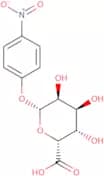
CAS:<p>4-Nitrophenyl alpha-D-glucuronide is a chromogenic substrate widely used for detecting and quantifying the activity of alpha glucuronidase enzyme. Upon cleavage by the enzyme, it releases the yellow-colored 4-nitrophenol, whose absorbance can be monitored spectrophotometrically. This substrate is routinely employed in biochemistry and molecular biology applications, such as enzyme assays, enzyme kinetics studies, and characterization of recombinant enzymes. As a non-toxic and easy-to-use reagent, 4-Nitrophenyl alpha-D-glucuronide provides a convenient and sensitive method for studying alpha-glucuronidase activity in various biological samples, including cell extracts, tissue homogenates, and purified enzyme preparations.</p>Formel:C12H13NO9Reinheit:Min. 97 Area-%Farbe und Form:Off-White PowderMolekulargewicht:315.23 g/mol2-Chloro-4-nitrophenyl phosphate
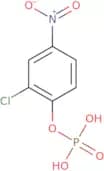
CAS:2-Chloro-4-nitrophenyl phosphate is a chromogenic substrate for phosphatases. Afer cleavage of the substrate, 2-chloro-4-nitrophenol is released, which can be quantified at 405 nm. 2-Chloro-4-nitrophenyl phosphate is used in clinical diagnostics to for prostate cancer, diagnosis of liver and bone diseases.Formel:C6H5ClNO6PReinheit:Min. 95 Area-%Molekulargewicht:253.53 g/mol5-Bromo-4-chloro-3-indoxyl-N-acetyl-beta-D-galactosaminide
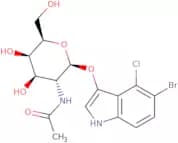
CAS:<p>5-Bromo-4-Chloro-3-Indoxyl-N-Acetyl-Beta-D-Galactosaminide is a chromogenic substrate for detecting beta-galactosidase and GalNAc-transferase enzymes. Upon hydrolysis by the enzyme, it produces a blue-green colored compound that can be detected visually or measured spectrophotometrically. This substrate is useful in characterizing the activity of Beta-Galactosidase and GalNAc-transferase enzymes involved in glycobiology research and diagnostic applications.</p>Formel:C16H18BrClN2O6Reinheit:Min. 98 Area-%Farbe und Form:Crystalline PowderMolekulargewicht:449.68 g/mol