AC-10780 - n-butylamine-99 | 109-73-9
Es wurde leider kein Produkt mit der Referenz AC-10780 gefunden, aber bitte schauen Sie sich die folgenden ähnlichen Produkte an:
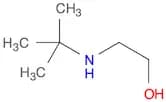
2-(tert-butylamino)ethanol
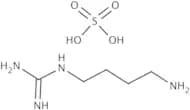
CAS:Formel:C6H15NOReinheit:98%Farbe und Form:SolidMolekulargewicht:117.1894Agmatine Sulfate
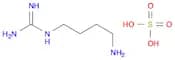
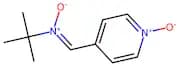
CAS:Formel:C5H14N4·H2SO4Reinheit:>95.0%(T)(HPLC)Farbe und Form:White to Almost white powder to crystalMolekulargewicht:228.27N-tert-Butyl-α-(4-pyridyl-1-oxide)nitrone
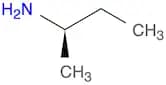
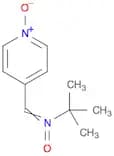
CAS:Formel:C10H14N2O2Reinheit:>98.0%(T)(HPLC)Farbe und Form:White to Light yellow powder to crystalMolekulargewicht:194.23(R)-(-)-sec-Butylamine
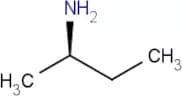
CAS:Formel:C4H11NReinheit:>98.0%(GC)(T)Farbe und Form:Colorless to Almost colorless clear liquidMolekulargewicht:73.14Di-sec-butylamine
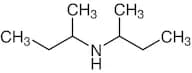
CAS:Formel:C8H19NReinheit:>99.0%(GC)Farbe und Form:Colorless to Almost colorless clear liquidMolekulargewicht:129.25Agmatine sulfate, 97%
CAS:<p>Agmatine is an intermediate in the biosynthesis of the polyamines putrescine and spermine. Agmatine binds with high affinity to 2-adrenergic receptors and imidazoline binding sites and produces blockade of the NMDA-receptor associated cation channels. Agmatine is a competitive inhibitor of nitric o</p>Formel:C5H16N4O4SReinheit:97%Farbe und Form:White, PowderMolekulargewicht:228.27(R)-(-)-2-Aminobutane, 99%
CAS:<p>(R)-(-)-2-Aminobutane is a chiral amine plays an important role in pharmaceutical chemistry and in organic synthesis as chiral auxiliary, which is used to determine the enantiomeric excess (ee). This Thermo Scientific Chemicals brand product was originally part of the Alfa Aesar product portfolio.</p>Formel:C4H11NReinheit:99%Farbe und Form:Liquid, Clear colorlessMolekulargewicht:73.14Agmatine · sulfate
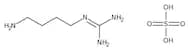
CAS:Agmatine is the decarboxylation product formed during the metabolization of arginine. As a clonidine-displacing substance, it binds to α₂-adrenergic and imidazoline receptors and stimulates the release of catecholamines from adrenal chromaffin cells. Agmatine inhibits cell proliferation and improves renal function in anti-Thy-1glomerulonephritis. It acts as an inhibitor of nitric oxide synthase (Auguet et al., Demady et al.). Gong et al. showed that agmatine exerts a significant anxiolytic effect in rats and mice. CAS Number (net): 306-60-5.Formel:C5H14N4·H2SO4Reinheit:> 99%Farbe und Form:White PowderMolekulargewicht:228.271-(4-aminobutyl)guanidine; sulfuric acid
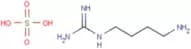
CAS:Formel:C5H16N4O4SReinheit:90%Farbe und Form:SolidMolekulargewicht:228.2699Agmatine sulphate
CAS:Agmatine sulphateFormel:C5H14N4·H2SO4Farbe und Form: white solidMolekulargewicht:228.27g/molN-Tert-Butyl-α-(4-Pyridyl-1-Oxide)Nitrone
CAS:N-Tert-Butyl-α-(4-Pyridyl-1-Oxide)NitroneReinheit:>98.0%Molekulargewicht:194.23g/molDi-sec-butylamine
CAS:Di-sec-butylamineFormel:C8H19NReinheit:99%Farbe und Form: clear. colourless liquidMolekulargewicht:129.24g/mol(1R)-(-)-1-Methylpropylamine
CAS:(1R)-(-)-1-MethylpropylamineFormel:C4H11NReinheit:≥95%Farbe und Form: clear. colourless liquidMolekulargewicht:73.13683g/molAgmatine sulfate
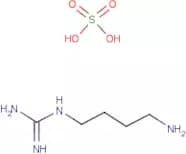
CAS:Formel:C5H14N4H2SO4Reinheit:≥ 98.0%Farbe und Form:White to off-white crystalline powderMolekulargewicht:228.27Agmatine sulfate
CAS:Agmatine sulfate (Agmatine sulfate salt) is a bioactive metabolite of the arginine amino acid.Formel:C5H16N4O4SReinheit:99.86% - 99.90%Farbe und Form:White To Off-White PowderMolekulargewicht:228.27Agmatine Sulfate
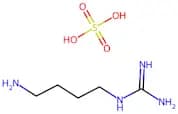
CAS:<p>Applications General Uses: Neuroprotective, CNS studies, Autism and depression researchDescription:Agmatine Sulfate is a polyamine derived from L-arginine (A769500) decarboxylation and is a known putative endogenous neurotransmitter at imidazoline receptors. Agmatine sulfate displaces clonidine at α2-adrenergic and at imidazoline receptors and was recently shown to exert some neuroprotective effects. It blocks NMDA-receptor associated cation channels. Acts as a competitive inhibitor of nitric oxide synthase (NOS). It functions as neurotransmitter since it is stored in synaptic vesicles and is related from axon terminals by depolarization(1). Protects autistic behavior in rats (2) and reverses depressive like behavior in mice. (3)<br>References Reis DJ, et al. 2000; Trends Pharmacol Sci. 2000 May;21(5):187-93 Kim JW, et al. 2016 Neuropharmacology. Sep 14;113(Pt A):71-81Neis VB, et al. 2016 Pharmacol Biochem Behav. Oct 12;150-151:108-114<br></p>Formel:C5H14N4·H2O4SFarbe und Form:NeatMolekulargewicht:228.27