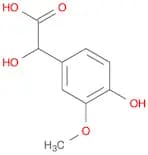
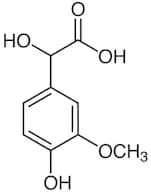
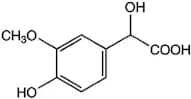
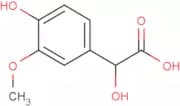
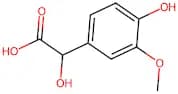
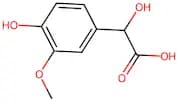
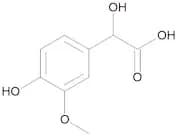
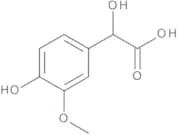
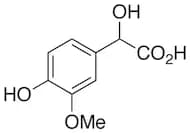
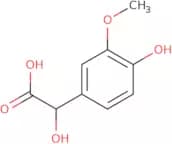
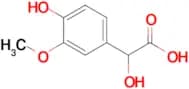
AC-16490 - 4-hydroxy-3-methoxymandelic-acid-99 | 55-10-7
DL-4-Hydroxy-3-methoxymandelic acid
CAS:Formel:C9H10O5Reinheit:97%Farbe und Form:SolidMolekulargewicht:198.1727DL-4-Hydroxy-3-methoxymandelic Acid
CAS:Formel:C9H10O5Reinheit:>98.0%(T)(HPLC)Farbe und Form:White to Gray to Red powder to crystalMolekulargewicht:198.174-Hydroxy-3-methoxy-DL-mandelic acid, 98%
CAS:This Thermo Scientific Chemicals brand product was originally part of the Alfa Aesar product portfolio. Some documentation and label information may refer to the legacy brand. The original Alfa Aesar product / item code or SKU reference has not changed as a part of the brand transition to Thermo Sci
Formel:C9H9O5Reinheit:98%Farbe und Form:Powder, Pale brown to brown to pale grayMolekulargewicht:197.17Vanillylmandelic acid
CAS:Vanillylmandelic acid, from catecholamine breakdown, helps diagnose pheochromocytoma; high levels link to depression.Formel:C9H10O5Reinheit:97.13%Farbe und Form:SolidMolekulargewicht:198.172-Hydroxy-2-(4-Hydroxy-3-Methoxyphenyl)Acetic Acid
CAS:2-Hydroxy-2-(4-Hydroxy-3-Methoxyphenyl)Acetic AcidReinheit:99%Molekulargewicht:198.17g/molVanillylmandelic acid
CAS:Kontrolliertes ProduktFormel:C9H10O5Farbe und Form:NeatMolekulargewicht:198.174-Hydroxy-3-methoxymandelic Acid
CAS:Kontrolliertes ProduktFormel:C9H10O5Farbe und Form:NeatMolekulargewicht:198.174-Hydroxy-3-methoxymandelic Acid
CAS:Kontrolliertes ProduktApplications A metabolite of catecholamines.
References Canfell, P., et al.: Clin. Chem., 32, 222 (1986), Nunez, C., et al.: Eur. J .Clin. Chem. Clin. Biochem., 32, 461 (1994), Weise, M., et al.: J. Clin. Endocrinol. Metab., 87, 1955 (2002),Formel:C9H10O5Farbe und Form:Off-WhiteMolekulargewicht:198.17DL-4-Hydroxy-3-methoxymandelic acid
CAS:DL-4-Hydroxy-3-methoxymandelic acid is a metabolite of the catecholamines, norepinephrine and epinephrine. It is found in the blood, urine and cerebrospinal fluid of humans. DL-4-Hydroxy-3-methoxymandelic acid is derived from the amino acid tyrosine. When the body's production of catecholamines exceeds its ability to break them down, these molecules accumulate and are excreted in urine as DL-4-hydroxy-3-methoxymandelic acid or as other metabolites. The concentration of DL-4-hydroxy 3 methoxymandelic acid in urine may be used to diagnose pheochromocytoma or neuroblastoma.
Formel:C9H10O5Reinheit:Min. 95%Farbe und Form:White PowderMolekulargewicht:198.17 g/mol2-Hydroxy-2-(4-hydroxy-3-methoxyphenyl)acetic acid
CAS:Formel:C9H10O5Reinheit:97%Farbe und Form:No data available.Molekulargewicht:198.174