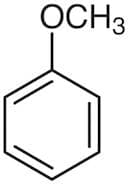
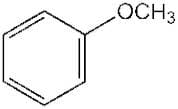
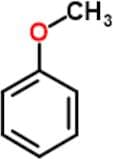
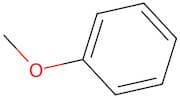
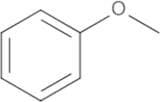
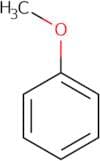
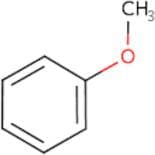
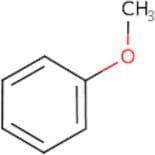
CAS 100-66-3
:Anisol
- Anisol
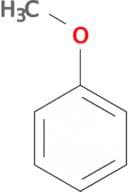
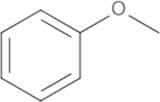
- Anisol (Methoxybenzene)
- Benzene, methoxy-
- Hichemix MB
- Methoxybenzene
- Methyl phenyl ether
- Nsc 7920
- Phenol methyl ether
- Phenoxymethane
- Phenyl methyl ether
- Phenylmethylether:
- m-Anisole
- Ver más sinónimos
Anisole, 99%
CAS:Anisole is widely used as a solvent for the synthesis of various organic compounds, anethole, nonylphenol isomer 4-(3',6'-dimethyl-3-heptyl)phenol, perfumes, insect pheromones and pharmaceuticals. It finds application in the preparation of inorganic complexes and materials such as tin-core/tin oxide
Fórmula:C7H8OPureza:99%Forma y color:Clear colorless, LiquidPeso molecular:108.14Anisole
CAS:Aromatic ethers and their halogenated, sulfonated, nitrated or nitrosated derivativesFórmula:C7H8OForma y color:Colorless LiquidPeso molecular:108.05751Canada Residual Solvents Mixture 1046 5000 µg/mL in Triacetin
CAS:Producto controlado- 100-66-3
- 108-21-4
- 109-60-4
- 109-66-0
- 109-94-4
- 110-19-0
- 121-44-8
- 123-51-3
- 123-86-4
- 141-78-6
- 142-82-5
- 1634-04-4
- 60-29-7
- 64-17-5
- 64-18-6
- 64-19-7
- 67-63-0
- 67-64-1
- 67-68-5
- 71-23-8
- 71-36-3
- 71-41-0
- 78-83-1
- 78-92-2
- 78-93-3
- 79-20-9
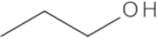
Fórmula:C3H8OForma y color:MixturePeso molecular:60.10Anisole
CAS:M03556 - Anisole
Fórmula:C7H8OPureza:>99%Forma y color:Liquid, Clear LiquidPeso molecular:108.14Anisole, GlenDry™, anhydrous
CAS:Fórmula:C7H8OPureza:≥ 99.7%Forma y color:Clear, colourless liquidPeso molecular:108.14Anisole
CAS:Producto controladoApplications Anisole is used in perfumery.
Not a dangerous good if item is equal to or less than 1g/ml and there is less than 100g/ml in the package
References Taylor, J.M., et al.: Toxicol. Appl. Pharmacol., 6, 378 (1964),Fórmula:C7H8OForma y color:NeatPeso molecular:108.14Anisole
CAS:Anisole is a redox potential chemical that is used as an antioxidant and as a co-solvent. It has been shown to inhibit the activity of enzymes such as sodium salts, transport properties, absorption enhancer, and toll-like receptor. Anisole also has been shown to have a reaction with a diazonium salt and trifluoroacetic acid, which can lead to the formation of aniline. The reaction mechanism is not fully understood but it may be due to its ability to absorb kinetic energy from other molecules.
Fórmula:C7H8OPureza:Min. 95%Forma y color:Clear LiquidPeso molecular:108.14 g/molAnisole extrapure, 99%
CAS:Fórmula:C7H8OPureza:min. 99%Forma y color:Clear, Colourless, LiquidPeso molecular:108.14Anisole extrapure AR, 99.5%
CAS:Fórmula:C7H8OPureza:min. 99.5%Forma y color:Clear, Colourless, Liquid, max. 10Peso molecular:108.14