CAS 1004-37-1
:2,6-Dimetil-4H-piran-4-tiona
Descripción:
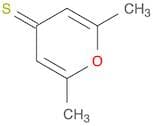
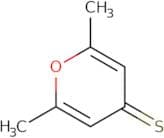
2,6-Dimetil-4H-piran-4-tiona, con el número CAS 1004-37-1, es un compuesto orgánico caracterizado por su estructura única que incluye un anillo de pirano con dos grupos metilo en las posiciones 2 y 6 y un grupo tiona en la posición 4. Este compuesto típicamente exhibe un color amarillo a marrón y es conocido por su olor distintivo. Es soluble en disolventes orgánicos, lo que lo hace útil en diversas aplicaciones químicas. La presencia del grupo tiona confiere una reactividad específica, permitiéndole participar en varias reacciones químicas, incluidas adiciones nucleofílicas y cicloadiciones. Además, 2,6-Dimetil-4H-piran-4-tiona puede exhibir actividad biológica, lo que lo hace de interés en química medicinal y agroquímicos. Su estabilidad y reactividad pueden verse influenciadas por factores ambientales como la temperatura y el pH. En general, este compuesto sirve como un bloque de construcción valioso en la síntesis orgánica y puede tener aplicaciones potenciales en farmacéuticos y ciencia de materiales.
Fórmula:C7H8OS
InChI:InChI=1S/C7H8OS/c1-5-3-7(9)4-6(2)8-5/h3-4H,1-2H3
Clave InChI:InChIKey=RZGQBLWMLLDDKL-UHFFFAOYSA-N
SMILES:S=C1C=C(C)OC(C)=C1
Sinónimos:- 2,6-Dimethyl-4-thiopyrone
- 2,6-Dimethylpyran-4-thione
- 4H-Pyran-4-thione, 2,6-dimethyl-
- Brn 0107420
- Nsc 75204
- 2,6-Dimethyl-4H-pyran-4-thione
- 5-17-09-00412 (Beilstein Handbook Reference)
Ordenar por
Pureza (%)
0
100
|
0
|
50
|
90
|
95
|
100
Encontrado 2 productos.
2,6-Dimethyl-4H-pyran-4-thione
CAS:2,6-Dimethyl-4H-pyran-4-thione is a ligand that binds to metal ions and forms coordination complexes. It has been shown to be an effective catalyst for the oxidation of alcohols and amines with molecular oxygen. 2,6-Dimethyl-4H-pyran-4-thione can also be used in the synthesis of organic compounds by reacting with halides. The optical and vibrational spectra are linear at low temperatures and exponentially increase at higher temperatures. This compound can be crystallized by XRD or fluorescence methods, depending on the desired outcome. Solvents such as acetone, NMP, DMSO, THF, water, and chloroform have been shown to affect the crystal structure of this compound in varying degrees.
Fórmula:C7H8OSPureza:Min. 95%Peso molecular:140.2 g/mol