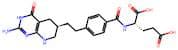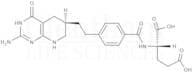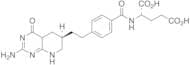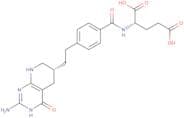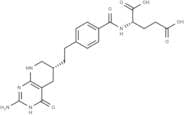
CAS 106400-81-1
:Lometrexol
Descripción:
Lometrexol es un compuesto químico clasificado como un antifolato, conocido principalmente por su papel en el tratamiento del cáncer, particularmente en el contexto de la leucemia y otras malignidades. Funciona inhibiendo la dihidrofolato reductasa (DHFR), una enzima crítica para la síntesis de ADN y la proliferación celular, impidiendo así el crecimiento de células cancerosas que se dividen rápidamente. Lometrexol se caracteriza por su similitud estructural con el folato, lo que le permite competir eficazmente con sustratos naturales por unirse a DHFR. Este compuesto se administra típicamente en un entorno clínico y se ha estudiado por su potencial en terapias combinadas para mejorar la eficacia de otros agentes anticancerígenos. Su farmacocinética, que incluye absorción, distribución, metabolismo y excreción, es esencial para determinar regímenes de dosificación apropiados. Además, al igual que muchos agentes quimioterapéuticos, Lometrexol puede presentar efectos secundarios, lo que requiere un monitoreo cuidadoso de los pacientes durante el tratamiento. En general, Lometrexol representa un avance significativo en la terapia dirigida contra el cáncer, contribuyendo al campo más amplio de la farmacología oncológica.
Fórmula:C21H25N5O6
InChI:InChI=1/C21H25N5O6/c22-21-25-17-14(19(30)26-21)9-12(10-23-17)2-1-11-3-5-13(6-4-11)18(29)24-15(20(31)32)7-8-16(27)28/h3-6,12,15H,1-2,7-10H2,(H,24,29)(H,27,28)(H,31,32)(H4,22,23,25,26,30)/t12-,15+/m1/s1
Sinónimos:- Lometrexolum
- Lometrexolum [INN-Latin]
- Unii-6P3Avy8A7Q
- L-Glutamic acid, N-(4-(2-((6R)-2-amino-1,4,5,6,7,8-hexahydro-4-oxopyrido(2,3-d)pyrimidin-6-yl)ethyl)benzoyl)-
- L-Glutamic acid, N-(4-(2-(2-amino-1,4,5,6,7,8-hexahydro-4-oxopyrido(2,3-d)pyrimidin-6-yl)ethyl)benzoyl)-, (R)-
- N-(4-{2-[(6R)-2-amino-4-oxo-1,4,5,6,7,8-hexahydropyrido[2,3-d]pyrimidin-6-yl]ethyl}benzoyl)-L-glutamic acid
Ordenar por
Pureza (%)
0
100
|
0
|
50
|
90
|
95
|
100
Encontrado 5 productos.
Lometrexol Hydrate
CAS:Producto controladoApplications It is an antifolate which inhibits glycinamide ribonucleotide formyltransferase (GARFT), an enzyme essential for de novo purine synthesis. Lometrexol has activity against tumors which are refractory to other drugs, notably Methotrexate.
Not a dangerous good if item is equal to or less than 1g/ml and there is less than 100g/ml in the package
References Gibbs, D., et al.: Cancer Res., 65, 11721 (2005), Gangjee, A., et al.: J. Med. Chem., 48, 5329 (2005), Hilgenbrink, A., et al.: J. Pharm. Sci., 94, 2135 (2005),Fórmula:C21H25N5O6·xH2OForma y color:NeatPeso molecular:443.45 + x(18.02)Lometrexol Hydrate
CAS:Lometrexol is an anti-cancer drug that belongs to the class of polymerase chain inhibitors. It inhibits the proliferation of cancer cells by binding to intracellular targets and interfering with DNA synthesis. Lometrexol is used to treat bowel disease, such as ulcerative colitis and Crohn's disease, which are caused by inflammation in the colon. Lometrexol has also been shown to have anti-inflammatory properties. The compound has been shown to inhibit transfer reactions in vitro, and low potency against infectious diseases. Lometrexol Hydrate is a prodrug that is hydrolyzed in vivo to lometrexol.Fórmula:C21H25N5O6·xH2OPureza:Min. 95%Peso molecular:443.45 g/molLometrexol
CAS:Lometrexol (LY 264618) is an antifolate that inhibits GARFT, blocks purine synthesis, induces apoptosis, and has anticancer properties.
Fórmula:C21H25N5O6Pureza:97.76% - 99.56%Forma y color:SolidPeso molecular:443.45