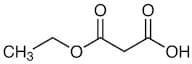
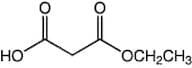
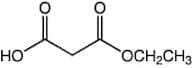
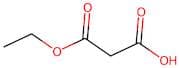
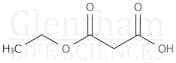
CAS 1071-46-1
:Malonato de monoetilo
Descripción:
Malonato de monoetilo, con el número CAS 1071-46-1, es un compuesto orgánico que pertenece a la clase de los ésteres del ácido malónico. Se caracteriza por su forma líquida incolora a amarillo pálido y tiene un olor afrutado. El compuesto presenta dos grupos etilo unidos a un esqueleto de malonato, lo que contribuye a su reactividad y utilidad en la síntesis orgánica. Malonato de monoetilo es conocido por su capacidad para someterse a diversas reacciones químicas, incluyendo la esterificación y la condensación, lo que lo convierte en un intermediario valioso en la síntesis de productos farmacéuticos, agroquímicos y otros compuestos orgánicos. Es soluble en disolventes orgánicos como el etanol y el éter, pero tiene una solubilidad limitada en agua. El compuesto también es reconocido por su papel en la síntesis de ésteres malónicos, un método utilizado para producir ácidos acéticos sustituidos y otros derivados. Se deben tomar precauciones de seguridad al manipular Malonato de monoetilo, ya que puede causar irritación en la piel y los ojos, y se deben observar las condiciones de almacenamiento adecuadas para mantener su estabilidad.
Fórmula:C5H8O4
InChI:InChI=1/C5H8O4/c1-2-9-5(8)3-4(6)7/h2-3H2,1H3,(H,6,7)
Clave InChI:InChIKey=HGINADPHJQTSKN-UHFFFAOYSA-N
SMILES:C(C(OCC)=O)C(O)=O
Sinónimos:- (Ethoxycarbonyl)acetic acid
- 3-Ethoxy-3-oxopropanoic acid
- Ethyl Hydrogen Malonate
- Ethyl malonate
- Ethylhydrogenmalonat
- Hidrogenomalonato De Etilo
- Hydrogenomalonate D'Ethyle
- Malonic acid, ethyl ester
- Malonic acid, monoethyl ester
- Monoethyl hydrogen malonate
- Monoethyl malonate
- Monoethyl propanedioate
- Propanedioic acid, 1-ethyl ester
- Propanedioic acid, monoethyl ester
- Malonic Acid Monomethyl Ester
- mono-Ethyl malonate
- Monoethyl malonic acid
- Malonic acid 1-ethyl
- Malonic acid 1-ethyl ester
- Malonic acid hydrogen 1-ethyl ester
- 3-ethoxy-3-oxo-propanoic acid
- Ethoxycarbonylacetic acid
- 3-ethoxy-3-oxapropanoic acid
- Ver más sinónimos
Ordenar por
Pureza (%)
0
100
|
0
|
50
|
90
|
95
|
100
Encontrado 9 productos.
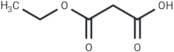
Monoethyl Malonate
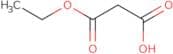
CAS:Fórmula:C5H8O4Pureza:>98.0%(T)Forma y color:Colorless to Light orange to Yellow clear liquidPeso molecular:132.12Ethyl hydrogen malonate, 96%
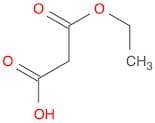
CAS:Ethyl hydrogen malonate is used as a reactant for the preparation of tetramic acids through Dieckmann ring closure and organocatalytic decarboxylative Doebner-Knoevenagel reactions. It is involved in the acylation reactions and Knoevenagel condensation with aldehydes. It is also used in the preparatFórmula:C5H8O4Pureza:96%Forma y color:Clear colorless to pale yellow, LiquidPeso molecular:132.12Ethyl hydrogen malonate, 90+%
CAS:Ethyl hydrogen malonate is used as a reactant for the preparation of tetramic acids through Dieckmann ring closure and organocatalytic decarboxylative Doebner-Knoevenagel reactions. It is involved in the acylation reactions and Knoevenagel condensation with aldehydes. It is also used in the preparatFórmula:C5H8O4Pureza:90+%Peso molecular:132.12Ethyl hydrogen malonate
CAS:Ethyl hydrogen malonateFórmula:C5H8O4Pureza:≥95%Forma y color: clear. faint yellow liquidPeso molecular:132.11g/molEthyl malonate
CAS:Fórmula:C5H8O4Pureza:≥ 98.0%Forma y color:Colourless to yellow liquidPeso molecular:132.113-Ethoxy-3-oxopropanoic acid
CAS:3-Ethoxy-3-oxopropanoic acid (Monoethyl malonic acid) belongs to the class of organic compounds known as dicarboxylic acids and derivatives.Fórmula:C5H8O4Pureza:99.72%Forma y color:SolidPeso molecular:132.11Ethyl hydrogen malonate
CAS:Ethyl hydrogen malonate (EHMB) is a pharmaceutical agent that is used as a catalyst in the production of pharmaceutical preparations. The magnesium salt of EHMB reacts with an inorganic acid to form diazonium salt, which reacts with amines to form methyl ketones. The methyl ketones are then reacted with malonic acid to form the corresponding deuterium isotope. The deuterium isotope can be used as a radioactive tracer for diagnostic imaging or therapy. EHMB also has anti-inflammatory activities and antimicrobial properties, which may be due to its ability to inhibit prostaglandin synthesis and bacterial growth, respectively.Fórmula:C5H8O4Pureza:Min. 95%Forma y color:PowderPeso molecular:132.11 g/mol