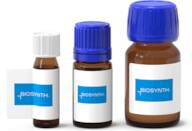
CAS 107444-51-9
:péptido similar al glucagón I fragmento 7-36*amida humano
Descripción:
El fragmento 7-36 amida del péptido similar al glucagón-1 (GLP-1) es una hormona péptida que desempeña un papel crucial en el metabolismo de la glucosa y la regulación del apetito. Se deriva del gen proglucagón y es secretado principalmente por las células L intestinales en respuesta a la ingesta de alimentos. Este péptido consta de 30 aminoácidos y es conocido por su capacidad para estimular la secreción de insulina de manera dependiente de la glucosa, ayudando así a reducir los niveles de azúcar en sangre. Además, el fragmento 7-36 amida de GLP-1 inhibe la liberación de glucagón, ralentiza el vaciamiento gástrico y promueve la saciedad, lo que lo convierte en un objetivo para el tratamiento de la diabetes y el manejo de la obesidad. La forma amida indica que el C-terminal del péptido está amidado, lo cual es importante para su actividad biológica y estabilidad. Debido a sus efectos fisiológicos, el GLP-1 y sus análogos se utilizan en aplicaciones terapéuticas, particularmente en el manejo de la diabetes mellitus tipo 2. El número CAS 107444-51-9 identifica de manera única este péptido específico en bases de datos químicas, facilitando la investigación y el desarrollo en farmacología y bioquímica.
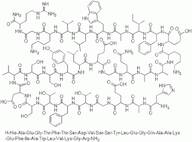
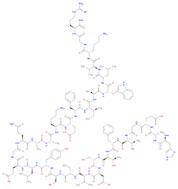
Fórmula:C149H226N40O45
InChI:InChI=1S/C149H226N40O45/c1-17-76(10)119(146(232)167-80(14)126(212)175-104(60-86-63-159-91-36-25-24-35-89(86)91)136(222)177-100(56-73(4)5)137(223)186-117(74(6)7)144(230)174-93(37-26-28-52-150)128(214)160-65-110(197)168-92(122(154)208)39-30-54-158-149(155)156)188-138(224)102(57-83-31-20-18-21-32-83)178-133(219)98(47-51-115(204)205)173-132(218)94(38-27-29-53-151)170-124(210)78(12)164-123(209)77(11)166-131(217)97(44-48-109(153)196)169-111(198)66-161-130(216)96(46-50-114(202)203)172-134(220)99(55-72(2)3)176-135(221)101(59-85-40-42-88(195)43-41-85)179-141(227)106(68-190)182-143(229)108(70-192)183-145(231)118(75(8)9)187-140(226)105(62-116(206)207)180-142(228)107(69-191)184-148(234)121(82(16)194)189-139(225)103(58-84-33-22-19-23-34-84)181-147(233)120(81(15)193)185-112(199)67-162-129(215)95(45-49-113(200)201)171-125(211)79(13)165-127(213)90(152)61-87-64-157-71-163-87/h18-25,31-36,40-43,63-64,71-82,90,92-108,117-121,159,190-195H,17,26-30,37-39,44-62,65-70,150-152H2,1-16H3,(H2,153,196)(H2,154,208)(H,157,163)(H,160,214)(H,161,216)(H,162,215)(H,164,209)(H,165,213)(H,166,217)(H,167,232)(H,168,197)(H,169,198)(H,170,210)(H,171,211)(H,172,220)(H,173,218)(H,174,230)(H,175,212)(H,176,221)(H,177,222)(H,178,219)(H,179,227)(H,180,228)(H,181,233)(H,182,229)(H,183,231)(H,184,234)(H,185,199)(H,186,223)(H,187,226)(H,188,224)(H,189,225)(H,200,201)(H,202,203)(H,204,205)(H,206,207)(H4,155,156,158)/t76-,77-,78-,79-,80-,81+,82+,90-,92-,93-,94-,95-,96-,97-,98-,99-,100-,101-,102-,103-,104-,105-,106-,107-,108-,117-,118-,119-,120-,121-/m0/s1
Clave InChI:DTHNMHAUYICORS-KTKZVXAJSA-N
SMILES:CC[C@H](C)[C@@H](C(=O)N[C@@H](C)C(=O)N[C@@H](CC1=CNC2=CC=CC=C21)C(=O)N[C@@H](CC(C)C)C(=O)N[C@@H](C(C)C)C(=O)N[C@@H](CCCCN)C(=O)NCC(=O)N[C@@H](CCCNC(=N)N)C(=O)N)NC(=O)[C@H](CC3=CC=CC=C3)NC(=O)[C@H](CCC(=O)O)NC(=O)[C@H](CCCCN)NC(=O)[C@H](C)NC(=O)[C@H](C)NC(=O)[C@H](CCC(=O)N)NC(=O)CNC(=O)[C@H](CCC(=O)O)NC(=O)[C@H](CC(C)C)NC(=O)[C@H](CC4=CC=C(C=C4)O)NC(=O)[C@H](CO)NC(=O)[C@H](CO)NC(=O)[C@H](C(C)C)NC(=O)[C@H](CC(=O)O)NC(=O)[C@H](CO)NC(=O)[C@H]([C@@H](C)O)NC(=O)[C@H](CC5=CC=CC=C5)NC(=O)[C@H]([C@@H](C)O)NC(=O)CNC(=O)[C@H](CCC(=O)O)NC(=O)[C@H](C)NC(=O)[C@H](CC6=CNC=N6)N
Sinónimos:- Glucagon-Like Peptide 1 (7-36) amide (human)
- H-His-Ala-Glu-Gly-Thr-Phe-Thr-Ser-Asp-Val-Ser-Ser-Tyr-Leu-Glu-Gly-Gln-Ala-Ala-Lys-Glu-Phe-Ile-Ala-Trp-Leu-Val-Lys-Gly-Arg-NH2
- Glp-1(7-36)
- Glucagon-Like Peptide I Fragment 7-36 Amide Human
Filtrar por
Porcentaje de pureza
0
100
|
0
|
50
|
90
|
95
|
100
Se han encontrado 8 productos.
- Precio más bajo
- Precio más alto
- Pureza más baja
- Pureza más alta
- Entrega estimada más rápida
Glucagon-Like Peptide-1 (7-36) amide, human
CAS:For cellular and molecular biology applicationsFórmula:C149H226N40O45Forma y color:Lyophilized Powder, WhitePeso molecular:3297.7GLP-1 (7-36) amide (human, bovine, guinea pig, mouse, rat)
CAS:GLP-1 (7-36) amide is secreted from the lower small intestine and shows a strong insulinotropic effect. GLP-1 (7-36) amide is considered as the most important incretin hormone. Its action is mediated by receptors expressed by the endocrine pancreatic B-cells. Considerable interest has focused on the development of this peptide as a therapeutic strategy for non-insulin-dependent (type 2 ) diabetes mellitus and associated neuropathy.Fórmula:C149H226N40O45Pureza:> 96%Forma y color:WhitePeso molecular:3297.68GLP-1(7-36)
CAS:Fórmula:C149H226N40O45Pureza:95%~99%Forma y color:White to Off-white PowderPeso molecular:3297.63GLP-1(7-36), amide
CAS:GLP-1 secretion by human enteroendocrine NCI-H716 cells is augmented in a dose-dependent manner by the addition of CPE.Cost-effective and quality-assured.Fórmula:C149H226N40O45Pureza:99.85%Forma y color:SolidPeso molecular:3297.63GLP-1 (7-36) amide
CAS:This is an incretin hormone that causes glucose dependent release of insulin by pancreatic beta cells. It is the cleavage product of GLP-1 (1-36) amide peptide. This peptide, human GLP-1 (7–36), shares the same sequence with preproglucagon (78-107), amide, human.
Fórmula:C149H226N40O45Forma y color:PowderPeso molecular:3,297.63 g/molGlucagon-like Peptide 1 (Human, 7-36 Amide)
CAS:Glucagon-like peptide 1 (GLP-1) is a peptide hormone that belongs to the glucagon family. It is a 36 amino acid polypeptide and is naturally synthesized in the ileum of humans, pigs, and cows. GLP-1 is an activator of ion channels, which are protein structures that regulate the flow of ions across cell membranes. This hormone also has been shown to inhibit the activity of protein interactions at the cell membrane or ligand binding to receptors.Fórmula:C149H226N40O45Pureza:Min. 95%Peso molecular:3,297.6 g/molGlucagon-Like Peptide I (7-36), amide, human
CAS:Custom research peptide; min purity 95%.Fórmula:C149H229N40O45Pureza:Min. 95%Peso molecular:3,297.7 g/mol