CAS 1081110-72-6
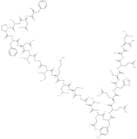
:H-FEN-ASN-ALA-PRO-FEN-ASP-VAL-GLI-ILE-LIS-LEU-SER-GLI-VAL-GLN-TIR-GLN-GLN-HIS-SER-GLN-ALA-LEU-NH2
Descripción:
La sustancia química con el nombre "H-FEN-ASN-ALA-PRO-FEN-ASP-VAL-GLI-ILE-LIS-LEU-SER-GLI-VAL-GLN-TIR-GLN-GLN-HIS-SER-GLN-ALA-LEU-NH2" y el número CAS "1081110-72-6" es un péptido sintético compuesto por una secuencia de aminoácidos. Este péptido presenta una variedad de aminoácidos esenciales y no esenciales, que contribuyen a sus propiedades estructurales y funcionales. La presencia de residuos hidrofóbicos como la fenilalanina, la valina y la isoleucina sugiere que el péptido puede exhibir interacciones hidrofóbicas, influyendo en su conformación y estabilidad. Además, la inclusión de residuos polares y cargados como la lisina, el ácido aspártico y la serina indica posibles sitios para enlaces de hidrógeno e interacciones iónicas, que pueden afectar la solubilidad y la actividad biológica. El grupo amida en el extremo C-terminal (NH2) mejora la estabilidad contra la degradación enzimática. Los péptidos como este a menudo se estudian por sus roles en procesos biológicos, aplicaciones terapéuticas potenciales y como modelos para entender el plegamiento y las interacciones de proteínas.
Fórmula:C116H176N32O33
Sinónimos:- PHE-ASN-ALA-PRO-PHE-ASP-VAL-GLY-ILE-LYS-LEU-SER-GLY-VAL-GLN-TYR-GLN-GLN-HIS-SER-GLN-ALA-LEU-NH2
- L-Leucinamide, L-phenylalanyl-L-asparaginyl-L-alanyl-L-prolyl-L-phenylalanyl-L-α-aspartyl-L-valylglycyl-L-isoleucyl-L-lysyl-L-leucyl-L-serylglycyl-L-valyl-L-glutaminyl-L-tyrosyl-L-glutaminyl-L-glutaminyl-L-histidyl-L-seryl-L-glutaminyl-L-alanyl-
- H-PHE-ASN-ALA-PRO-PHE-ASP-VAL-GLY-ILE-LYS-LEU-SER-GLY-VAL-GLN-TYR-GLN-GLN-HIS-SER-GLN-ALA-LEU-NH2
- OBESTATIN (HUMAN)
- H-PHE-ASN-ALA-PRO-PHE-ASP-VAL-GLY-ILE-LYS-LEU-S
- FNAPFDVGIKLSGVQYQQHSQAL-NH2
Ordenar por
Pureza (%)
0
100
|
0
|
50
|
90
|
95
|
100
Encontrado 7 productos.
Obestatin (human)
CAS:Bachem ID: 4050435.
Fórmula:C116H176N32O33Pureza:> 96%Forma y color:White PowderPeso molecular:2546.87Obestatin (human)
CAS:Obestatin (human) is an endogenous ligand for G-protein eurythmic entity 39 formed by shearing of preproghrelin and can be used to study obesity.Fórmula:C116H176N32O33Pureza:99.75%Forma y color:SolidPeso molecular:2546.83Obestatin (human)
CAS:Custom research peptide; min purity 95%. For different specs please use the Peptide Quote ToolFórmula:C116H176N32O33Peso molecular:2,546.87 g/molObestatin (Human)
CAS:Obestatin is a 23 amino acid gastrointestinal peptide, encoded for by the ghrelin gene and is known to reduce food intake through supressing appetite. This peptide has been found to influence the pancreas, cardiovascular system and adipose tissues as well as the gastrointestinal system. One study showed that when high-fat diet fed rats were given chronic administration of obestatin it prevented the development of non-alcoholic fatty liver disease. Consequently Obestatin has the potential to be used in preventing obesity-related diseases.Fórmula:C116H176N32O33Pureza:Min. 95%Peso molecular:2,546.89 g/molObestatin (human) trifluoroacetate salt
CAS:Please enquire for more information about Obestatin (human) trifluoroacetate salt including the price, delivery time and more detailed product information at the technical inquiry form on this pageFórmula:C116H176N32O33Pureza:Min. 95%Peso molecular:2,546.83 g/molObestatin (Human)
CAS:Obestatin is a peptide hormone product available as a 0.1mg vial. It is produced by the same gene that encodes ghrelin another peptide hormone involved in regulating appetite and energy balance. It is believed however that obestatin is in fact a food intake suppressor and may reduce body weight gain in rodents. It also may be a potential ligand for GPR3. However its effects on appetite and energy balance need to be further understood as some studies have suggested that human obestatin may not have significant effects on appetite and energy balance, while others have reported potential roles in regulating glucose metabolism and insulin secretion.
Fórmula:C116H176N32O33Pureza:Min. 95%Peso molecular:2,546.8 g/mol