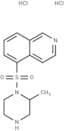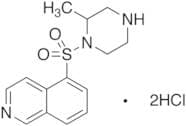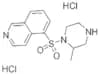
CAS 108930-17-2
:H 7 dihidrocloruro
Descripción:
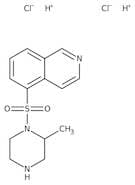
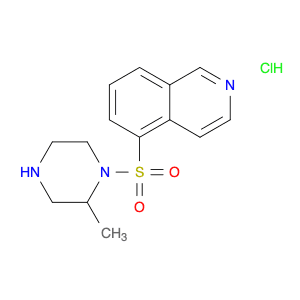
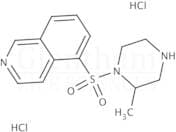
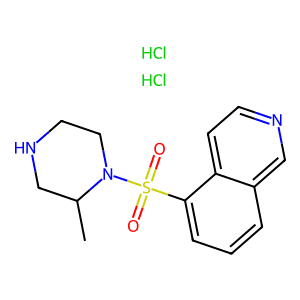
H7 dihidrocloruro, con el número CAS 108930-17-2, es un compuesto químico que típicamente exhibe características asociadas con su estructura molecular y grupos funcionales. Como una sal de dihidrocloruro, es probable que sea un sólido cristalino estable a temperatura ambiente, soluble en agua y otros solventes polares debido a la presencia de iones de cloruro. El compuesto puede exhibir propiedades básicas, ya que se deriva de una base que ha sido protonada por ácido clorhídrico. Sus interacciones moleculares pueden incluir enlaces de hidrógeno, lo que puede influir en su solubilidad y reactividad. H7 dihidrocloruro puede ser utilizado en diversas aplicaciones, incluidas formulaciones farmacéuticas, donde podría servir como un ingrediente activo o un agente estabilizante. Las hojas de datos de seguridad típicamente indicarían precauciones de manejo, como con muchas sustancias químicas, para mitigar los riesgos asociados con la exposición. En general, las características específicas de H7 dihidrocloruro dependerían de su estructura molecular precisa y del contexto de su uso.
Fórmula:C14H17N3O2S·2ClH
InChI:InChI=1S/C14H17N3O2S.2ClH/c1-11-9-16-7-8-17(11)20(18,19)14-4-2-3-12-10-15-6-5-13(12)14;;/h2-6,10-11,16H,7-9H2,1H3;2*1H
Clave InChI:InChIKey=OARGPFMFRLLKPF-UHFFFAOYSA-N
SMILES:S(=O)(=O)(C=1C2=C(C=CC1)C=NC=C2)N3C(C)CNCC3.Cl
Sinónimos:- (+/-)-1-(5-Isoquinolinesulfonyl)-2-Methylpiperazine 2Hcl
- (+/-)-1-(5-Isoquinolinesulfonyl)-2-Methylpiperazine Dihydrochloride
- (+/-)-1-(5-Isoquinolinesulphonyl)-2-Methylpiperazine Dihydrochloride
- (-)-1-(5-Isoquinolinesulfonyl)-2-Methylpiperazine, Di-Hcl Salt
- (3R)-4-(isoquinolin-5-ylsulfonyl)-3-methylpiperazin-1-ium
- (3S)-4-(isoquinolin-5-ylsulfonyl)-3-methylpiperazin-1-ium
- 1-(5-Isoquinolinylsulfonyl)-2-Methyl-Piperazine Dihydrochloride
- 5-[(2-Methylpiperazin-1-Yl)Sulfonyl]Isoquinoline Dihydrochloride
- 5-[(2-Methylpiperazin-1-Yl)Sulfonyl]Isoquinoline Hydrochloride
- H-7
- Isoquinoline, 5-[(2-methyl-1-piperazinyl)sulfonyl]-, hydrochloride (1:2)
- Piperazine, 1-(5-isoquinolinylsulfonyl)-2-methyl-, dihydrochloride
- Ver más sinónimos
Ordenar por
Pureza (%)
0
100
|
0
|
50
|
90
|
95
|
100
Encontrado 8 productos.
H-7 dihydrochloride
CAS:Protein kinase inhibitor. Inhibits cyclic nucleotide dependent protein kinase (PKA) and protein kinase C This Thermo Scientific Chemicals brand product was originally part of the Alfa Aesar product portfolio. Some documentation and label information may refer to the legacy brand. The original Alfa AFórmula:C14H17N3O2S•2HClPeso molecular:364.29Protein kinase inhibitor H-7 2HCl
CAS:Fórmula:C14H19Cl2N3O2SPureza:98%Forma y color:SolidPeso molecular:364.2906Protein kinase inhibitor H-7 dihydrochloride
CAS:Protein kinase inhibitor H-7 dihydrochloridePureza:≥98%Peso molecular:364.29g/molProtein kinase inhibitor H-7 dihydrochloride
CAS:Protein kinase inhibitor H-7 dihydrochloride(H-7 dihydrochloride) is a potent protein kinase C (PKC) inhibitor.Fórmula:C14H19Cl2N3O2SPureza:99.81%Forma y color:White Crystalline SolidPeso molecular:364.291-(5-Isoquinolinesulfonyl)-2-methylpiperazine Dihydrochloride
CAS:Producto controladoApplications A selective inhibitor of protein kinase C or cyclic-nucleotide-dependent protein kinases.
References Hidaka, H. and Kawamoto, S.: Biochem. and Biophys. Res. Comm., 125, 1, 258 (1984)Fórmula:C14H17N3O2S·2ClHForma y color:NeatPeso molecular:364.29H-7 dihydrochloride
CAS:H-7 is a cytostatic agent that inhibits the activation of transcription by inhibiting the synthesis of DNA and RNA. H-7 has shown to be an effective inhibitor of epidermal growth factor and α subunit, which are involved in the proliferation of cancer cells. In addition, H-7 can inhibit calcium ion influx into the cell, which may cause cell death. This drug also has potent inducers effects on primary cells, such as HL-60 cells, and induces apoptosis in carcinoma cell lines. H-7 is not an inhibitor of cyclase activity but enhances it when added with guanine nucleotide binding proteins (G proteins) activators such as forskolin. This leads to increased levels of cyclic AMP. As a result, H-7 inhibits protein synthesis and activates cytosolic calcium channels.Fórmula:C14H17N3O2S·2HClPureza:Min. 95%Peso molecular:364.29 g/mol