CAS 11121-48-5
:Rosa de Bengala
Descripción:
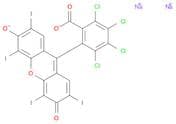
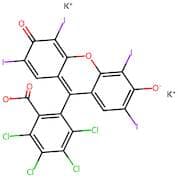
Rosa de Bengala es un colorante sintético que pertenece a la clase de los colorantes xanténicos, caracterizado por su vibrante color rosa a rojo. Se utiliza comúnmente en diversas aplicaciones, incluyendo como un tinte biológico en microscopía, un fotosensibilizador en terapia fotodinámica y como un trazador en estudios ambientales. La estructura química de Rosa de Bengala presenta un derivado dibromado de la fluoresceína, que contribuye a su fuerte absorbancia en el espectro visible. Es soluble en agua y en disolventes orgánicos, lo que lo hace versátil para diferentes condiciones experimentales. Rosa de Bengala exhibe propiedades fototóxicas, que pueden ser aprovechadas en aplicaciones médicas para atacar y destruir células cancerosas al ser activadas por la luz. Además, se ha estudiado por sus propiedades antioxidantes y su posible uso en las industrias alimentaria y cosmética. Sin embargo, las consideraciones de seguridad son importantes, ya que puede causar irritación en la piel y reacciones alérgicas en algunas personas. En general, Rosa de Bengala es un compuesto valioso tanto en la investigación científica como en aplicaciones prácticas, con una variedad de características que lo hacen adecuado para diversos usos.
Fórmula:Unspecified
InChI:InChI=1/C20H4Cl4I4O5/c21-10-8(9(20(31)32)11(22)13(24)12(10)23)7-3-1-5(25)16(29)14(27)18(3)33-19-4(7)2-6(26)17(30)15(19)28/h1-2,29H,(H,31,32)
Sinónimos:- Bengal Rose
- HFinCl<sub>4</sub>I<sub>4</sub>
- Rb 1017
- Rose Bengale
- SODIUM TETRAIODODICHLOROFLUORESCEIN
- C.I. Acid Red 94
- redno.105
- Rose Bengal
- TETRACHLOROTETRAIODOFLUORESCEIN SODIUM SALT
- RB
- rose
- C.I.AcidRed94(45440)
- TETRAIODOTETRACHLOROFLUORESCEIN DISODIUM SALT
- 2,3,4,5-tetrachloro-6-(6-hydroxy-2,4,5,7-tetraiodo-3-oxo-3H-xanthen-9-yl)benzoic acid
- Ver más sinónimos
Ordenar por
Pureza (%)
0
100
|
0
|
50
|
90
|
95
|
100
Encontrado 5 productos.
Rose Bengal
CAS:Rose Bengal is a photosensitizer effective against microbial cells. In the presence of light and oxygen, it inhibits the growth of yeast cells and other microorganisms, sometimes leading to their death. Rose Bengal can also limit bacterial growth, restrict the colony size of filamentous fungi, and suppress the growth of "spreading fungi" such as Rhizopus and Trichoderma.Forma y color:Solid(3-Oxo-6-Oxido-2,4,5,7-Tetraiodo-3H-Xanthen-9-Yl)-3,4,5,6-Tetrachlorobenzoate Sodium Salt
CAS:(3-Oxo-6-Oxido-2,4,5,7-Tetraiodo-3H-Xanthen-9-Yl)-3,4,5,6-Tetrachlorobenzoate Sodium SaltPureza:95%Sodium 2,3,4,5-tetrachloro-6-(2,4,5,7-tetraiodo-6-oxido-3-oxo-3H-xanthen-9-yl)benzoate
CAS:Pureza:98%Peso molecular:1017.63PV-10
CAS:PV-10 is a peptide that activates ion channels. It is an agonist for the nicotinic acetylcholine receptor (nAChR) and a low-affinity antagonist for the N-methyl-D-aspartate receptor (NMDAR). PV-10 binds to specific sites on the nAChR, which causes the channel to open and allow ions to flow into the cell. This leads to depolarization of the membrane, which triggers an action potential in neurons. PV-10 is also able to bind to other proteins such as NR1 subunits of NMDARs and alpha 7 subunits of nAChRs. These interactions inhibit the function of these receptors and prevent them from opening their channels. This prevents calcium influx into cells, blocking neurotransmitter release and preventing the activation of downstream pathways that lead to neuronal death. PV-10 has been shown to be selective for certain types of ion channels over othersFórmula:C20H4Cl4I4O5Pureza:Min. 95%Peso molecular:973.7 g/mol