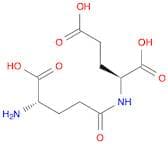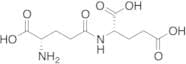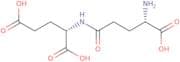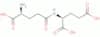
CAS 1116-22-9
:Ácido L-γ-glutamil-L-glutámico
Descripción:
Ácido L-γ-glutamil-L-glutámico, también conocido como un dipeptido, es un compuesto formado por dos residuos de ácido glutámico unidos por un enlace peptídico. Se caracteriza por su estructura, que incluye un grupo funcional ácido carboxílico y un grupo amino, típico de los aminoácidos. Esta sustancia es soluble en agua, reflejando la naturaleza polar de sus grupos funcionales, y exhibe propiedades asociadas con los aminoácidos, como la capacidad de participar en diversas reacciones bioquímicas. Ácido L-γ-glutamil-L-glutámico se estudia a menudo en el contexto de su papel en las vías metabólicas y sus posibles aplicaciones en nutrición y farmacéuticos. También puede exhibir actividad biológica, influyendo en la neurotransmisión y la señalización celular debido a su participación en la síntesis de neurotransmisores. La estabilidad y reactividad del compuesto pueden verse influenciadas por factores como el pH y la temperatura, lo que hace importante considerar estas condiciones en entornos experimentales. En general, Ácido L-γ-glutamil-L-glutámico es una molécula significativa en bioquímica con diversas implicaciones en la salud y la enfermedad.
Fórmula:C10H16N2O7
InChI:InChI=1S/C10H16N2O7/c11-5(9(16)17)1-3-7(13)12-6(10(18)19)2-4-8(14)15/h5-6H,1-4,11H2,(H,12,13)(H,14,15)(H,16,17)(H,18,19)/t5-,6-/m0/s1
Clave InChI:InChIKey=OWQDWQKWSLFFFR-WDSKDSINSA-N
SMILES:[C@H](NC(CC[C@@H](C(O)=O)N)=O)(CCC(O)=O)C(O)=O
Sinónimos:- (2S)-2-{[(4S)-4-ammonio-4-carboxylatobutanoyl]amino}pentanedioate
- <span class="text-smallcaps">L</smallcap>-Glutamic acid, <smallcap>L</span>-γ-glutamyl-
- <span class="text-smallcaps">L</smallcap>-Glutamic acid, N-<smallcap>L</span>-γ-glutamyl-
- <span class="text-smallcaps">L</smallcap>-γ-Glutamyl-<smallcap>L</span>-glutamic acid
- Gamma-Glutamylglutamic Acid
- Glutamic acid, N-<span class="text-smallcaps">L</smallcap>-γ-glutamyl-, <smallcap>L</span>-
- Glutamic acid, N-<span class="text-smallcaps">L</span>-γ-glutamyl-
- H-Gamma-Glu-Glu-Oh
- L-gamma-glutamyl-L-glutamic acid
- N-gamma-L-Glutamyl-L-glutamic acid
- gamma-Glutamylglutamate
- γ-<span class="text-smallcaps">L</smallcap>-Glutamyl-<smallcap>L</span>-glutamic acid
- γ-Glutamylglutamic acid
- L-Glutamic acid, N-L-γ-glutamyl-
- L-Glutamic acid, L-γ-glutamyl-
- Glutamic acid, N-L-γ-glutamyl-
- Glutamic acid, N-L-γ-glutamyl-, L-
- Ver más sinónimos
Ordenar por
Pureza (%)
0
100
|
0
|
50
|
90
|
95
|
100
Encontrado 6 productos.
H-Glu(Glu-OH)-OH
CAS:<p>Bachem ID: 4000639.</p>Fórmula:C10H16N2O7Forma y color:White PowderPeso molecular:276.25γ-L-Glutamyl L-Glutamic Acid
CAS:Producto controlado<p>Applications H-GAMMA-GLU-GLU-OH (cas# 1116-22-9) is a useful research chemical.<br></p>Fórmula:C10H16N2O7Forma y color:NeatPeso molecular:276.24H-Glu(Glu-OH)-OH
CAS:<p>H-Glu(Glu-OH)-OH is a synthetic amino acid that is currently being investigated as a diagnostic agent for the detection of intracellular protein degradation by matrix metalloproteinase-9 (MMP-9). H-Glu(Glu-OH)-OH is taken up by cells in a concentration and time dependent manner, with an uptake rate of approximately 1.6 x 10^6 molecules per cell per hour. The uptake mechanism is not yet known, but has been hypothesized to be due to receptor binding. H-Glu(Glu-OH)-OH binds to cerebellar granule cells and alters mitochondrial metabolism, which may be related to its effects on the ubiquitin proteasome pathway. This compound also has diagnostic potential for atherosclerosis and glutamate transport disorders.</p>Fórmula:C10H16N2O7Pureza:Min. 95%Peso molecular:276.24 g/mol