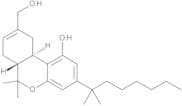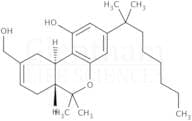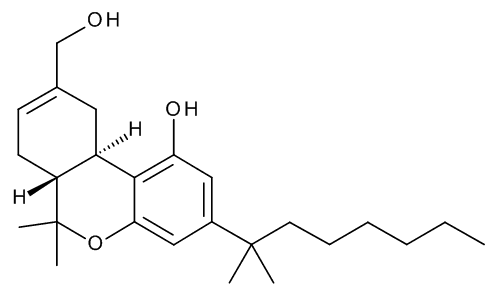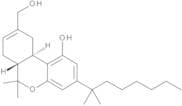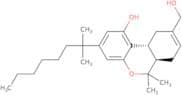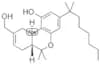
CAS 112830-95-2
:HU-210
Descripción:
HU-210 es un cannabinoide sintético que está estructuralmente relacionado con el THC, el componente activo del cannabis. Es conocido por su alta potencia y afinidad por los receptores cannabinoides, particularmente CB1 y CB2, que son parte del sistema endocannabinoide en el cuerpo humano. Este compuesto se caracteriza por su capacidad para producir efectos similares a los de los cannabinoides naturales, incluyendo analgesia, estimulación del apetito y alteraciones en el estado de ánimo y la percepción. Debido a su potencia, HU-210 ha sido estudiado por sus posibles aplicaciones terapéuticas, pero también plantea preocupaciones sobre la seguridad y el potencial de abuso. Como un químico de investigación, no está aprobado para uso médico y a menudo se asocia con desafíos legales y regulatorios. Su estabilidad y solubilidad en disolventes orgánicos lo hacen adecuado para estudios de laboratorio, pero la falta de estudios humanos completos limita la comprensión de sus efectos a largo plazo y su perfil de seguridad. En general, HU-210 ejemplifica las complejidades de los cannabinoides sintéticos y sus implicaciones tanto en la investigación como en la salud pública.
Fórmula:C25H38O3
InChI:InChI=1S/C25H38O3/c1-6-7-8-9-12-24(2,3)18-14-21(27)23-19-13-17(16-26)10-11-20(19)25(4,5)28-22(23)15-18/h10,14-15,19-20,26-27H,6-9,11-13,16H2,1-5H3/t19-,20-/m1/s1
Clave InChI:InChIKey=SSQJFGMEZBFMNV-WOJBJXKFSA-N
SMILES:OC1=C2[C@]3([C@](C(C)(C)OC2=CC(C(CCCCCC)(C)C)=C1)(CC=C(CO)C3)[H])[H]
Sinónimos:- (6AR,10aR)-3-(1,1-Dimethylheptyl)-6a,7,10,10a-tetrahydro-1-hydroxy-6,6-dimethyl-6H-dibenzo[b,d]pyran-9-methanol
- (6aR)-trans-3-(1,1-Dimethylheptyl)-6a,7,10,10a-tetrahydro-1-hydroxy-6,6-dimethyl-(6H)-dibenzo[b.d]pyran-9-methanol
- (6aR,10aR)-9-(hydroxymethyl)-6,6-dimethyl-3-(2-methyloctan-2-yl)-6a,7,10,10a-tetrahydro-6H-benzo[c]chromen-1-ol
- (6aS,10aS)-3-(1,1-dimethylheptyl)-9-(hydroxymethyl)-6,6-dimethyl-6a,7,8,10a-tetrahydrobenzo[c]isochromen-1-ol
- 6H-Dibenzo[b,d]pyran-9-methanol, 3-(1,1-dimethylheptyl)-6a,7,10,10a-tetrahydro-1-hydroxy-6,6-dimethyl-, (6aR,10aR)-
- 6H-Dibenzo[b,d]pyran-9-methanol, 3-(1,1-dimethylheptyl)-6a,7,10,10a-tetrahydro-1-hydroxy-6,6-dimethyl-, (6aR-trans)-
- HU-210 DEA Schedule I
- HU 210
- (-)-HU-210
- HU-210/112830-95-2
- HU-210 (exempt preparation)
- (-)-11-OH-Δ8-THC-1,1-dimethylheptyl
- HU-210 (solution)
- HU 210 (100μg/mL in Methanol)
- (6aR)-6aβ,7,10,10aα-Tetrahydro-6,6-dimethyl-1-hydroxy-3-(1,1-dimethylheptyl)-6H-dibenzo[b,d]pyran-9-methanol
- HU-210 (Spice Cannabinoid)
- (6aR)-6aβ,7,10,10aα-Tetrahydro-1-hydroxy-6,6-dimethyl-3-(1,1-dimethylheptyl)-6H-dibenzo[b,d]pyran-9-methanol
- 11-OH-Δ8-THC-1,1-dimethylheptyl
- Ver más sinónimos
Ordenar por
Pureza (%)
0
100
|
0
|
50
|
90
|
95
|
100
Encontrado 6 productos.
HU 210 (100 μg/ml in Methanol)
CAS:Producto controladoFórmula:C25H38O3Forma y color:Single SolutionPeso molecular:386.57HU 210
CAS:Producto controladoStability Hygroscopic
Applications A synthetic agonist analog of ∆9-Tetrahydro Cannabinol (T293200), which is the primary psychoactive component of marijuana. HU-210 is a potent central cannabinoid (CB1) and peripheral cannabinoid (CB2) receptor agonist. It binds to neuroblastoma cell membrane CB1 receptors with about the same affinity as CP-55940. Synthetic cannabinoidsControlled Substance.
References Slipetz, D.M. et al.: Mol. Pharmacol., 48, 352 (1995); Bertalovitz, A.C. et al.: Drug Dev. Res., 71, 404 (2010); Howlett, A.C. et al.: Curr. Pharm. Des., 1, 343 (1995);Fórmula:C25H38O3Forma y color:Light YellowPeso molecular:386.57HU 210
CAS:Producto controladoHU-210 is a synthetic cannabinoid receptor agonist with a strong affinity for the CB1 and CB2 receptor (Ki = 0.061 and 0.52 nM, respectively)1. In vitro, it has been shown to promote proliferation of embryonic neural stem cells in the hippocampus through the activation of Gi/o proteins and ERK signaling2. In vivo, it has been associated with counteracting amyloid beta-dependent inflammation in Alzheimer’s disease as well as preventing neuronal loss and cognitive decay. In vivo effects are thought to be mediated by CB1 and CB2 receptors mediated activation of microglia-secreted TNFα and other inflammatory markers3.Fórmula:C25H38O3Pureza:Min. 95%Peso molecular:386.57 g/mol