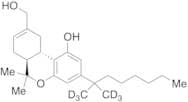
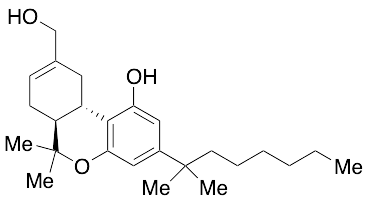
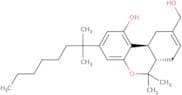
CAS 112924-45-5
:1,1-Dimetilheptil-11-hidroxitetrahidrocannabinol
Descripción:
1,1-Dimetilheptil-11-hidroxitetrahidrocannabinol, comúnmente conocido como un cannabinoide sintético, es un compuesto que imita los efectos de los cannabinoides naturales encontrados en la planta de cannabis. Esta sustancia se caracteriza por su compleja estructura molecular, que incluye un esqueleto de tetrahidrocannabinol (THC) modificado con una cadena lateral de dimetilheptilo y un grupo hidroxilo en la posición 11. Su fórmula química contribuye a su lipofilia, permitiéndole interactuar de manera efectiva con los receptores cannabinoides en el cuerpo, particularmente los receptores CB1 y CB2, que están involucrados en varios procesos fisiológicos como la sensación de dolor, la regulación del estado de ánimo y el control del apetito. El compuesto se estudia típicamente por sus posibles efectos terapéuticos, incluyendo propiedades analgésicas y antiinflamatorias, pero también puede exhibir efectos psicoactivos similares a los del THC. Debido a su naturaleza sintética, puede presentar diferentes perfiles farmacocinéticos y farmacodinámicos en comparación con los cannabinoides naturales, lo que genera preocupaciones sobre la seguridad, la legalidad y el potencial de abuso.
Fórmula:C25H38O3
InChI:InChI=1/C25H38O3/c1-6-7-8-9-12-24(2,3)18-14-21(27)23-19-13-17(16-26)10-11-20(19)25(4,5)28-22(23)15-18/h10,14-15,19-20,26-27H,6-9,11-13,16H2,1-5H3/t19-,20-/m0/s1
Clave InChI:InChIKey=SSQJFGMEZBFMNV-PMACEKPBSA-N
SMILES:OC1=C2[C@@]3([C@@](C(C)(C)OC2=CC(C(CCCCCC)(C)C)=C1)(CC=C(CO)C3)[H])[H]
Sinónimos:- (+)-Hu-210
- (6aS,10aS)-3-(1,1-Dimethylheptyl)-6a,7,10,10a-tetrahydro-1-hydroxy-6,6-dimethyl-6H-dibenzo[b,d]pyran-9-methanol
- (6aS,10aS)-9-(hydroxymethyl)-6,6-dimethyl-3-(2-methyloctan-2-yl)-6a,7,10,10a-tetrahydro-6H-benzo[c]chromen-1-ol
- 6H-Dibenzo[b,d]pyran-9-methanol, 3-(1,1-dimethylheptyl)-6a,7,10,10a-tetrahydro-1-hydroxy-6,6-dimethyl-, (6aS,10aS)-
- 6H-Dibenzo[b,d]pyran-9-methanol, 3-(1,1-dimethylheptyl)-6a,7,10,10a-tetrahydro-1-hydroxy-6,6-dimethyl-, (6aS-trans)-
- Dexanabinol
- Hu 211
- Prs 211007-000
- Sinnabidiol
- 1,1-Dimethylheptyl-11-hydroxytetrahydrocannabinol
- [6aS,(+)]-6a,7,10,10aβ-Tetrahydro-1-hydroxy-6,6-dimethyl-3-(1,1-dimethylheptyl)-6H-dibenzo[b,d]pyran-9-methanol
- (6aS,10aS)-3-(1,1-Dimethylheptyl)-6a,77,10,10a-tetrahydro-1-hydroxy-6,6-dimethyl-6H-dibenzo[b,d]pyran-9-methanol
- (6AR)-TRANS-3-(1,1-DIMETHYLHEPTYL)-6A,7,10,10A-TETRAHYDRO-1-HYDROXY-6,6-DIMETHYL-6H-DIBENZO[B,D]PYRAN-9-METHANOL
- (6AR,10AR)-3-(1,1'-DIMETHYLHEPTYL)-6A,7,10,10A-TETRAHYDRO-1-HYDROXY-6,6-DIMETHYL-6H-DIBENZO[B,D]PYRAN-9-METHANOL
- (6aS,10aS)-9-(hydroxymethyl)-6,6-dimethyl-3-(2-methyloctan-2-yl)-6a,7,10,10a-tetrahydrobenzo[c]chromen-1-ol
- (6aS,10aS)-3-(1,1-dimethylheptyl)-6,6-dimethyl-9-methylol-6a,7,10,10a-tetrahydrobenzo[c]chromen-1-ol
- (6aS)-6aα,7,10,10aβ-Tetrahydro-6,6-dimethyl-1-hydroxy-3-(1,1-dimethylheptyl)-6H-dibenzo[b,d]pyran-9-methanol
- Ver más sinónimos
Ordenar por
Pureza (%)
0
100
|
0
|
50
|
90
|
95
|
100
Encontrado 3 productos.
HU 211
CAS:Producto controladoApplications HU-211 is a synthetic cannabinoid derivative that inhibits TNFα and interleukin-6 (1,2,3). HU-211 exhibits neuroprotective, antioxidant, and anti-inflammatory properties. It might be a useful agent for the treatment of stroke patients, by protecting neuronal lysosomes from nitric oxide (NO)-mediated toxicity.
References (1) Shohami, E., et al.: J. Neuroimmunol., 72, 169 (1997)(2) Ramazan, D., et al.: Neuochemical Res., 33, 1683 (2008) (3) Leker, R., et al.: J. Neurol. Sci., 162, 114 (1999)Fórmula:C25H38O3Forma y color:NeatPeso molecular:386.57HU 211
CAS:Producto controladoHU 211 is a novel synthetic cannabinoid that has been shown to have a number of pharmacological activities. It has been shown to induce neuronal death by causing mitochondrial membrane potential depolarization, which leads to the release of cytochrome c and other apoptotic factors from the mitochondria. HU 211 has also been shown to inhibit tumor growth in animal models when administered alone or in combination with cytotoxic agents like paclitaxel. The synergistic effect between HU 211 and paclitaxel is due to their ability to decrease the expression of anti-apoptotic molecules. HU 211 also inhibits transcriptional regulation, leading to inhibition of protein synthesis and cell proliferation. HU 211's antitumor activity has been demonstrated in animal models for breast, colon, lung, liver, and prostate cancers as well as bowel disease (including colitis), Parkinson's disease, and dopamine-related disorders.Fórmula:C25H38O3Pureza:Min. 95%Peso molecular:386.57 g/mol