CAS 113-59-7
:Clorprotixeno
Descripción:
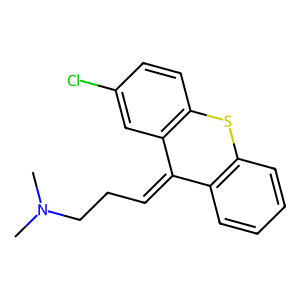
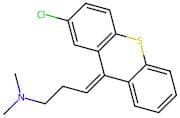
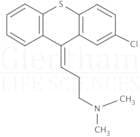
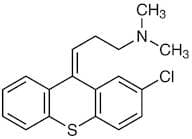
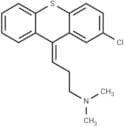
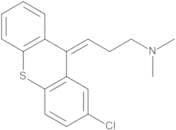
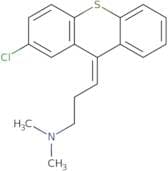
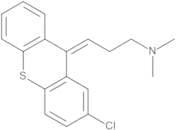
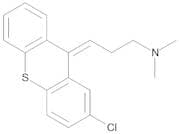
Clorprotixeno es un medicamento antipsicótico utilizado principalmente en el tratamiento de la esquizofrenia y otros trastornos psicóticos. Pertenece a la clase de compuestos de tioxanteno y exhibe propiedades tanto antipsicóticas como sedantes. La estructura química de Clorprotixeno incluye un núcleo de tioxanteno, que se caracteriza por un sistema de anillos fusionados que contiene átomos de azufre y nitrógeno. Este compuesto actúa principalmente como un antagonista de la dopamina, influyendo en la actividad de los neurotransmisores en el cerebro, particularmente en los receptores de dopamina, lo cual es crucial para sus efectos terapéuticos. Clorprotixeno se administra típicamente en forma oral y también puede estar disponible como una formulación inyectable. Su farmacocinética implica el metabolismo en el hígado, con una vida media relativamente larga, lo que permite una dosificación una vez al día en muchos casos. Los efectos secundarios comunes pueden incluir sedación, aumento de peso y síntomas extrapiramidales, que son típicos de muchos medicamentos antipsicóticos. Debido a sus efectos sedantes, se aconseja precaución al operar maquinaria o conducir mientras se toma este medicamento. En general, Clorprotixeno es una opción importante en el manejo farmacológico de condiciones graves de salud mental.
Fórmula:C18H18ClNS
InChI:InChI=1S/C18H18ClNS/c1-20(2)11-5-7-14-15-6-3-4-8-17(15)21-18-10-9-13(19)12-16(14)18/h3-4,6-10,12H,5,11H2,1-2H3/b14-7-
Clave InChI:InChIKey=WSPOMRSOLSGNFJ-AUWJEWJLSA-N
SMILES:C(\CCN(C)C)=C/1\C=2C(SC=3C1=CC=CC3)=CC=C(Cl)C2
Sinónimos:- (3E)-3-(2-chloro-9H-thioxanthen-9-ylidene)-N,N-dimethylpropan-1-aminium chloride
- (3Z)-3-(2-Chloro-9H-thioxanthen-9-ylidene)-N,N-dimethyl-1-propanamine
- (3Z)-3-(2-chloro-9H-thioxanthen-9-ylidene)-N,N-dimethylpropan-1-amine
- (Z)-3-(2-Chloro-9H-thioxanthen-9-ylidene)-N,N-dimethyl-1-propanamine
- 1-Propanamine, 3-(2-chloro-9H-thioxanthen-9-ylidene)-N,N-dimethyl-, (3Z)-
- 1-Propanamine, 3-(2-chloro-9H-thioxanthen-9-ylidene)-N,N-dimethyl-, (Z)-
- 2-Chloro-3-(Dibenzo(B,E)Thiin-10-Ylidene)Propyldimethylamine
- 9H-Thioxanthene, 1-propanamine deriv.
- CPT
- CPX
- Chlorprothixen
- Chlorprotixen
- Chlorprotixene
- Chlothixen
- Chorprothixene
- Clorprotixeno
- Cloxan
- Iaractan
- Mk 184
- N 714
- Paxyl
- Rentovet
- Ro 4-0403
- Ro 4-04033
- Tactaran
- Taractan
- Tarasan
- Tardan
- Thioxanthene-Δ9,γ-propylamine, 2-chloro-N,N-dimethyl-, (Z)-
- Thioxanthene-Δ<sup>9,γ</sup>-propylamine, 2-chloro-N,N-dimethyl-, (Z)-
- Traquilan
- Trictal
- Truxal
- Truxaletten
- Truxil
- Vetacalm
- cis-Chlorprothixene
- Ver más sinónimos
Ordenar por
Pureza (%)
0
100
|
0
|
50
|
90
|
95
|
100
Encontrado 12 productos.
{3-[(9Z)-2-chloro-9H-thioxanthen-9-ylidene]propyl}dimethylamine
CAS:Fórmula:C18H18ClNSPureza:98%Forma y color:SolidPeso molecular:315.8602Chlorprothixene 100 µg/mL in Acetonitrile
CAS:Fórmula:C18H18ClNSForma y color:Single SolutionPeso molecular:315.86Chlorprothixene
CAS:Fórmula:C18H18ClNSPureza:>98.0%(T)Forma y color:White to Orange to Green powder to crystalPeso molecular:315.86Chlorprothixene
CAS:Chlorprothixene (Truxal) is a typical antipsychotic drug of the thioxanthene class, which was the first of the series to be synthesized.Fórmula:C18H18ClNSPureza:98.77% - 99.756%Forma y color:Pale Yellow Crystals SolidPeso molecular:315.86Chlorprothixene
CAS:Applications Chlorprothixene
Not a dangerous good if item is equal to or less than 1g/ml and there is less than 100g/ml in the packageFórmula:C18H18ClNSForma y color:White To Light YellowPeso molecular:315.86Chlorprothixene
CAS:Producto controladoChlorprothixene is a derivative of fluorescein and has been used in the treatment of bone cancer. The reaction mechanism of chlorprothixene is not well understood, but it is believed to be due to its ability to bind with 5-HT2 receptors. Chlorprothixene also has anti-inflammatory properties, which may be due to the inhibition of nitrogen atoms in immune cells. This drug has low potency and can cause drug interactions with other drugs that are metabolized by enzymes in the liver such as cytochrome P450 enzymes. It also has a trifluoroacetic acid substituent, which can cause significant pharmacokinetic changes when given intravenously.Fórmula:C18H18ClNSPureza:Min. 95%Forma y color:PowderPeso molecular:315.86 g/mol

![{3-[(9Z)-2-chloro-9H-thioxanthen-9-ylidene]propyl}dimethylamine](/_next/image/?url=https%3A%2Fstatic.cymitquimica.com%2Fproducts%2FIN%2Fthumb%2FDA00785B.jpg&w=3840&q=75)