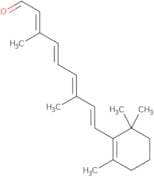
CAS 116-31-4
:Retinal
Descripción:
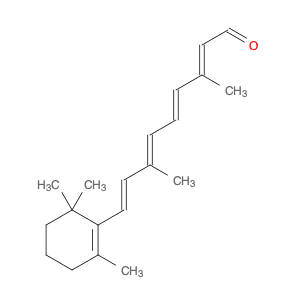
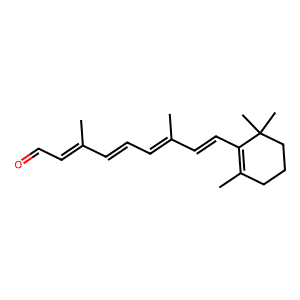
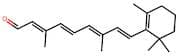
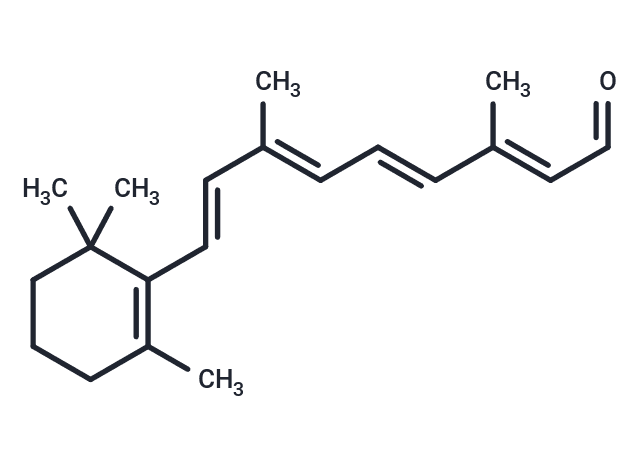
Retinal, también conocido como aldehído de vitamina A, es un compuesto orgánico vital con la fórmula química C20H28O. Es un derivado de la vitamina A y desempeña un papel crucial en el proceso visual, particularmente en la función de las células fotorreceptoras en la retina. Retinal existe en dos formas isoméricas: 11-cis-Retinal y todo-trans-Retinal, siendo la primera esencial para la visión ya que se une a las proteínas opsina para formar rodopsina, un receptor sensible a la luz. El compuesto se caracteriza por su sistema de enlaces dobles conjugados, que contribuye a sus propiedades de absorción de luz. Retinal es típicamente un sólido amarillento a naranja a temperatura ambiente y es soluble en disolventes orgánicos, pero menos en agua. Su estabilidad puede verse afectada por la luz y el oxígeno, lo que lleva a la isomerización o degradación. Además de su importancia biológica, Retinal también se estudia por sus posibles aplicaciones en fotónica y ciencia de materiales debido a sus propiedades ópticas únicas.
Fórmula:C20H28O
InChI:InChI=1S/C20H28O/c1-16(8-6-9-17(2)13-15-21)11-12-19-18(3)10-7-14-20(19,4)5/h6,8-9,11-13,15H,7,10,14H2,1-5H3/b9-6+,12-11+,16-8+,17-13+
Clave InChI:InChIKey=NCYCYZXNIZJOKI-OVSJKPMPSA-N
SMILES:C(=C/C(=C/C=C/C(=C/C=O)/C)/C)\C=1C(C)(C)CCCC1C
Sinónimos:- (all-E)-15-Apo-β-caroten-15-al
- (all-E)-3,7-Dimethyl-9-(2,6,6-trimethyl-1-cyclohexen-1-yl)-2,4,6,8-nonatetraenal
- 15-Apo-β-caroten-15-al
- 15-Apo-β-carotenal
- 2,4,6,8-Nonatetraenal, 3,7-dimethyl-9-(2,6,6-trimethyl-1-cyclohexen-1-yl)-, (all-E)-
- Axerophthal
- E-Retinal
- Retinal, all-trans-
- Retinaldehido
- Retinaldehyd
- Retinaldehyde
- Retinene
- Retinene 1
- Vitamin A aldehyde
- Vitamin A1 aldehyde
- Vitamin A<sub>1</sub> aldehyde
- all-E-Retinal
- all-trans-Retinal
- all-trans-Retinaldehyde
- all-trans-Vitamin A aldehyde
- trans-Retinal
- trans-Vitamin A aldehyde
- Ver más sinónimos
Ordenar por
Pureza (%)
0
100
|
0
|
50
|
90
|
95
|
100
Encontrado 12 productos.
All-trans-Retinal
CAS:Fórmula:C20H28OPureza:≥ 98.0%Forma y color:Yellow, orange or brown powderPeso molecular:284.44All-trans-retinal
CAS:All-trans-retinal (Vitamin A aldehyde) is a one of the major vitamin A metabolites in the retina.Fórmula:C20H28OPureza:98.56% - 98.70%Forma y color:SolidPeso molecular:284.44all-trans-Retinal-14,15-13C2
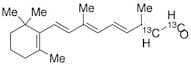
CAS:Producto controladoApplications Labelled Retinal. Corotenoid component of the visual pigments.
References Ball, et al.: Biochem. J., 42, 516 (1948), O’Brien, D.F., et al.: Science, 218, 961 (1982),Fórmula:C18C2H28OForma y color:NeatPeso molecular:286.42all-trans-Retinal
CAS:Producto controladoStability Hygroscopic
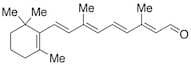
Applications Corotenoid component of the visual pigments. All-trans retinal is converted to retinoic acid in vivo by the action of retinal dehydrogenase.
References Ball, et al.: Biochem. J., 42, 516 (1948), O’Brien, D.F., et al.: Science, 218, 961 (1982),Fórmula:C20H28OForma y color:Yellow To Dark OrangePeso molecular:284.44Retinylaldehyde
CAS:Retinylaldehyde is a derivative of vitamin A that is important for visual health. It is an inhibitor of the chloride channel, which may be due to its ability to inhibit alcohol dehydrogenase and polymerase chain reaction (PCR). Retinylaldehyde has been shown to have a high affinity for nuclear DNA and can bind to guanine nucleotide-binding protein (G protein) in neural cells. This activity leads to chronic cough in mice. Retinylaldehyde also has been shown as having significant up-regulation in human monocytes when exposed to toll-like receptor ligands. The role of retinylaldehyde in the immune system is not fully understood, but it may play a role in modulating the response to bacterial infection by altering the production of cytokines such as interleukin-1β (IL-1β) and tumor necrosis factor alpha (TNFα).Fórmula:C20H28OPureza:Min. 98 Area-%Forma y color:PowderPeso molecular:284.44 g/mol