CAS 117-84-0
:Di-n-octil ftalato
Descripción:
Di-n-octil ftalato (DnOP), con el número CAS 117-84-0, es un líquido incoloro a amarillento que se utiliza principalmente como plastificante en la producción de cloruro de polivinilo (PVC) flexible y otros polímeros. Tiene un alto punto de ebullición y baja volatilidad, lo que lo hace efectivo para mejorar la flexibilidad y durabilidad de los materiales plásticos. El DnOP se caracteriza por su relativamente baja solubilidad en agua pero buena solubilidad en disolventes orgánicos, lo que facilita su uso en diversas aplicaciones, incluidos recubrimientos, adhesivos y selladores. La sustancia es conocida por su baja toxicidad en comparación con otros ftalatos, pero ha suscitado preocupaciones ambientales y de salud debido a sus posibles propiedades disruptoras endocrinas. Las agencias regulatorias han examinado su uso, lo que ha llevado a restricciones en ciertas aplicaciones, particularmente en productos de consumo. En general, aunque el DnOP cumple funciones industriales importantes, su impacto ambiental y sus implicaciones para la salud requieren una gestión y consideración cuidadosas en su aplicación.
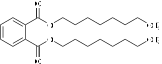
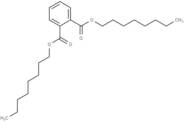
Fórmula:C24H38O4
InChI:InChI=1S/C24H38O4/c1-3-5-7-9-11-15-19-27-23(25)21-17-13-14-18-22(21)24(26)28-20-16-12-10-8-6-4-2/h13-14,17-18H,3-12,15-16,19-20H2,1-2H3
Clave InChI:InChIKey=MQIUGAXCHLFZKX-UHFFFAOYSA-N
SMILES:C(OCCCCCCCC)(=O)C1=C(C(OCCCCCCCC)=O)C=CC=C1
Sinónimos:- 1,2-Benzenedicarbonic acid, dioctyl ester
- 1,2-Benzenedicarboxylic acid, 1,2-dioctyl ester
- 1,2-Benzenedicarboxylic acid, dioctyl ester
- 1,2-Di-n-octyl phthalate
- Benzenedicarboxylic acid di-n-octyl ester
- Bis(n-octyl) phthalate
- DOP
- Di-N-Octyl Phthalate
- Di-Octyl Phthalate
- Di-n-octyl o-phthalate
- Dicapryl phthalate
- Dicaprylyl phthalate
- Dinopol NOP
- Dioctyl 1,2-benzenedicarboxylate
- Dioctyl o-benzenedicarboxylate
- Dioctyl o-phthalate
- Dioctylphthalat
- Dnop
- Ftalato De Dioctilo
- Monocizer W 555
- Nsc 15318
- Octyl phthalate
- Phtalate de dioctyle
- Phthalate, Dioctyl
- Phthalic acid, dioctyl ester
- Phthalsaeure-Di-N-Octyl-Ester
- RCRA waste number U107
- Unii-8X3Rj0527W
- Vinycizer 85
- n-Dioctyl phthalate
- n-Octyl phthalate
- Ver más sinónimos
Filtrar por
Porcentaje de pureza
0
100
|
0
|
50
|
90
|
95
|
100
- Precio más bajo
- Precio más alto
- Pureza más baja
- Pureza más alta
- Entrega estimada más rápida
Di-n-octyl Phthalate
CAS:Producto controladoApplications Phthalate ester used as plasticizers and additives. Used in toxicology studies as well as risk assessment studies of food contamination that occurs via migration of phthalates into foodstuffs from food-contact materials (FCM).
References Irvin, E.A. et al.: Chemosphere, 80, 1301 (2010); Petersen, J.H. et al.: Food Add. Contam. Part A Chem. Anal. Cont. Expos. Risk. Assess., 27, 1608 (2010); Kwack, S.J. et al.: Toxicol. Res., 26, 75 (2010);Fórmula:C24H38O4Forma y color:NeatPeso molecular:390.56DI-N-OCTYL PHTHALATE
CAS:Phthalate ester: plasticizer/additive, studied for food contamination and toxicology.Fórmula:C24H38O4Pureza:98.22%Forma y color:SolidPeso molecular:390.5561Phthalic acid. bis-n-octyl ester in Methanol
CAS:MethanolFórmula:C24H38O4Forma y color:LiquidPeso molecular:390.6Phthalic acid. bis-n-octyl ester in n-Hexane
CAS:n-HexaneFórmula:C24H38O4Forma y color:LiquidPeso molecular:390.6Di-n-octyl phthalate
CAS:Di-n-octyl phthalate (DNOP) is a phthalate that is used as a plasticizer in polyvinyl chloride. It is also used as an analytical reagent for the determination of activated phthalates in water, food, and human serum samples. DNOP has been shown to inhibit mitochondrial function and cellular respiration. This inhibition may be due to its ability to bind to the mitochondrial membrane and cause oxidative damage. It has also been shown to inhibit the growth of bacteria such as Escherichia coli by blocking protein synthesis. DNOP has been found to be chemically stable in rat liver microsomes, which indicates that it does not easily react with other chemicals or degrade over time.Fórmula:C24H38O4Pureza:Min. 95%Peso molecular:390.56 g/mol