CAS 118-48-9
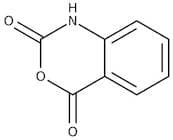
:Anhídrido isatoico
Descripción:
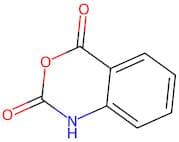
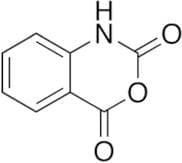
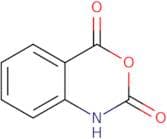
Anhídrido isatoico, con el número CAS 118-48-9, es un compuesto orgánico caracterizado por su grupo funcional anhidro derivado del ácido isatoico. Aparece como un sólido cristalino blanco a amarillo pálido y es conocido por su relativamente baja solubilidad en agua pero buena solubilidad en disolventes orgánicos como el etanol y la acetona. El compuesto tiene un punto de fusión que típicamente se encuentra dentro de un rango moderado, indicando su estado sólido a temperatura ambiente. Anhídrido isatoico se utiliza principalmente en la síntesis orgánica, particularmente en la producción de colorantes, productos farmacéuticos y agroquímicos. Puede actuar como un reactivo en varias reacciones químicas, incluidos los procesos de acilación. Además, exhibe reactividad hacia nucleófilos, lo que lo hace valioso en la síntesis de moléculas orgánicas más complejas. Se deben observar precauciones de seguridad al manipular este compuesto, ya que puede representar riesgos para la salud al exponerse. En general, Anhídrido isatoico es un bloque de construcción versátil en la química orgánica sintética.
Fórmula:C8H5NO3
InChI:InChI=1/C8H5NO3/c10-7-5-3-1-2-4-6(5)9-8(11)12-7/h1-4H,(H,9,11)
Clave InChI:InChIKey=TXJUTRJFNRYTHH-UHFFFAOYSA-N
SMILES:O=C1C=2C(NC(=O)O1)=CC=CC2
Sinónimos:- 1,2-Dihydro-3,1-benzoxazine-2,4-dione
- 1H-3,1-Benzoxazine-2,4-dione
- 1H-Benz[d][1,3]oxazine-2,4-dione
- 1H-Benzo[d][1,3]oxazin-2,4-dione
- 1H-Benzo[d][1,3]oxazine-2,4-dione
- 2,4-Dihydro-1H-3,1-benzoxazine-2,4-dione
- 2,4-Dioxo-1,2-dihydro-4H-3,1-benzoxazine
- 2-Hydroxy-4H-3,1-benzoxazin-4-one
- 3,1-Benzoxazine-2,4(1H)-dione
- 4H-3,1-Benzoxazin-2,4(1H)-dion
- 4H-3,1-Benzoxazine-2,4(1H)-dione
- 4H-3,1-benzoxazina-2,4(1H)-diona
- Benzoic acid, 2-(carboxyamino)-, cyclic anhydride
- Isatoic Anhydride
- Isatoic acid anhydride
- Isatosaeureanhydrid
- Nsc 104662
- Nsc 29555
- 2H-3,1-Benzoxazine-2,4(1H)-dione
- 2-(carboxyamino)-benzoicacicyclicanhydride
- ANTHRANILIC ACID N-CARBOXYLIC ACID ANHYDRIDE
- ISATOLC ANHYDRIDE
- TIMTEC-BB SBB003928
- 1,4-DIHYDRO-2H-3,1-BENZOXAZIN-2,4-DIONE
- BENZOXAZINEDIONE
- N-CARBOXYANTHRANILIC ACID CYCLIC ANHYDRIDE
- Anthranilic acid, N-carboxy-, cyclic anhydride
- LABOTEST-BB LT00053651
- Ver más sinónimos
Ordenar por
Pureza (%)
0
100
|
0
|
50
|
90
|
95
|
100
Encontrado 7 productos.
Isatoic Anhydride
CAS:Fórmula:C8H5NO3Pureza:>98.0%(T)(HPLC)Forma y color:White to Almost white powder to crystalPeso molecular:163.13Isatoic anhydride, 97%
CAS:This Thermo Scientific Chemicals brand product was originally part of the Alfa Aesar product portfolio. Some documentation and label information may refer to the legacy brand. The original Alfa Aesar product / item code or SKU reference has not changed as a part of the brand transition to Thermo Sci
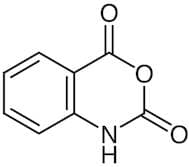
Fórmula:C8H5NO3Pureza:97%Forma y color:White to grey or cream to pale brown, PowderPeso molecular:163.131H-Benzo[d][1,3]oxazine-2,4-dione
CAS:Fórmula:C8H5NO3Pureza:96%Forma y color:SolidPeso molecular:163.1302Isatoic Anhydride
CAS:Producto controladoApplications Isatoic anhydride is a potent inactivator of α-chymotrypsin and inactivates stoichiometrically. Isatoic Anhydride is an important compound in the preparation of serine protease inhibitors.
References Moorman, A.J. et al.: J. AM. Chem. Soc., 104, 6785 (1982); Shinogi, M. et al.: J. Pharmac. Sci., 74, 782 (1985); Khiav, B. et al.: Int. Arch. Allergy Immunol., 113, 291 (1997);Fórmula:C8H5NO3Forma y color:NeatPeso molecular:163.13Isatoic anhydride
CAS:Fórmula:C8H5NO3Pureza:96%Forma y color:Solid, White - Almost white powderPeso molecular:163.132Isatoic anhydride
CAS:Isatoic anhydride is a nitro compound that has minimal toxicity and is soluble in water. It does not have a redox potential, but is easily oxidized by atmospheric oxygen or peroxide to form nitrate. Isatoic anhydride reacts with amines to produce hydroxyl groups and diazonium salts. This product has been used as an antimicrobial agent, as well as a reagent for the synthesis of other compounds. The mechanism of this reaction is believed to involve the formation of a nitroso-diazonium salt intermediate, which reacts with amines to produce hydroxyl groups and diazonium salts.Fórmula:C8H5NO3Pureza:Min. 95%Peso molecular:163.13 g/mol


![1H-Benzo[d][1,3]oxazine-2,4-dione](/_next/image/?url=https%3A%2Fstatic.cymitquimica.com%2Fproducts%2FIN%2Fthumb%2FDA00351G.jpg&w=3840&q=75)