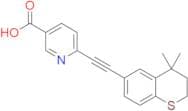
CAS 118292-41-4
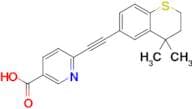
:Ácido tazaroténico
Descripción:
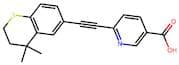
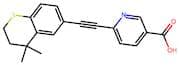
Ácido tazaroténico es un retinoide sintético, conocido principalmente por su aplicación en dermatología, particularmente en el tratamiento del acné y la psoriasis. Es un miembro de la familia de los retinoides, que son compuestos derivados de la vitamina A y son conocidos por su capacidad para regular el crecimiento y la diferenciación celular. Ácido tazaroténico funciona como un agonista selectivo de los receptores de ácido retinoico, específicamente RAR-β y RAR-γ, que desempeñan roles cruciales en la renovación celular de la piel y la reducción de la inflamación. El compuesto se caracteriza por su capacidad para modular la expresión génica, lo que lleva a una mejora en la textura de la piel y a la reducción de lesiones. Se administra típicamente de forma tópica y es conocido por sus posibles efectos secundarios, incluyendo irritación de la piel y fotosensibilidad. Ácido tazaroténico también se estudia por su potencial en el tratamiento de otras condiciones, como ciertos tipos de cáncer, debido a su influencia en los procesos celulares. En general, sus propiedades únicas lo convierten en un agente terapéutico valioso en los tratamientos dermatológicos.
Fórmula:C19H17NO2S
InChI:InChI=1S/C19H17NO2S/c1-19(2)9-10-23-17-8-4-13(11-16(17)19)3-6-15-7-5-14(12-20-15)18(21)22/h4-5,7-8,11-12H,9-10H2,1-2H3,(H,21,22)
Clave InChI:InChIKey=IQIBKLWBVJPOQO-UHFFFAOYSA-N
SMILES:CC1(C)C=2C(=CC=C(C#CC3=CC=C(C(O)=O)C=N3)C2)SCC1
Sinónimos:- 6-[2-(3,4-Dihydro-4,4-dimethyl-2H-1-benzothiopyran-6-yl)ethynyl]-3-pyridinecarboxylic acid
- AGN 190299
- 3-Pyridinecarboxylic acid, 6-[(3,4-dihydro-4,4-dimethyl-2H-1-benzothiopyran-6-yl)ethynyl]-
- 2H-1-Benzothiopyran, 3-pyridinecarboxylic acid deriv.
- 3-Pyridinecarboxylic acid, 6-[2-(3,4-dihydro-4,4-dimethyl-2H-1-benzothiopyran-6-yl)ethynyl]-
Ordenar por
Pureza (%)
0
100
|
0
|
50
|
90
|
95
|
100
Encontrado 10 productos.
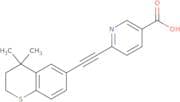
3-Pyridinecarboxylicacid, 6-[2-(3,4-dihydro-4,4-dimethyl-2H-1-benzothiopyran-6-yl)ethynyl]-
CAS:Fórmula:C19H17NO2SPureza:97%Forma y color:SolidPeso molecular:323.4088Tazarotenic acid
CAS:Tazarotenic acid (AGN-190299) is a retinoid prodrug which is converted to its active formFórmula:C19H17NO2SPureza:97.83%Forma y color:SolidPeso molecular:323.41Tazarotenic Acid-d8
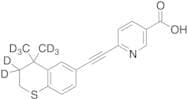
CAS:Producto controladoApplications Labelled Tazarotenic Acid (T010060). Tazarotenic acid is the major active metabolite of Tazarotene (T010050).
References Nagpal, S., et al.: J. Biol. Chem., 270, 923 (1995), Madhu, C., et al.: J. Pharm. Sci., 86, 972 (1997), Attar, M., et al.: Drug Metab. Dispos., 31, 476 (2003),Fórmula:C19H9D8NO2SForma y color:Light Yellow To BeigePeso molecular:331.46Tazarotenic Acid
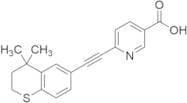
CAS:Producto controladoApplications Tazarotenic acid is the major active metabolite of Tazarotene (T010050).
References Nagpal, S., et al.: J. Biol. Chem., 270, 923 (1995), Madhu, C., et al.: J. Pharm. Sci., 86, 972 (1997), Attar, M., et al.: Drug Metab. Dispos., 31, 476 (2003),Fórmula:C19H17NO2SForma y color:NeatPeso molecular:323.41Tazarotenic acid
CAS:Tazarotene is a synthetic retinoid that has been used for the treatment of psoriasis, acne and skin cancer. Tazarotene is a prodrug that is converted to active metabolites in the skin. In vitro assays using human sclera have shown that tazarotene has high receptor activity and can inhibit the synthesis of collagenase, which leads to an increase in dermal thickness. Tazarotene also has been shown to induce hepatic steatosis and toxicity studies have shown liver enzyme elevation, as well as increased serum levels of triglycerides and cholesterol. Tazarotene can cause skin irritation or dryness due to its low pH level, although the risk of localized irritation increases with higher concentrations or application time. The effects on skin are reversible upon discontinuation of use.Fórmula:C19H17NO2SPureza:Min. 98 Area-%Forma y color:PowderPeso molecular:323.41 g/mol
![3-Pyridinecarboxylicacid, 6-[2-(3,4-dihydro-4,4-dimethyl-2H-1-benzothiopyran-6-yl)ethynyl]-](/_next/image/?url=https%3A%2Fstatic.cymitquimica.com%2Fproducts%2FIN%2Fthumb%2FDA007QG4.jpg&w=3840&q=75)