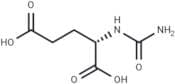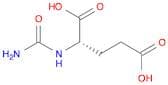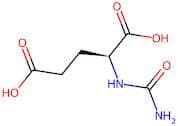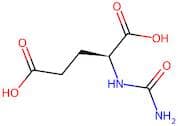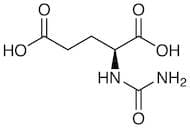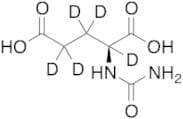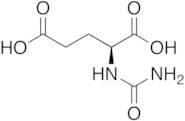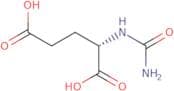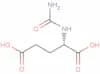
CAS 1188-38-1
:Ácido carbamilglutámico
Descripción:
Ácido carbamilglutámico, con el número CAS 1188-38-1, es un derivado de aminoácido caracterizado por la presencia de un grupo carbamoilo unido a la cadena lateral del ácido glutámico. Este compuesto se representa típicamente como un sólido cristalino blanco y es soluble en agua, reflejando su naturaleza polar debido a la presencia de grupos funcionales de ácido carboxílico y amina. Juega un papel significativo en los procesos bioquímicos, particularmente en la síntesis de ciertos péptidos y proteínas. Ácido carbamilglutámico también es conocido por sus posibles aplicaciones en nutrición y medicina, particularmente como un suplemento que puede apoyar las funciones metabólicas. Su estructura le permite participar en varias reacciones bioquímicas, convirtiéndolo en un tema de interés tanto en la investigación como en el desarrollo farmacéutico. Además, es importante manejar este compuesto con cuidado, al igual que con muchos aminoácidos y sus derivados, para garantizar la seguridad y estabilidad en entornos de laboratorio.
Fórmula:C6H10N2O5
InChI:InChI=1S/C6H10N2O5/c7-6(13)8-3(5(11)12)1-2-4(9)10/h3H,1-2H2,(H,9,10)(H,11,12)(H3,7,8,13)/t3-/m0/s1
Clave InChI:InChIKey=LCQLHJZYVOQKHU-VKHMYHEASA-N
SMILES:[C@@H](CCC(O)=O)(NC(N)=O)C(O)=O
Sinónimos:- (2S)-2-(Carbamoylamino)pentanedioic acid
- (S)-2-Ureidopentanedioic acid
- <span class="text-smallcaps">L</span>-Glutamic acid, N-(aminocarbonyl)-
- Carbaglu
- Carbamino-<span class="text-smallcaps">L</span>-glutamic acid
- Carbamino-L-glutamic acid
- Carbamylglutamic acid
- Carglumic acid
- Carglumic acid [INN]
- Glutamic acid, N-carbamoyl-, <span class="text-smallcaps">L</span>-
- Glutamic acid, N-carbamoyl-, L- (8CI)
- L-Glutamic acid, N-(aminocarbonyl)-
- L-N-Carbamoylglutamic acid
- N-(Aminocarbonyl)-<span class="text-smallcaps">L</span>-glutamic acid
- N-(aminocarbonyl)-L-Glutamic acid
- N-Carbamoyl-<span class="text-smallcaps">L</span>-glutamic acid
- N-Carbamoyl-L-glutamic acid
- N-Carbamoyl-S-glutamic acid
- N-Carbamyl-<span class="text-smallcaps">L</span>-glutamic acid
- N-Carbamylglutamate
- NCG
- Oe 312
- Ucedane
- Unii-5L0Hb4V1Ew
- Ureidoglutaric acid
- Ver más sinónimos
Ordenar por
Pureza (%)
0
100
|
0
|
50
|
90
|
95
|
100
Encontrado 14 productos.
Carglumic Acid
CAS:Acyclic amides (including acyclic carbamates) and their derivatives and salts thereof, nesoiFórmula:C6H10N2O5Forma y color:White PowderPeso molecular:190.05897Carglumic Acid
CAS:Carglumic Acid (Ureidoglutaric acid) is an orphan drug used to treat hyperammonemia in patients with N-acetyl glutamate synthase absence.Fórmula:C6H10N2O5Pureza:99.54%Forma y color:SolidPeso molecular:190.15Carglumic Acid-13C5-15N
CAS:Fórmula:C13C5H10N15NO5Forma y color:White To Off-White SolidPeso molecular:196.11N-Carbamoyl L-Glutamic Acid
CAS:Fórmula:C6H10N2O5Pureza:>95.0%(T)Forma y color:White to Light yellow powder to crystalPeso molecular:190.16N-Carbamyl-L-glutamic Acid-d5
CAS:Producto controladoApplications Labelled analogue of N-Carbamyl-L-glutamic Acid. N-Carbamyl-L-glutamic Acid has been shown to have protective effects against ammonia intoxication and is used in the treatment of acute hyperammonemia.
References Paik, W.K. et al.: Life Sci., 15, 1189 (1974); O'Connor, J.E. et al.: Eur. J. Pediat., 148, 540 (1989); Lee, J.H. et al.: Biochem. Biophys. Res. Chem., 248, 391 (1998);Fórmula:C6D5H5N2O5Forma y color:White To Off-WhitePeso molecular:195.185N-Carbamyl-L-glutamic Acid
CAS:Producto controladoApplications N-Carbamyl-L-glutamic Acid has been shown to have protective effects against ammonia intoxication and is used in the treatment of acute hyperammonemia.
References Paik, W.K. et al.: Life Sci., 15, 1189 (1974); O'Connor, J.E. et al.: Eur. J. Pediat., 148, 540 (1989); Lee, J.H. et al.: Biochem. Biophys. Res. Chem., 248, 391 (1998);Fórmula:C6H10N2O5Forma y color:NeatPeso molecular:190.15N-Carbamyl-L-glutamic acid
CAS:N-Carbamyl-L-glutamic acid is a cofactor required for the activity of a number of enzymes, including those involved in energy metabolism. It is synthesized from glutamic acid by the enzyme N-carbamylase and functions as an intermediate in the synthesis of urea and pyrimidine nucleotides. The structural analysis of N-carbamyl-L-glutamic acid has been studied using laser ablation mass spectrometry and X-ray crystallography. This information provides important insights into its role in mitochondrial function, specifically with regards to the synthesis of ATP and urea.Fórmula:C6H10N2O5Pureza:Min. 95%Forma y color:PowderPeso molecular:190.15 g/mol(S)-2-Ureidopentanedioic acid
CAS:Fórmula:C6H10N2O5Pureza:98%Forma y color:SolidPeso molecular:190.155