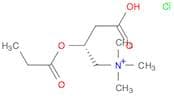
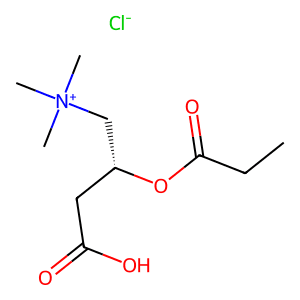
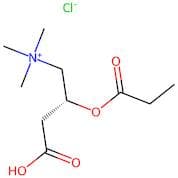
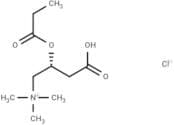
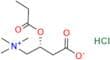
CAS 119793-66-7
:Dromos
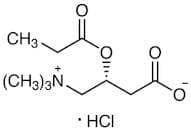
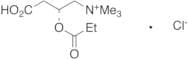
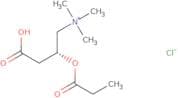
- (2R)-3-Carboxy-N,N,N-trimethyl-2-(propanoyloxy)propan-1-aminium chloride
- 1-Propanaminium, 3-carboxy-N,N,N-trimethyl-2-(1-oxopropoxy)-, chloride (1:1), (2R)-
- 1-Propanaminium, 3-carboxy-N,N,N-trimethyl-2-(1-oxopropoxy)-, chloride, (2R)-
- 1-Propanaminium,3-carboxy-N,N,N-trimethyl-2-(1-oxopropoxy)-,chloride,(R)-
- Dromos
- Levocarnitine propionate hydrochloride
- Levocarnitine propionate HCl
- Propionyl-L-Carnitine hydrochloride
- St 261
(2R)-3-carboxy-N,N,N-trimethyl-2-(1-oxopropoxy)-1-propanaminium chloride
CAS:Fórmula:C10H20ClNO4Pureza:98%Forma y color:SolidPeso molecular:253.7231Levocarnitine propionate hydrochloride
CAS:Levocarnitine propionate hydrochloride
Pureza:≥98%Peso molecular:253.72g/molLevocarnitine propionate hydrochloride
CAS:Levocarnitine propionate hydrochloride (ST-261) is used for the treatment of the deterioration of renal function, congestive heart failure, and other diseases.Fórmula:C10H20ClNO4Pureza:90% - 99.77%Forma y color:SolidPeso molecular:253.72Propionyl-L-Carnitine HCl salt
CAS:Fórmula:C10H20NO4.ClPureza:>98%Forma y color:SolidPeso molecular:253.72Propionyl-L-carnitine Hydrochloride
CAS:Fórmula:C10H19NO4·HClPureza:>98.0%(T)Forma y color:White to Almost white powder to crystalPeso molecular:253.72(R)-Propionyl carnitine chloride
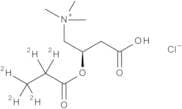
CAS:Fórmula:C10H19NO4·HClForma y color:White to off-white powder to crystalsPeso molecular:253.72Propionyl-d5-L-carnitine HCl
CAS:Producto controladoApplications Propionyl-d5-L-carnitine HCl is a useful isotopically labeled compound of (R)-Propionyl Carnitine Chloride (P786400)
Fórmula:C10D5H15NO4·ClForma y color:Off-WhitePeso molecular:258.75(R)-Propionyl Carnitine Chloride
CAS:Producto controladoStability Hygroscopic
Applications L-Propionyl carnitine has been shown to improve the heart's mechanical recovery and other metabolic parameters after ischemia-reperfusion.
References Reznick, A.Z., et al.: Arch. Biochem Biophys., 296, 394 (1992),Fórmula:C10H20NO4·ClForma y color:NeatPeso molecular:253.72(R)-2-Propionyl-3-(trimethylaminium)butanoic acid chloride
CAS:(R)-2-Propionyl-3-(trimethylaminium)butanoic acid chloride is a drug that is used to treat inflammatory bowel disease. It has been shown to be effective in treating both Crohn's disease and ulcerative colitis by suppressing the inflammation of the bowel. This drug works by inhibiting the production of prostaglandins, which are responsible for causing pain and swelling in the intestines. (R)-2-Propionyl-3-(trimethylaminium)butanoic acid chloride also has an effect on particle activity index, which can be measured by colonoscopy. The effective dose of this drug is unknown, but it has been shown to be safe at low doses.
Fórmula:C10H20ClNO4Pureza:Min. 95%Forma y color:PowderPeso molecular:253.72 g/mol