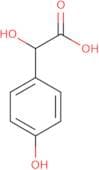
CAS 1198-84-1
:Ácido (±)-4-hidroximandélico
Descripción:
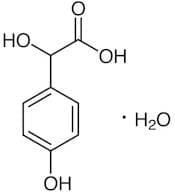
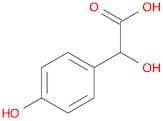
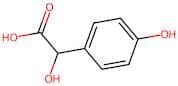
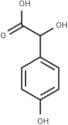
Ácido (±)-4-hidroximandélico, con el número CAS 1198-84-1, es un compuesto orgánico que sirve como un bloque de construcción quiral en diversas síntesis químicas. Es un derivado del ácido mandélico, caracterizado por la presencia de un grupo hidroxilo en la posición 4 del anillo aromático. Este compuesto típicamente aparece como un sólido cristalino blanco a blanco sucio y es soluble en agua y disolventes orgánicos, reflejando su naturaleza polar debido al grupo hidroxilo. La presencia de ambos enantiómeros en la designación (±) indica que existe como una mezcla racémica, que puede exhibir diferentes actividades biológicas en comparación con sus enantiómeros individuales. Ácido (±)-4-hidroximandélico es de interés en la investigación farmacéutica y puede estar involucrado en la síntesis de varios compuestos biológicamente activos. Sus propiedades, como el punto de fusión y la rotación específica, pueden variar según la pureza y las condiciones específicas bajo las cuales se maneja. Al igual que muchos ácidos orgánicos, puede exhibir un comportamiento ácido en solución, contribuyendo a su reactividad en diversas reacciones químicas.
Fórmula:C8H8O4
InChI:InChI=1/C8H8O4/c9-6-3-1-5(2-4-6)7(10)8(11)12/h1-4,7,9-10H,(H,11,12)/p-1/t7-/m0/s1
Clave InChI:InChIKey=YHXHKYRQLYQUIH-UHFFFAOYSA-N
SMILES:C(C(O)=O)(O)C1=CC=C(O)C=C1
Sinónimos:- (2R)-hydroxy(4-hydroxyphenyl)ethanoate
- (2S)-hydroxy(4-hydroxyphenyl)ethanoate
- (RS)-p-Hydroxymandelic acid
- (±)-α,4-Dihydroxybenzeneacetic acid
- 2-(4-Hydroxyphenyl)-2-hydroxyacetic acid
- 2-(4′-Hydroxyphenyl)-2-hydroxyethanoic acid
- 2-Hydroxy-2-(4-hydroxyphenyl)acetic acid
- 4-Hydroxy-<span class="text-smallcaps">DL</span>-mandelic acid
- 4-Hydroxymandelic acid
- 4-Hydroxyphenylglycolic acid
- <span class="text-smallcaps">DL</span>-4-Hydroxymandelic acid
- <span class="text-smallcaps">DL</span>-p-Hydroxymandelic acid
- <span class="text-smallcaps">DL</span>-p-Hydroxyphenylglycolic acid
- Benzeneacetic acid, α,4-dihydroxy-
- Hydroxy(4-Hydroxyphenyl)Acetic Acid
- Mandelic acid, p-hydroxy-
- P-hydroxy mandelic acid
- p-Hydroxymandelic acid
- p-Hydroxyphenylglycolic acid
- DL-4-HYDROXYMANDELIC ACID
- RARECHEM AL BO 0522
- 4,α-Dihydroxybenzeneacetic acid
- 4-HYDROXYM AND ELIC ACID
- 4-HYDROXYMANDELIC ACID 97% HPLC
- Ver más sinónimos
Ordenar por
Pureza (%)
0
100
|
0
|
50
|
90
|
95
|
100
Encontrado 6 productos.
DL-4-Hydroxymandelic Acid Monohydrate
CAS:Fórmula:C8H8O4·H2OPureza:>98.0%(T)(HPLC)Forma y color:White to Light red powder to crystalPeso molecular:186.17Benzeneacetic acid, α,4-dihydroxy-
CAS:Fórmula:C8H8O4Pureza:95%Forma y color:SolidPeso molecular:168.1467p-Hydroxymandelic acid
CAS:p-Hydroxymandelic acid (4-Hydroxymandelic acid) is an acidic metabolite of p-octopamine and p-synephrine (p-phenylephrine).Fórmula:C8H8O4Pureza:99.45%Forma y color:SolidPeso molecular:168.152-Hydroxy-2-(4-hydroxyphenyl)acetic acid
CAS:Fórmula:C8H8O4Pureza:95%Forma y color:SolidPeso molecular:168.148DL-4-Hydroxymandelic acid
CAS:DL-4-Hydroxymandelic acid is a phenolic acid that belongs to the family of organic acids. It is synthesized from 4-hydroxyphenylpyruvate and p-hydroxybenzoic acid by an enzyme called hydroxylase in the liver. The frequency shift in DL-4-Hydroxymandelic acid is caused by the hydrogen bonding between its hydroxyl group and pyran ring. This reaction occurs spontaneously, with no need for a catalyst or a change in pH. The reaction mechanism starts with the addition of water to the molecule, which results in an intermediate that breaks down into two molecules of formaldehyde and one molecule of formate. The reaction solution was found to be acidic because it contained H+ ions (H+).Fórmula:C8H8O4Pureza:Min. 95%Forma y color:PowderPeso molecular:168.15 g/mol