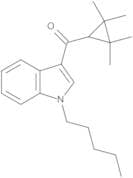
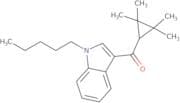
CAS 1199943-44-6
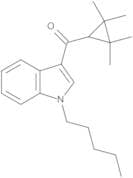
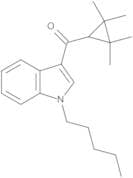
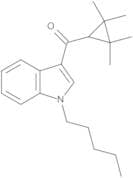
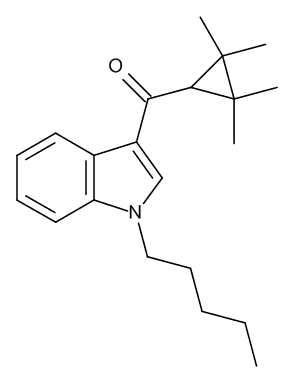
:(1-Pentil-1H-indol-3-il)(2,2,3,3-tetrametilciclopropil)metanona
Descripción:
(1-Pentil-1H-indol-3-il)(2,2,3,3-tetrametilciclopropil)metanona, identificado por su número CAS 1199943-44-6, es un compuesto sintético que pertenece a la clase de los derivados del indol. Esta sustancia se caracteriza por su compleja estructura molecular, que incluye un grupo indol unido a un grupo ciclopropilo. La presencia de la cadena pentilo contribuye a sus propiedades hidrofóbicas, mientras que el componente tetrametilciclopropilo añade volumen estérico, influyendo en su interacción con los objetivos biológicos. Este compuesto ha atraído la atención en contextos de investigación, particularmente en estudios relacionados con los receptores cannabinoides, debido a sus posibles efectos psicoactivos. Su solubilidad y estabilidad pueden variar según las condiciones ambientales, y puede exhibir propiedades farmacológicas únicas. Al igual que con muchos cannabinoides sintéticos, comprender su perfil de seguridad, incluida la toxicidad y el potencial de abuso, es crucial para evaluar sus implicaciones en contextos terapéuticos y recreativos. El manejo adecuado y el cumplimiento normativo son esenciales al trabajar con tales sustancias en entornos de laboratorio.
Fórmula:C21H29NO
InChI:InChI=1S/C21H29NO/c1-6-7-10-13-22-14-16(15-11-8-9-12-17(15)22)18(23)19-20(2,3)21(19,4)5/h8-9,11-12,14,19H,6-7,10,13H2,1-5H3
Clave InChI:InChIKey=NBMMIBNZVQFQEO-UHFFFAOYSA-N
SMILES:C(=O)(C1C(C)(C)C1(C)C)C=2C=3C(N(CCCCC)C2)=CC=CC3
Sinónimos:- (1-Pentyl-1H-Indol-3-Yl)(2,2,3,3-Tetramethylcyclopropyl)Methanone
- Methanone, (1-pentyl-1H-indol-3-yl)(2,2,3,3-tetramethylcyclopropyl)-
- Methanone, (1- pentyl- 1H- indol- 3- yl) (2, 2, 3, 3- tetramethylcycloprop yl)
- Ur-144
Ordenar por
Pureza (%)
0
100
|
0
|
50
|
90
|
95
|
100
Encontrado 9 productos.
UR-144 ((1-Pentylindol-3-yl)(2,2,3,3-tetramethylcyclopropyl)methanone; KM X-1)
CAS:Producto controladoForma y color:NeatUR-144 ((1-Pentylindol-3-yl)(2,2,3,3-tetramethyl-cyclopropyl)methanone; KM X-1) 0.1 mg/ml in Acetonitrile
CAS:Producto controladoForma y color:Single SolutionUR-144 ((1-Pentylindol-3-yl)(2,2,3,3-tetramethylcyclopropyl)methanone; KM X-1) 1.0 mg/ml in Acetonitrile
CAS:Producto controladoForma y color:Single Solution(1-Pentyl-1H-indol-3-yl)(2,2,3,3-tetramethylcyclopropyl)methanone (UR-144)
CAS:Producto controlado<p>Applications (1-Pentyl-1H-indol-3-yl)(2,2,3,3-tetramethylcyclopropyl)methanone is an Indol-3-ylcycloalkyl Ketone with high affinity for the CB2 cannabinoid receptor. Tetramethylcyclopropyl group was found to lead to high affinity CB2 agonists. Synthetic Cannabinoids<br>References Malan, T., et al.: Curr. Opin. Pharmacol., 3, 62 (2003), Cabral, G., et al.: J. Leukocyte Biol., 78, 1192 (2005), Beltramo, M., et al.: Eur. J. Neurosci., 23, 1530 (2006), Dziadulewicz, E., et al.: J. Med. Chem., 50, 3851 (2007),<br></p>Fórmula:C21H29NOForma y color:White To Off-WhitePeso molecular:311.46(1-Pentyl-1H-indol-3-yl)(2,2,3,3-tetramethylcyclopropyl)methanone (UR-144) (1.0 mg/mL in Methanol)
CAS:Producto controladoFórmula:C21H29NOForma y color:Single SolutionPeso molecular:311.46UR 144
CAS:Producto controladoUR-144 is a weak synthetic cannabinoid that binds as a selective full agonist to the peripheral cannabinoid receptor CB2 (EC50 = 72 nM). It also binds to CB1 (EC50 = 421 nM) with much lower affinity1. It was recently shown to impair cell proliferation and induce the activation of apoptotic pathways in vitro through different mechanisms as well as causing loss of mitochondrial membrane potential in placental trophoblasts in vitro2. Salmonella/microsome assays revealed induction of DNA damage without gene aberration in lymphocytes3. In vivo mice models showed depression of locomotor activity, catalepsy and hypothermia at a dosage of 10mg/kg, indicating a weak cannabinoid-like activity1.Fórmula:C21H29NOPureza:Min. 95%Peso molecular:311.46 g/mol